
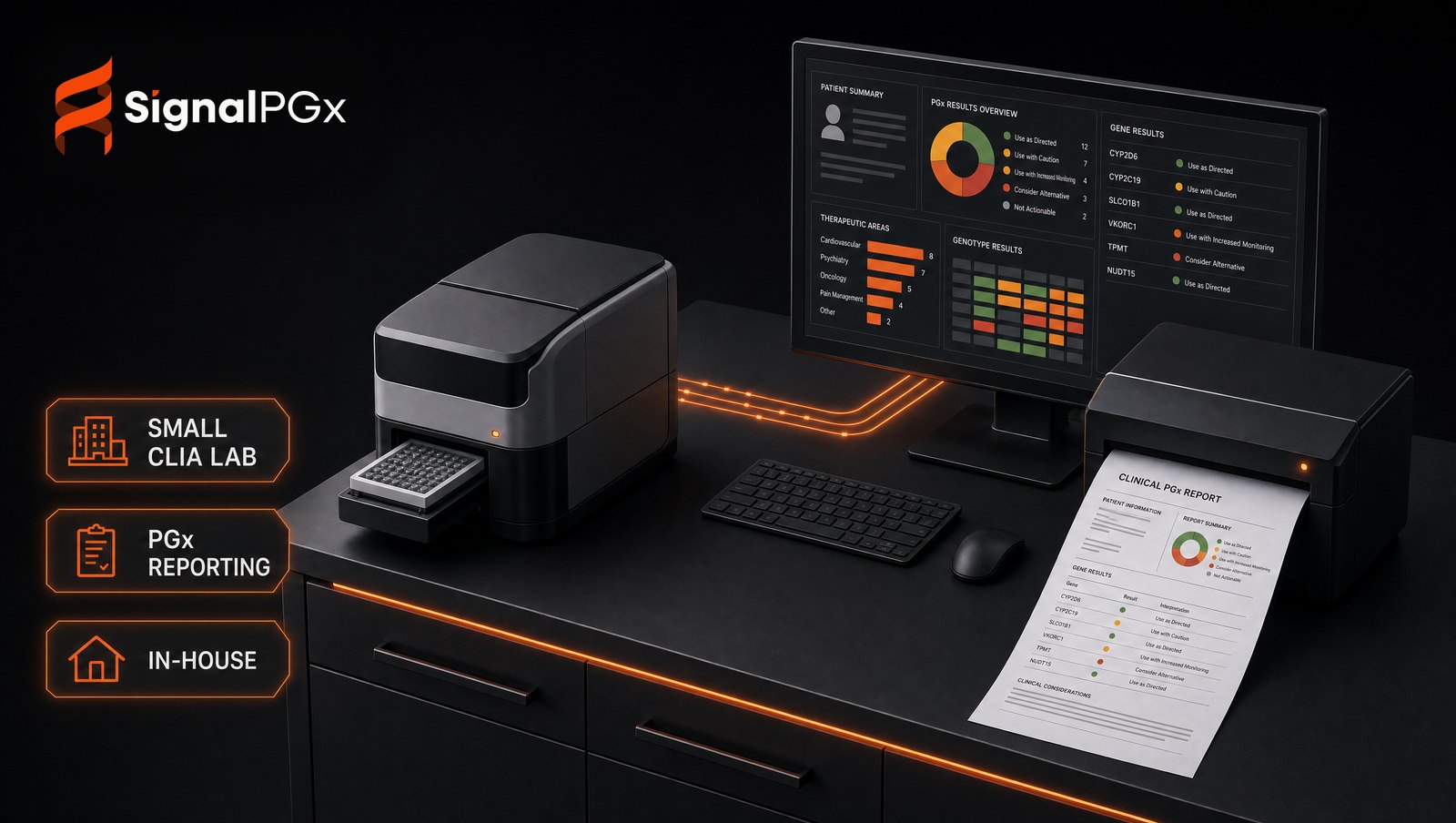
Pharmacogenomics software for a small CLIA lab automates evidence curation and report templating so your existing, CLIA-qualified medical director can validate and sign out PGx reports — without hiring a geneticist, genetic counselor, or bioinformatician. SignalPGx ingests already-called genotypes, matches them to CPIC, FDA, and DPWG guidance, and produces white-label reports your director reviews and signs out under your CLIA license.
Why are small independent CLIA labs launching PGx now?
The clinical case for pharmacogenomics has stopped being theoretical and started showing up in drug labels your ordering physicians already read. In October 2025, the FDA updated the Xeloda (capecitabine) prescribing information to a boxed warning: "Test patients for genetic variants of DPYD prior to initiating XELODA unless immediate treatment is necessary." That is a hard strengthening of FDA's 2022 language, which had merely said to "consider" DPYD testing. In February 2026, FDA extended a comparable boxed warning to fluorouracil (5-FU) injection labeling, and it had already strengthened DPD-deficiency language across the fluoropyrimidine class in 2024.
Here is the detail that matters for an independent lab: FDA's own labeling notes that an FDA-authorized test for detecting DPYD variants is not currently available. That testing is performed as a laboratory-developed test under the ordering lab's own validation. In other words, a boxed-warning mandate is being fulfilled by CLIA labs, not by a single cleared kit. Add the broader Table of Pharmacogenomic Biomarkers in Drug Labeling, which spans a broad and growing set of drug-gene pairs, and you have durable, physician-driven demand. For a small lab that already runs molecular assays, PGx is a differentiated, recurring line you can launch on existing instrumentation.
The staffing bottleneck: how do you offer PGx without hiring a geneticist?
For most small labs, the constraint is never the chemistry — it is the interpretation. Turning a called genotype into a defensible, guideline-anchored report is skilled clinical work, and the specialists who do it well are scarce and expensive. Board-certified clinical geneticists and genetic counselors command competitive full-time salaries, are hard to recruit into a small lab, and are even harder to retain when a single hire represents a large fixed cost against an unproven test line.
The instinct is to treat that as a hiring problem. It is really an evidence-and-templating problem. Your medical director already has the clinical judgment to review a genotype call, evaluate a recommendation, and sign it out. What consumes time is the manual work underneath that judgment: reading current CPIC and DPWG guidance, reconciling it against FDA labeling, checking star-allele-to-phenotype translation, and hand-building a formatted report for every patient.
SignalPGx is PGx interpretation software that automates that layer. It curates the evidence and drafts the structured report so your existing director validates and signs out — rather than researching and typesetting from scratch. You are not replacing clinical oversight; you are removing the repetitive burden that would otherwise force you to hire a full genetics team before your first billable report. For a deeper treatment of the make-versus-buy math, see our build-vs-buy analysis.
How does pharmacogenomics software for a small CLIA lab actually work?
SignalPGx sits at a deliberately narrow point in the pipeline. It is downstream of variant and star-allele calling — your lab performs genotyping and provides called results — and upstream of clinical prescribing, where the treating physician makes the final drug decision. The software neither calls variants nor prescribes; it converts your called genotypes into a review-ready interpretation.
The flow is straightforward:
- Intake. You submit already-called genotypes in the format your workflow produces — VCF, PharmCAT output, Agena MassARRAY exports, or CSV. SignalPGx does not align reads or call variants; it consumes what your assay already produced.
- Automated interpretation. The engine translates diplotypes to phenotypes, matches them against curated CPIC, FDA, and DPWG guidance, and flags actionable drug-gene results — drawing on a company-asserted 50+ pharmacogenes, 950+ medications, and 7,700+ drugs with drug-drug interaction context across 15+ evidence sources.
- Director review and sign-out. Your CLIA-qualified medical director reviews genotype accuracy, evidence curation, and every recommendation, edits where clinical judgment dictates, and signs the report out under your CLIA license.
That third step is not optional and not automated. SignalPGx reduces the manual burden of steps one and two; it does not replace medical interpretation, clinical judgment, or your regulatory oversight. The result respects the software-as-aid, human-sign-out model appropriate to lab-developed tests. If you want the end-to-end mechanics, the genotype-to-guidance pipeline walks through each stage.
Pre-built CPIC, FDA, and DPWG interpretation logic your director doesn't have to code
The hardest part of a homegrown PGx program is not building it once — it is keeping it current. Guidelines move. Star-allele definitions get revised, CPIC publishes updated dosing recommendations, FDA changes label language (as the DPYD boxed-warning sequence shows), and a report that was defensible last quarter can quietly drift out of date.
SignalPGx ships pre-built interpretation logic so your director does not code guideline rules or maintain a spreadsheet of drug-gene pairs. Take DPYD as the worked example: CPIC's fluoropyrimidine guideline recommends a standard-of-care dose for normal metabolizers, roughly a 50% starting-dose reduction for intermediate metabolizers, and avoidance (or a strongly reduced dose where no alternative exists) for poor metabolizers. That logic is encoded and maintained against the source guidance, so the draft your director reviews already reflects current recommendations rather than a static internal copy.
Crucially, this is curated evidence, not raw data dumped into a template. The platform integrates CPIC, DPWG, FDA, PharmGKB, DailyMed, ClinVar/ClinGen, PharmVar, and PharmCAT among its sources, reconciled into a single interpretive layer described in our unified evidence source overview. When guidance shifts, Living Reanalysis can flag previously issued reports whose recommendations have moved — turning guideline drift from a liability into a managed, auditable event. SignalAI, our guardrailed, cite-or-refuse reviewer assistant, supports your director during review but never signs out autonomously.
White-label, CLIA-fit report templates your director controls
A PGx report is a clinical document that carries your lab's name into a prescriber's chart, so the presentation layer is not cosmetic. SignalPGx produces white-label reports branded entirely as your lab's — your logo, your report identity, your medical director's signature block — with no "Powered by" footprint. The prescriber sees your lab, not a software vendor.
Your director controls the template, not just the branding. Recommendation wording, the drugs and genes surfaced, reference ranges, methodology and limitations language, and disclaimers are configurable so the output fits your validated menu and your compliance posture. This matters because the report has to survive scrutiny: CAP's accreditation program includes a Molecular Pathology checklist covering clinical molecular genetics applications, including pharmacogenomics, and your report is part of what an inspector reviews. The software formats and structures; your director owns the clinical content and the sign-out.
That division is the point. SignalPGx does not perform your CLIA validation, does not hold your accreditation, and does not sign out as a service. It generates structured, consistent, defensible output that fits your CLIA lab workflow, so every report leaves the door looking like your lab produced it — because, clinically and legally, your lab did. For the principles behind report defensibility, see clinically defensible PGx reports.
How do results reach prescribers? EHR and LIS integration
A PGx result that lives in a PDF nobody opens does not change prescribing. The value shows up only when the interpretation reaches the physician at the point of the drug decision, which means your reports have to flow into the systems clinicians already use.
SignalPGx supports the standards that make that possible: HL7 for classic lab-interface messaging into your LIS, FHIR for structured resources into modern EHRs, CDS Hooks so a pharmacogenomic flag can surface inside the prescribing workflow, and SMART on FHIR so an authorized clinician can open a report in context. The goal is that a DPYD result does not sit in a portal — it appears where an oncologist is about to order capecitabine.
For a small lab, this is also a competitive lever. Ordering practices increasingly expect discrete, integrable results rather than faxed PDFs, and being the lab that delivers cleanly into their EHR is a real reason to keep sending you samples. You do not need to build these interfaces from scratch; they are part of the integrations layer. Our deep dive on PGx EHR integration with FHIR and CDS Hooks covers the architecture, and the interpretation still ends where it should: with the treating physician making the prescribing decision.
No in-lab installation, no new IT hire
Small labs rarely have spare IT capacity, and the last thing a launch needs is an on-premise server to provision, patch, and secure. SignalPGx is cloud-based, so there is nothing to install in the lab and no new IT staff to hire to keep it running. Your team logs in, submits called genotypes, and reviews drafts through a browser.
That model also carries the infrastructure obligations you would otherwise have to build yourself. The platform runs on HIPAA-compliant, secured hosting with encryption in transit and at rest, role-based access control, tenant isolation, and an audit trail that records who reviewed and signed out each report — the kind of documentation an inspector or an internal quality review expects. Disaster recovery and backups are handled at the platform level rather than depending on a single server under a bench in your lab.
The security and compliance posture is designed to fit into your CLIA program rather than sit outside it. To be precise about ownership: SignalPGx provides the hosting, access controls, and audit trail; your lab retains its CLIA responsibilities, its validation, and its accreditation. The software gives you enterprise-grade infrastructure without the enterprise-grade headcount, which is exactly what lets a small independent lab stand up a credible PGx line without a data-center project attached to it.
What does it cost to launch a PGx line — software vs. a full genetics team?
The honest way to compare cost is to compare cost structures, not to quote figures. Building interpretation in-house means fixed, recurring salary: a full-time genetics specialist (or several) plus, often, a bioinformatician to maintain rules and pipelines. Those costs land whether you sign out ten reports a month or a thousand, and they land before your first dollar of revenue. A software subscription converts that fixed clinical-labor cost into a per-report or tiered cost that scales with volume, letting a small lab launch without betting the practice on a single hire. You can model your own break-even against our pricing.
On the revenue side, PGx testing is billed under specific molecular CPT codes — for example, 81225 (CYP2C19), 81226 (CYP2D6), 81227 (CYP2C9), 81232 (DPYD), and 81355 (VKORC1, typically reported alongside CYP2C9 for warfarin). Note that these are individual codes; the broader molecular-pathology numbering range also contains unrelated gene analyses, so bill only the specific codes your validated menu supports.
Coverage is where realism is essential. Under the MolDX program, administered by Palmetto GBA and Noridian as Medicare Administrative Contractors, the DEX Diagnostics Exchange registry assigns test-specific Z-codes so payers can identify the exact proprietary test billed under a generic CPT code, and coverage is governed by pharmacogenomics Local Coverage Determinations that vary by MAC jurisdiction. There is no single universal PGx LCD, and reimbursement is never guaranteed for any test or panel. SignalPGx does not register your Z-codes, perform your billing, or determine coverage — those belong to your lab. This section is general information, not legal, billing, or regulatory advice; confirm CPT selection, MolDX registration, and coverage with your own compliance and billing counsel.
To model the decision honestly, populate a simple framework with your own numbers: expected monthly volume, your realized reimbursement per test under applicable payer policy, and per-report software cost versus fully loaded salary for the genetics staff you would otherwise hire. Because the software cost scales with volume while a salaried team does not, the comparison usually favors buy at low-to-moderate volume and stays defensible as you grow.
From first genotype to first signed-out report
It helps to see the whole customer journey, because the point of buying interpretation software is that the path from a cold start to a signed-out report is short. A small independent lab typically moves through the same sequence.
- Establish the menu. You decide which drug-gene pairs to offer, validate the underlying genotyping assays under your CLIA license, and document your methodology. This is your work; the software does not perform validation.
- Configure the interpretation and report. Your medical director sets recommendation wording, selects the genes and drugs surfaced, and brands the report template — establishing the standard every future report inherits.
- Wire up delivery. You connect the integrations you need so results flow into your LIS and your ordering practices' EHRs, rather than living in a portal.
- Run the first case. A sample is genotyped, the called result is submitted, and SignalPGx returns a drafted, guideline-matched interpretation.
- Review and sign out. Your director reviews genotype accuracy, evidence, and recommendations, edits as clinical judgment requires, and signs out the report under your CLIA license.
After that first report, the marginal effort per case drops sharply, because the hard, repetitive layer — reading guidance, translating phenotypes, formatting — is automated and maintained for you. As guidance evolves, Living Reanalysis keeps your issued reports honest against current recommendations. That is the whole proposition for a small lab: your director's clinical judgment stays exactly where regulation requires it, while the evidence curation and templating that would otherwise force a premature genetics hire are handled by software. For a broader launch playbook, our guide on how clinical labs launch PGx reporting covers the operational details, and the CLIA framework itself is documented by CMS. You get to offer a clinically current, physician-integrated, defensible PGx line — built on the staff and instruments you already have.
← Back to InsightsSee how SignalPGx fits your lab
White-label pharmacogenomics interpretation and reporting for CLIA laboratories — your medical director signs out, your brand ships.
Book a demo