
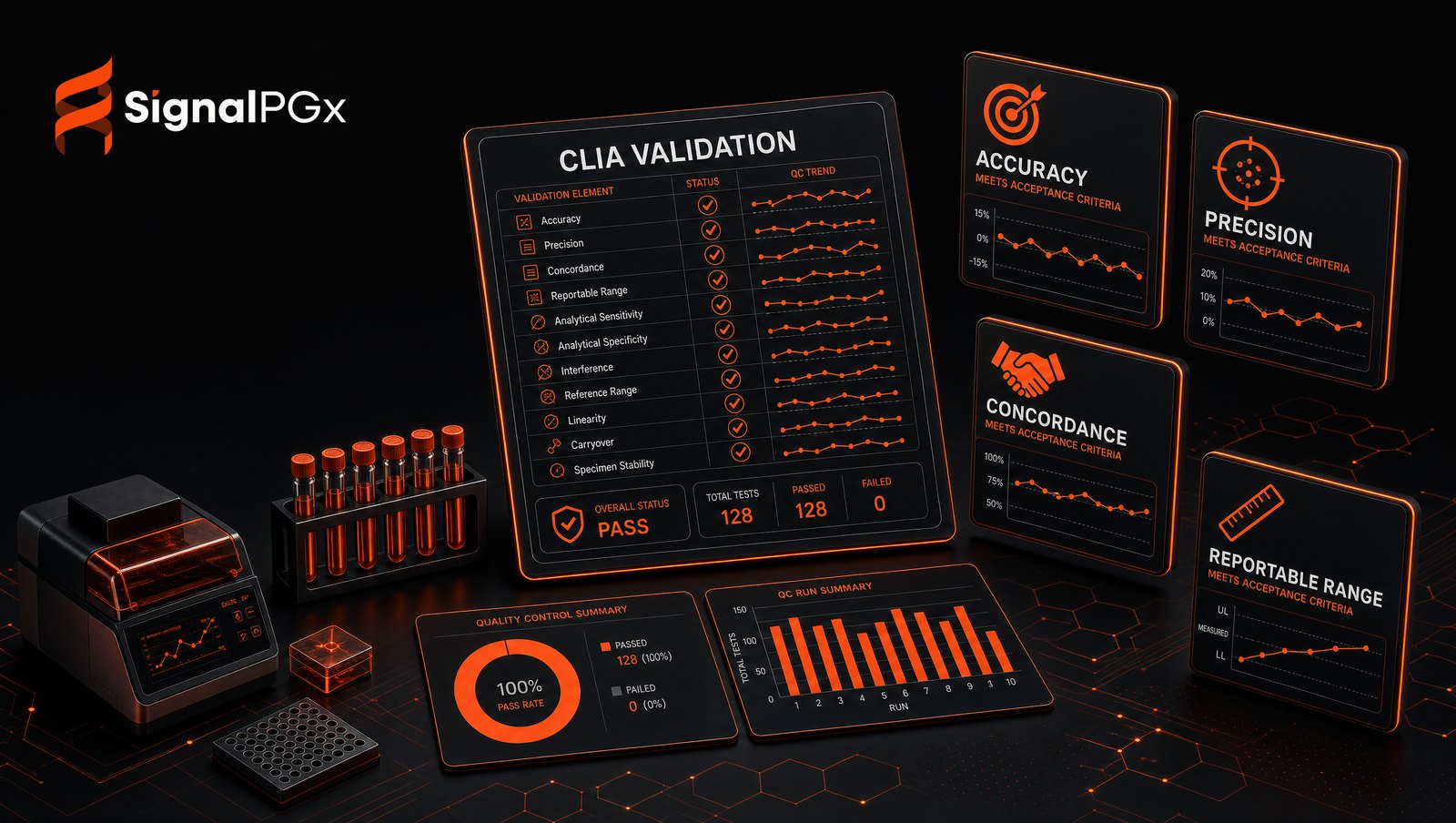
To validate a pharmacogenomic assay under CLIA, your lab establishes performance specifications across the seven analytical characteristics in 42 CFR 493.1253 — accuracy, precision, analytical sensitivity, analytical specificity, reportable range, reference intervals, and any other required characteristic — using a known-sample concordance study against orthogonal references, documented in a director-signed validation packet.
The regulatory pull toward pharmacogenomics has rarely been stronger. FDA updated fluoropyrimidine labeling in stages — 5-FU injection products in 2024, followed by a boxed warning added to capecitabine's label in October 2025 — both addressing dihydropyrimidine dehydrogenase (DPD) deficiency risk and DPYD genetic testing before treatment. Oncology teams are now asking their reference labs whether DPYD is on the menu, and payers, pharmacists, and prescribers are asking similar questions across psychiatry, cardiology, and pain.
Standing up the test menu is the easy part. The place where PGx programs stall is validation: generating defensible concordance data, mapping CLIA's abstract performance-specification language onto discrete genotype calls, and assembling a packet your director can actually sign. This guide is written for the person doing that work. It walks the entire lab-side validation study — the seven analytical characteristics, building a known-sample cohort, running concordance against Sanger or GIAB references, CAP accreditation specifics, director qualifications, proficiency testing, and a realistic first-year plan. Throughout, the assumption is that your lab owns the CLIA license, the wet-lab genotyping, and the medical-director sign-out; software and templates only help you organize and export the evidence.
Why Do So Many Labs Fail PGx Validation? The Five Common Blockers
Most PGx validations do not fail on the bench chemistry. They fail because the validation study was scoped, documented, or staffed in a way that could not survive a CAP inspector's read of the packet. Five blockers recur.
First is scope drift: the lab validates a genotyping panel but never explicitly validates the genotype-to-phenotype-to-recommendation interpretation layer, leaving a gap between what the instrument reports and what the clinical report claims. Second is thin known-sample coverage — a cohort that hits common star alleles but never exercises the rare, clinically consequential variants (DPYD no-function alleles, CYP2D6 structural variants, hybrids and gene deletions) where errors actually harm patients. Third is no orthogonal reference plan, so discordances cannot be adjudicated because there is no independent truth source. Fourth is incomplete documentation: raw data, acceptance criteria, and the director's review are scattered rather than assembled into a single signed packet. Fifth is personnel and qualification gaps discovered late, when the director or technical supervisor does not clearly meet the high-complexity pathway.
Each of these is preventable with upfront design. We cover the deeper organizational reasons PGx programs stall — budget, staffing, and stakeholder alignment — in our companion piece on why lab PGx programs stall; this article stays inside the validation study itself. The practical takeaway: decide before you pull a single sample what you are validating (assay plus interpretation), which alleles you must cover, what your orthogonal reference is, how you will document acceptance, and who is qualified to sign. Write those five answers down first. They become the skeleton of your validation plan and the first thing a surveyor will look for.
How to Validate a Pharmacogenomic Assay Under CLIA: The Seven Required Analytical Characteristics
CLIA does not publish a pharmacogenomics-specific validation standard. Instead, for any laboratory-developed or modified high-complexity test, 42 CFR 493.1253 requires you to establish performance specifications across seven analytical characteristics before reporting patient results. Translating each into concrete PGx terms is the core intellectual work of the validation.
- Accuracy — do your genotype/diplotype calls match a reference truth? For PGx this is your concordance study against Sanger sequencing, a validated orthogonal assay, or characterized reference materials.
- Precision — reproducibility and repeatability. Run the same known samples within-run, between-run, between-day, and across operators and instruments; confirm the diplotype and phenotype call are stable.
- Analytical sensitivity — the lowest input (DNA quantity/quality) at which the assay reliably calls the expected genotype. Establish minimum acceptable input and quality metrics.
- Analytical specificity — including interfering substances. Demonstrate the assay is not confounded by common interferents, pseudogenes, or paralogous sequence (critical for CYP2D6 given CYP2D7).
- Reportable range — the set of variants, alleles, and diplotypes the assay is designed to detect and report. Define it explicitly; anything outside it is "not tested," not "wild type."
- Reference intervals (reference values) — for genotyping this is expressed as allele/genotype frequencies and the phenotype categories you assign, appropriate to the populations you serve.
- Any other performance characteristic required for test performance — for PGx this often means genotype-to-phenotype translation accuracy and the correctness of the guideline-based recommendation logic.
That seventh, catch-all characteristic is where PGx diverges most from a routine chemistry assay, and where labs most often under-document. Your report does not stop at a diplotype — it asserts a metabolizer phenotype and a clinical recommendation. Treat the translation layer as a validatable component with its own known-input/expected-output test set. The the CDC Laboratory Test Verification and Validation Toolkit is a useful, discipline-neutral scaffold for structuring these studies, and the classic Westgard walkthrough of the CLIA method-validation process helps frame accuracy and precision experiments. Note: this is general methodology guidance, not PGx-specific regulation.
How Do You Build a Known-Sample Reference Cohort? Sample Size, Sourcing, and Tracking
Your accuracy and precision studies are only as strong as the known samples behind them. The goal is a cohort that covers the clinically important alleles across every gene on your menu, with independently established "truth" for each. CLIA does not mandate a PGx-specific minimum sample count, so beware anyone who quotes you a magic number. General, non-PGx method-validation literature offers illustrative anchors — CLSI EP12 references roughly 20 samples for qualitative verification, and method-comparison guidance commonly cites around 40 patient specimens — but these are starting points, not a regulatory floor for genotyping.
For a genotyping assay, statistical power matters less than allelic coverage. A sound cohort typically includes:
- At least one representative sample for each star allele or variant in your reportable range, prioritizing no-function and decreased-function alleles.
- The clinically consequential rare variants and structural events — CYP2D6 gene deletions, duplications, and hybrids; DPYD no-function alleles such as those cited in CPIC and FDA labeling.
- Heterozygous and homozygous representations, so you exercise diplotype calling, not just variant detection.
- Population diversity appropriate to your patient base, since allele frequencies differ substantially by ancestry.
Sourcing options include commercially characterized reference materials, samples from public repositories such as Coriell, GIAB reference genomes, residual de-identified clinical specimens (under your IRB/QA framework), and proficiency-testing residuals. Blend them: characterized reference materials give you high-confidence truth, while residual clinical samples give you real-world matrix and pre-analytic variability.
Tracking is where audits are won or lost. Maintain a sample-level ledger linking each specimen to its expected genotype, its truth source, the run(s) it appeared in, and the observed result. Because this cohort involves human-derived material and potentially identifiable data, handle chain-of-custody and access controls the way you would any clinical specimen — the same data-protection posture described in our overview of the security and compliance foundation applies to validation data, not just production reporting. A clean, queryable ledger is what lets you compute concordance quickly and re-run the analysis when your reportable range expands.
How Do You Run Concordance Testing Against Sanger or GIAB References?
Concordance testing is the heart of your accuracy study: you compare your assay's calls to an orthogonal reference and quantify agreement. The reference must be methodologically independent from the assay under validation, which is why Sanger sequencing and NIST's characterized reference genomes are the workhorses. Sanger is the long-standing confirmatory method for individual variants; NIST's Genome in a Bottle (GIAB) reference materials provide well-characterized genomes widely used to validate NGS-based pipelines, including in pharmacogenomics work.
Structure the study so the comparison is unambiguous:
- Define the unit of concordance. Decide up front whether you are scoring per-variant, per-genotype, per-diplotype, or per-phenotype. For PGx, report at least diplotype-level and phenotype-level concordance, because a correct set of variants can still produce a wrong diplotype if phasing or copy-number logic fails.
- Lock acceptance criteria before running. State your target positive percent agreement, negative percent agreement, and overall concordance, plus how you will handle no-calls. Predefining thresholds keeps the study from becoming post-hoc rationalization.
- Run blinded where feasible. Analysts scoring your assay's output should not be steering toward the known answer.
- Adjudicate every discordance. Each mismatch gets a documented root-cause: reference error, assay limitation, sample swap, or interpretation-logic gap. Unresolved discordances are findings, not footnotes.
Two references are better than one for hard cases. When Sanger and your assay disagree on a structural CYP2D6 event, a third orthogonal method or a GIAB-characterized sample can break the tie. Keep the provenance of every reference call — which source, which version, which coordinate build — because a surveyor will ask how you know your "truth" is true. Our discussion of maintaining a unified, provenance-tracked evidence source explains why that version discipline matters as much for validation references as for production guideline logic. Finally, capture concordance as a computed, exportable dataset rather than a hand-tallied spreadsheet, so the same analysis reruns cleanly when you add alleles or update methods.
What CAP Accreditation Requirements Are Specific to Pharmacogenomics?
Most labs offering PGx pursue CAP accreditation on top of CLIA certification, and the two are not redundant — CAP's discipline-specific checklists impose requirements more granular than CLIA's baseline. For pharmacogenomics, the relevant instrument is CAP's Molecular Pathology Checklist, which covers clinical molecular genetics applications including PGx alongside areas such as HLA, forensics, and parentage testing. Pull the current requirements directly from CAP's live documents rather than paraphrase from memory: checklists are revised periodically, and the 2024 edition incorporated the CLIA final-rule personnel changes.
At a high level, expect the Molecular Pathology Checklist to hold you to documented requirements across:
- Validation and verification — a complete validation record for each assay, covering the performance characteristics above, with defined acceptance criteria and director approval.
- Reportable range and result reporting — explicit definition of what the assay detects, and clear reporting of variants, diplotypes, phenotypes, and interpretive comments.
- Reagent, control, and reference-material management — lot verification, positive/negative and known-genotype controls per run.
- Personnel qualifications and competency — director, technical supervisor, and testing-personnel qualifications and ongoing competency assessment.
- Proficiency testing — enrollment and performance, discussed in its own section below.
- Quality management and document control — SOPs, corrective action, and periodic review.
The authoritative, current list lives in CAP's accreditation checklists, accessible to enrolled and accredited labs; treat any secondhand summary (including this one) as orientation, not the checklist of record. A practical tip: build your validation packet with the checklist item numbers as headers, so the eventual inspection is a mapping exercise rather than a scavenger hunt. If your PGx clinical reports are where interpretive requirements land, our guidance on producing clinically defensible PGx reports pairs naturally with the reporting-related checklist items. CAP requirements are the lab's responsibility to meet; no software, template, or vendor confers CAP accreditation on your behalf.
What Are the CLIA Laboratory Director Qualifications for a PGx Program?
Get the director qualification question right early, because it can gate your entire go-live. A common trap is citing 42 CFR 493.1405, which governs directors of moderate-complexity testing. Most PGx molecular and interpretive assays are classified high complexity, and high-complexity director qualifications live in the separate, more stringent 42 CFR 493.1443. Scope your program's complexity level explicitly and cite the matching regulation.
Under 493.1443, a high-complexity laboratory director generally qualifies through one of several pathways:
- A licensed MD/DO board-certified in anatomic and/or clinical pathology (ABP/AOBP).
- An MD/DO or podiatrist with the required laboratory experience directing high-complexity testing plus qualifying continuing education.
- An individual with an earned doctoral degree in a qualifying laboratory science, holding certification from an HHS-approved board, plus the required experience.
- Grandfathering for directors already serving in the role as of December 28, 2024, subject to continuous-employment conditions.
For non-physician directors of a molecular/PGx lab, the most relevant HHS-approved board is the American Board of Medical Genetics and Genomics (ABMGG), alongside boards such as ABCC, ABB, ABFT, ABMM, ACHI, NRCC, and ASCP BOC DMLI for other specialties; CMS publishes the current approved-board list. On the physician side, Molecular Genetic Pathology — a joint ABP/ABMGG subspecialty requiring roughly a year of accredited fellowship training whose scope explicitly includes pharmacogenomics — is a well-matched credential.
Two timing notes matter. CMS's updated CLIA personnel regulations took full effect December 28, 2024, and the CAP Personnel Guidance Document details how the grandfathering provision applies across director, technical supervisor, and technical consultant roles — cite the current version, since it is periodically revised. Confirm not just the director but the whole personnel stack (technical supervisor, general supervisor where applicable, testing personnel) against the live tables before you commit to a launch date. This is general regulatory orientation, not legal advice; verify your specific situation against the regulation and your accrediting body.
Proficiency Testing and the CAP PGX Survey: Enrollment, Ongoing Compliance, and Gene Coverage
Validation gets you to launch; proficiency testing (PT) keeps you compliant afterward. CLIA and CAP require ongoing external assessment of analyte performance, and for pharmacogenomics CAP offers a dedicated proficiency-testing survey under the product code PGX. Enrollment is an annual, per-analyte commitment: you receive blinded challenge samples, run them through your production workflow exactly as you would patient specimens, submit your genotype and phenotype calls, and are graded against peer and reference consensus.
Historically, the CAP PGX survey has covered genes such as CYP2B6, CYP2C19, CYP2C9, CYP2D6, CYP3A4, CYP3A5, SLCO1B1, and VKORC1 — but gene coverage changes between catalog years, so confirm the current list in CAP's live Surveys Catalog before you map your menu to available PT. Do not assume any specific gene (for example, DPYD) is or is not on the current survey without checking; coverage evolves, and this is exactly the kind of detail an inspector expects you to have verified recently.
Where formal PT is not available for a gene on your menu, CLIA requires an alternative assessment at least twice per year — typically inter-laboratory sample exchange or a defined internal re-testing protocol with documented acceptance criteria. Build this into your quality plan from day one, because rare-gene menus almost always outrun available PT products. Key ongoing-compliance practices:
- Enroll in PGX (or the applicable survey) for every analyte where PT exists, before or at launch.
- Run PT samples through the identical production pipeline — same instruments, same interpretation logic, same reviewers — with no special handling.
- Investigate and document any unacceptable or discordant PT result as a corrective-action event.
- Establish and record alternative assessment for uncovered analytes twice yearly.
PT performance is also a quiet validation signal: a program whose PT calls drift is often a program whose interpretation logic or reference data has fallen out of date. Keeping guideline and reference versions current — the discipline behind living, re-analyzable reports — reduces the risk of a surprise PT miss.
Validation Project Planning: Timeline, Staffing, and Budget for the First 12 Months
Treat validation as a project with a charter, not a task someone squeezes between clinical runs. There is no authoritative, regulation-published timeline or cost figure for PGx validation, so anyone quoting a precise "six-to-twelve months and $X" is offering planning experience, not a cited standard. What you can plan against are the discrete workstreams and their dependencies. A defensible sequence for the first year looks like this:
- Scoping and design (weeks 1–6) — define menu, reportable range, complexity classification, required alleles, orthogonal reference strategy, and personnel/qualification confirmation.
- Cohort assembly and procurement (weeks 4–12) — source characterized reference materials, repository samples, and residual specimens; build the sample ledger.
- Analytical studies (weeks 8–20) — accuracy/concordance, precision, sensitivity, specificity, reportable range, reference intervals, and interpretation-logic verification.
- Documentation and packet assembly (weeks 16–24) — compile raw data, acceptance criteria, discordance adjudications, and SOPs into a director-signed packet mapped to CAP checklist items.
- Director review, sign-out, and launch readiness (weeks 20–28) — final review, competency assessments, PT enrollment, and go-live.
Staffing typically spans a project lead, a molecular technologist or two for bench work, a bioinformatics or LIS resource for data flow, and the medical director for oversight and sign-out. Budget lines cluster around reference materials and specimens, reagents and instrument time, informatics/interpretation tooling, PT enrollment, and personnel hours. If you are standing up the program from scratch as a business, factor the reimbursement pathway into planning too — common PGx CPT gene-analysis codes include 81225 (CYP2C19), 81226 (CYP2D6), 81227 (CYP2C9), 81230 (CYP3A4), 81231 (CYP3A5), 81232 (DPYD), and 81355 (VKORC1); Medicare's MolDX program maintains LCD L38335 for PGx and requires a registered test with a DEX Z-Code identifier submitted alongside the CPT code in participating jurisdictions. Coverage is indication- and payer-specific and can be denied; no code or Z-Code registration guarantees reimbursement. This is general orientation, not legal, billing, or regulatory advice — verify current codes against the AMA CPT codebook and coverage terms with your MAC/MolDX. For the broader operational playbook of taking a program live, see how clinical labs launch PGx reporting.
How Does Interpretation Software Support Validation Without Owning It?
Interpretation software has a specific, bounded role in your validation study: it helps you generate, organize, and export the evidence — it does not perform the validation, and it does not sign out results. The lab's genotyping generates the calls; the medical director owns every performance decision and every patient report. Understanding that boundary keeps your packet clean and your compliance posture honest.
Where a downstream interpretation layer like SignalPGx's platform earns its keep is the seventh analytical characteristic — genotype-to-phenotype-to-recommendation translation. SignalPGx ingests already-called genotypes and star alleles (VCF, PharmCAT output, Agena MassARRAY, or CSV); it sits downstream of variant and star-allele calling and does not align reads or call variants itself. For validation, that means you can feed a battery of known diplotypes through the interpretation logic and export the resulting phenotype assignments and guideline-based recommendations as a structured dataset to compare against your expected, CPIC/FDA-consistent answers. Concretely, the software helps you:
- Export a concordance-ready dataset of genotype-in / interpretation-out across your known-sample cohort, so the translation layer is verifiable, not assumed.
- Produce reference reports for known samples that document exactly what a given diplotype yields, with the evidence sources and versions behind each call.
- Preserve data provenance — which guideline, which evidence source, which version informed each recommendation — supporting the reproducibility a surveyor expects.
Two guardrails are worth stating plainly. SignalPGx is not a diagnostic test and is not FDA-cleared; it produces structured output that fits inside your CLIA-licensed, director-supervised workflow, and your director reviews and signs out every report. And its assistant layer, SignalAI, is a cite-or-refuse tool that supports human reviewers rather than acting autonomously. Data flowing between your LIS and the interpretation layer should follow the architecture described for LIS integrations, so validation and production share one auditable pipeline. The software helps you assemble the packet; the accountability stays with the lab.
Troubleshooting Known-Sample Discrepancies: Common Validation Roadblocks
Discordances are not failures — unexamined discordances are. When a known sample calls differently than expected, work a disciplined root-cause tree before you touch acceptance criteria. In practice, PGx validation discrepancies cluster into a handful of causes, and each has a distinct fix.
- Reference error. The "truth" is wrong — a mislabeled repository sample, an outdated Sanger call, or a coordinate/build mismatch. Re-confirm the reference with an independent method before blaming the assay.
- Diplotype/phasing failure. Correct variants, wrong diplotype, usually from phasing ambiguity or star-allele definition drift. Check your allele-definition version against PharmVar and confirm the assay's phasing logic.
- Copy-number and structural blind spots. CYP2D6 duplications, deletions, and hybrids are the classic offenders; a SNP-only assay will silently miss them. Confirm your reportable range accounts for structural events, and flag out-of-range results as "not detected," never as normal.
- Paralog/pseudogene interference. CYP2D7 contamination of CYP2D6 calls, for instance. This is an analytical-specificity finding — document it and define mitigations.
- Genotype-to-phenotype translation mismatch. The diplotype is right but the phenotype or recommendation is wrong, pointing at the interpretation layer or a stale guideline version.
- No-call and low-input artifacts. Marginal DNA quality producing intermittent failures — an analytical-sensitivity signal that should tighten your input criteria.
Adjudicate each discordance to one of these root causes, document the resolution, and — critically — feed the finding back into your reportable range, SOPs, or acceptance criteria rather than quietly excluding the sample. A translation-layer mismatch is often a version problem: the assay is fine, but the guideline or evidence data the recommendation rests on has moved. Keeping interpretation logic anchored to a single, versioned medication-intelligence graph makes that class of discordance both rarer and easier to trace. Every resolved discrepancy strengthens the packet; the goal is a validation record where a reviewer can see not just that you hit your concordance targets, but that you understood and closed every case where you didn't.
Assembling a Packet Your Director Can Sign
Validation under CLIA is not a single experiment — it is a body of evidence, organized so that a qualified director can attest to analytical performance and an inspector can verify it without archaeology. The through-line of everything above is documentation discipline: decide your scope and acceptance criteria first, exercise the clinically consequential alleles, adjudicate every discordance, and map each artifact to the regulation and the CAP checklist item it satisfies.
Sequence it deliberately. Establish the seven analytical characteristics of 42 CFR 493.1253 against a known-sample cohort with orthogonal truth; verify the genotype-to-phenotype-to-recommendation translation as its own component, not an afterthought; confirm your director and personnel qualify under the correct high-complexity pathway in 42 CFR 493.1443; enroll in PT and define alternative assessment for uncovered analytes; and keep your reference data and guideline versions current so the program stays validated after launch. Software and templates can generate concordance datasets, reference reports, and provenance records that make the packet faster to build — but the validation, the quality oversight, and the sign-out belong to your CLIA lab and its medical director.
The labs that clear validation cleanly are rarely the ones with the fanciest instruments. They are the ones who treated the validation as a designed project, wrote down their acceptance criteria before pulling a sample, and could show — for every gene, every allele, and every discrepancy — exactly how they knew the answer was right. Build the packet that way and the inspection becomes a confirmation of work already done well. None of the above is legal, billing, or regulatory advice; confirm current requirements against the CLIA regulations, your accrediting organization, and your own counsel before relying on any specific step.
← Back to InsightsSee how SignalPGx fits your lab
White-label pharmacogenomics interpretation and reporting for CLIA laboratories — your medical director signs out, your brand ships.
Book a demo