
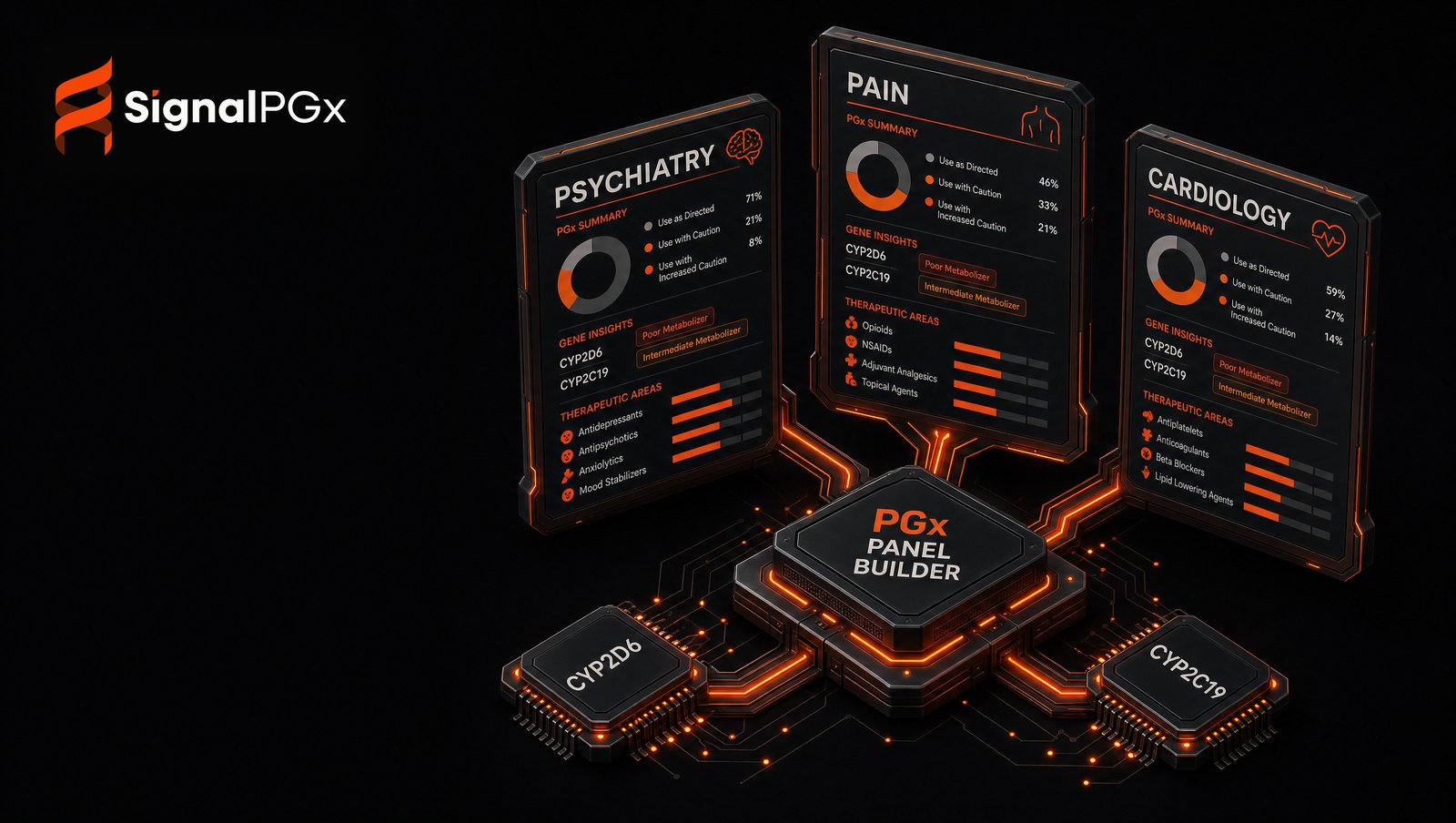
To build your own specialty pharmacogenomics panel, a CLIA lab selects CPIC Level A gene-drug pairs for its clinical focus (psychiatry, pain, or cardiology), validates the assay under its own CLIA license, and applies white-label interpretation software to turn already-called genotypes into structured, sign-out-ready reports — avoiding the vendor lock-in of closed platforms like GeneSight or Mayo PSYQP.
Lab directors evaluating specialty pharmacogenomics (PGx) face a fork: license a closed, branded panel and resell it at someone else's margin, or build a CPIC-concordant panel your lab owns end to end. This pillar lays out how to design psychiatric, pain, and cardiovascular specialty panels around evidence-graded gene selection, disciplined call criteria, and a defensible sign-out — with a clear-eyed view of where the evidence is strong, where expert consensus is skeptical, and where the regulatory and billing lines actually sit. A note on terminology up front: where this article uses "CPIC Tier 1" as SEO shorthand, we mean CPIC's own highest actionability grade, Level A. CPIC classifies gene-drug evidence as Levels A/B/C/D, not numbered tiers.
Why Build Your Own Specialty Pharmacogenomics Panel Instead of Licensing a Closed Platform?
Licensing a closed platform is fast, but it hands the economics, the gene content, and the report brand to a vendor. Panels like Mayo Clinic Laboratories' PSYQP panel and GeneSight (Myriad) are laboratory-developed tests (LDTs) regulated under CLIA and CAP — neither is FDA-approved or FDA-cleared — so "licensed" does not mean "FDA-endorsed." When you resell, you inherit a fixed gene list you cannot tune to your patient population and a report layout you cannot align to your prescribers' workflow.
Building your own panel flips those constraints. You choose the genes, you own the CLIA validation, and you keep the interpretation margin instead of paying a per-test license fee. The build-versus-buy decision is really a decision about control and durability, which we cover in depth in our build vs. buy PGx reporting analysis and in the white-label reporting model. The practical unlock is separating the two jobs: the wet-lab assay you validate and run, and the interpretation layer that turns genotypes into guidance — a layer you can license as software without licensing the panel itself.
What Genes Belong on a Psychiatric Pharmacogenomics Panel — and What Does the Evidence Actually Support?
Sound psychiatric pharmacogenomics panel design under CPIC starts by separating the small set of clinically actionable genes from the much larger set that vendors bundle for breadth. The genes with CPIC Level A, guideline-backed relevance in psychiatry are narrow: CYP2D6 and CYP2C19 (antidepressant and, for CYP2D6, some antipsychotic metabolism), plus the HLA immunogenetic alleles **HLA-B\*15:02 and HLA-A\*31:01** for carbamazepine and oxcarbazepine hypersensitivity risk. For contrast, Mayo's PSYQP catalogs a much broader set — CYP2D6, CYP2C19, HLA-A\*31:01, HLA-B\*15:02, and many additional genes — with a stated 3–14 day turnaround.
Breadth is where you must be careful. FDA's November 2018 Safety Communication warned that many genetic tests marketed to predict psychiatric medication response lack sufficient supporting evidence, and cautioned against changing treatment based solely on such results. Expert consensus in Psychiatric Times reinforces that only CYP2D6, CYP2C19, HLA-B\*15:02, and HLA-A\*31:01 currently rise to clinically actionable in psychiatry. The defensible framing is not "diagnose the right antidepressant" — it is to reduce your medical director's manual review burden across established pharmacokinetic gene-drug pairs, under human sign-out. These panels are not diagnostic tests.
How Do You Select Opioid-Safe Genes for a Pain Management PGx Panel?
Pain management PGx panel opioid-safe gene selection rests on one CPIC guideline: the CYP2D6, OPRM1, and COMT guideline covering codeine, tramadol, and related opioids. Its actionable core is metabolism-driven drug selection — CPIC recommends that CYP2D6 poor and ultrarapid metabolizers avoid codeine and tramadol because altered conversion to active metabolite drives both efficacy failure and toxicity risk. This is a medication-selection and drug-gene interaction question, not an addiction forecast.
That distinction is the whole discipline of pain-panel design. CPIC's opioid guideline is not validated as an opioid-misuse or addiction-risk predictor, and framing it that way invites both regulatory and clinical trouble. Position a pain panel strictly around medication-response and drug-drug-interaction (DDI) flagging: CYP2D6 for codeine/tramadol selection, CYP2C9 for NSAID exposure (for example celecoxib), and CYP2D6/CYP2C19 where tricyclic antidepressants are co-prescribed for chronic pain. The CPIC guideline database is the authoritative gene-drug source here. Your interpretation layer's job is to surface those established pairs and interaction flags to a reviewer — never to output a risk score a clinician might mistake for a diagnosis.
Can You Build a 12-Gene Cardiovascular Pharmacogenomics Panel Framework?
A cardiovascular pharmacogenomics panel with 12-gene cardiology coverage is a design choice a lab makes, not an industry-standard fixed list. For reference, Helix's cardiovascular PGx panel is described by Helix as an 11-gene panel (ABCB1, ABCG2, CYP2C9, CYP2C19, CYP2D6, CYP3A4, CYP4F2, GRK4, SLCO1B1, VKORC1, plus the CYP2C cluster). If you build to 12 genes, present that explicitly as your lab's own framework — do not attribute a "12-gene" count to Helix or any competitor.
The actionable spine of any cardiology panel is CPIC Level A: CYP2C19 for clopidogrel antiplatelet response, CYP2C9 plus VKORC1 for warfarin dosing, and SLCO1B1 for simvastatin-associated myopathy risk. For historical and research context, the NHLBI Working Group report on cardiovascular pharmacogenomics (JAHA, 2012) reviews warfarin, clopidogrel, and statin pharmacogenomics — though as a 2012 priorities report, it should be paired with current CPIC guidelines for actionable recommendations. The interpretation task is drug-gene interaction flagging against the patient's medication list, which the lab's director reviews and signs out.
How Do You Design Specialty Panels: Gene Selection, Call Criteria, and CPIC Concordance?
Panel design is three linked decisions: which genes, which star alleles and call criteria, and how you keep interpretation concordant with CPIC. Gene selection should be evidence-anchored — start from CPIC Level A pairs relevant to the specialty, then decide deliberately whether to add lower-evidence content and how to label it. Over-inclusion is the most common design error, because every added gene expands your validation burden and your reviewer's cognitive load without necessarily adding actionable guidance.
Call criteria are upstream of interpretation. Your assay (VCF-based sequencing, PharmCAT, Agena MassARRAY, or another method) produces star-allele calls; the interpretation layer consumes those already-called genotypes rather than re-calling variants — a separation we detail on the platform page. Analytical validation is non-negotiable: CAP's Molecular Pathology and Common checklists require you to establish accuracy, precision, analytical sensitivity and specificity, and reportable range before clinical use. Consult the current CAP Molecular Pathology checklist for exact requirements rather than a paraphrase. For a practical program-building tutorial, the Implementing Pharmacogenomics at Your Institution guide (drawing on University of Florida and UIC experience) covers gene-drug pair selection, resourcing, and decision-support challenges.
What Should a Specialty PGx Panel Report Look Like — and Where Do Liability Boundaries Sit?
A clear specialty PGx panel report format uses a green/yellow/red triage so a prescriber can scan phenotype-driven actionability at a glance: green for standard use, yellow for caution or monitoring, red for a guideline recommendation to avoid or alter therapy. The value of the color layer is triage speed, not decision authority — every flag maps to a cited CPIC (or DPWG/FDA) recommendation the reader can inspect, and the underlying genotype-to-phenotype logic stays transparent.
The sign-out is where liability boundaries are drawn. Under 42 CFR 493.1443, a CLIA high-complexity laboratory director is generally a physician board-certified in pathology or a doctoral-degree holder in a clinical laboratory science with HHS-approved board certification, among other defined pathways. That director reviews and signs out every report — the software supports the review; it does not interpret or sign out as a service, and it does not replace clinician judgment. Final prescribing decisions rest with the treating physician. Our guide to clinically defensible PGx reports details the sign-out standards and audit trail that keep this human-in-the-loop model defensible.
How Does White-Label Interpretation Software Enable Lab-Owned Specialty Panels?
White-label interpretation software is the layer that lets you own the panel without building the interpretation engine yourself. SignalPGx intakes already-called genotypes — VCF, PharmCAT, Agena MassARRAY, or CSV — and sits downstream of variant and star-allele calling; it does not call variants, align reads, or perform diagnostic testing, and it is not FDA-cleared. It produces structured, cited, reviewer-ready output that carries your lab's brand and fits your CLIA lab workflow, under your CLIA license.
The interpretation draws on a unified evidence base: 50+ pharmacogenes, 950+ medications, and DDI coverage spanning 7,700+ drugs, reconciled across 15+ evidence sources (including CPIC, DPWG, FDA, DailyMed, PharmVar, and ClinVar/ClinGen). That reconciliation is the medication intelligence graph, and reviewers can lean on SignalAI — a guardrailed, cite-or-refuse assistant that supports the director but never acts autonomously. This is the mechanism behind the white-label reporting model: your assay, your CLIA, your director's sign-out, your report — with the evidence-integration heavy lifting handled in software.
Build vs. License: What Do the Economics and Break-Even Actually Look Like?
The economics come down to who captures the interpretation margin. Licensing a closed panel typically means a per-test license fee or revenue share on every report, with no control over the gene list or the report brand — predictable but capped. Building your own panel front-loads cost into assay validation and interpretation setup, then amortizes it across volume, so the per-report economics improve as throughput grows and the margin stays with the lab. We describe the mechanics, not a promised ROI, in the build vs. buy breakdown.
On billing: common single-gene PGx CPT codes include 81225 (CYP2C19), 81226 (CYP2D6), 81227 (CYP2C9), and 81355 (VKORC1) — these are individual, non-adjacent codes, not a continuous 81225–81355 block, and unrelated assays sit in between. Multi-gene combinatorial psychiatric or pain panels are commonly billed under CPT 81418, which requires at least six genes including CYP2C19 and CYP2D6 (with CYP2D6 copy-number analysis). Labs billing Medicare typically must register a Z-code with MolDX (LCD L38337 governs PGx testing) and may need a Technical Assessment dossier for novel or laboratory-developed panels. Coverage and payer acceptance vary and are never guaranteed — this is not legal, billing, or regulatory advice, and SignalPGx does not perform Z-code registration or billing for the lab.
What Compliance and Evidence Standards Govern Specialty PGx Panels — CPIC Levels, DPWG, and FDA Labels?
Evidence discipline is what keeps a specialty panel defensible over time. CPIC publishes free, peer-reviewed, evidence-graded guidelines using Levels A/B/C/D (Level A being the highest actionability) — again, not numbered "tiers." The Dutch Pharmacogenetics Working Group (DPWG) publishes complementary peer-reviewed gene-drug guidance, useful where CPIC and DPWG converge or differ; reconciling them is exactly the problem our guideline reconciliation primer addresses.
FDA sits alongside these as a labeling and cataloging authority. In October 2025, FDA approved an updated capecitabine (Xeloda) label recommending DPYD genetic testing before starting treatment unless treatment must begin urgently, citing risk of severe or fatal toxicity in patients with DPD deficiency — and FDA has extended similar DPYD-testing language to other fluoropyrimidines (check the current label at DailyMed or accessdata.fda.gov). FDA's Table of Pharmacogenetic Associations catalogs evaluated gene-drug pairs, but listing is not FDA clearance of any test. Because labels and guidelines move, version drift is a live risk; automated living reanalysis and disciplined guideline-update automation keep issued reports concordant with the evidence you cited.
Case Study: How Might a CLIA Lab Transition from GeneSight Resale to Custom Pain and Psych Panels?
The following is an illustrative composite — not a specific customer account, and it contains no performance figures. Consider a CLIA high-complexity lab that has been reselling a licensed psychotropic panel and wants to recapture margin and control its gene content. The transition is sequential, not a rip-and-replace: the lab first validates its own assay for the CPIC Level A core (CYP2D6, CYP2C19, and the relevant HLA alleles for psychiatry; CYP2D6, CYP2C9, and CYP2C19 for pain), documenting accuracy, precision, sensitivity/specificity, and reportable range under CAP requirements.
With calls in hand, the lab layers white-label interpretation over its validated genotypes, brands the green/yellow/red report to its prescribers, and routes every report through its medical director's sign-out. Delivery into ordering workflows — LIS, EHR, and SMART/CDS Hooks — is handled through integrations, so prescribers receive guidance where they already work. As a one-line historical caution about the opioid-PGx category specifically: Proove Biosciences, an opioid-risk PGx test, entered receivership in 2017 amid a federal fraud and kickback investigation and effectively ceased operations — a reminder to keep pain panels framed as medication-response and DDI tools with citable evidence, never as risk predictors.
Bringing It Together: An Owned, Evidence-Anchored Specialty Panel
Building your own specialty pharmacogenomics panel is less about adding genes than about drawing sharp lines: CPIC Level A content at the core, honest labeling of anything beyond it, rigorous CLIA validation, a color-triaged report that always traces back to a cited guideline, and a licensed medical director who signs out every case. Psychiatry rewards restraint over breadth; pain demands medication-response framing over risk prediction; cardiology benefits from a small, high-actionability spine you can defend. In every specialty, the point of white-label interpretation software is to compress your reviewer's manual burden and keep issued reports concordant as guidelines move — not to make the clinical decision.
That division of labor is also the compliance line. SignalPGx is for post-calling interpretation by CLIA labs with licensed MDs; it does not perform diagnostic testing, variant calling, or establish medical necessity. The CLIA license, the assay validation, and the sign-out belong to your lab — the software supplies structured, cited output your director reviews and owns. Built that way, a specialty panel is durable: evidence-anchored, defensible under audit, and free of the vendor lock-in that comes with reselling someone else's closed platform.
← Back to InsightsSee how SignalPGx fits your lab
White-label pharmacogenomics interpretation and reporting for CLIA laboratories — your medical director signs out, your brand ships.
Book a demo