
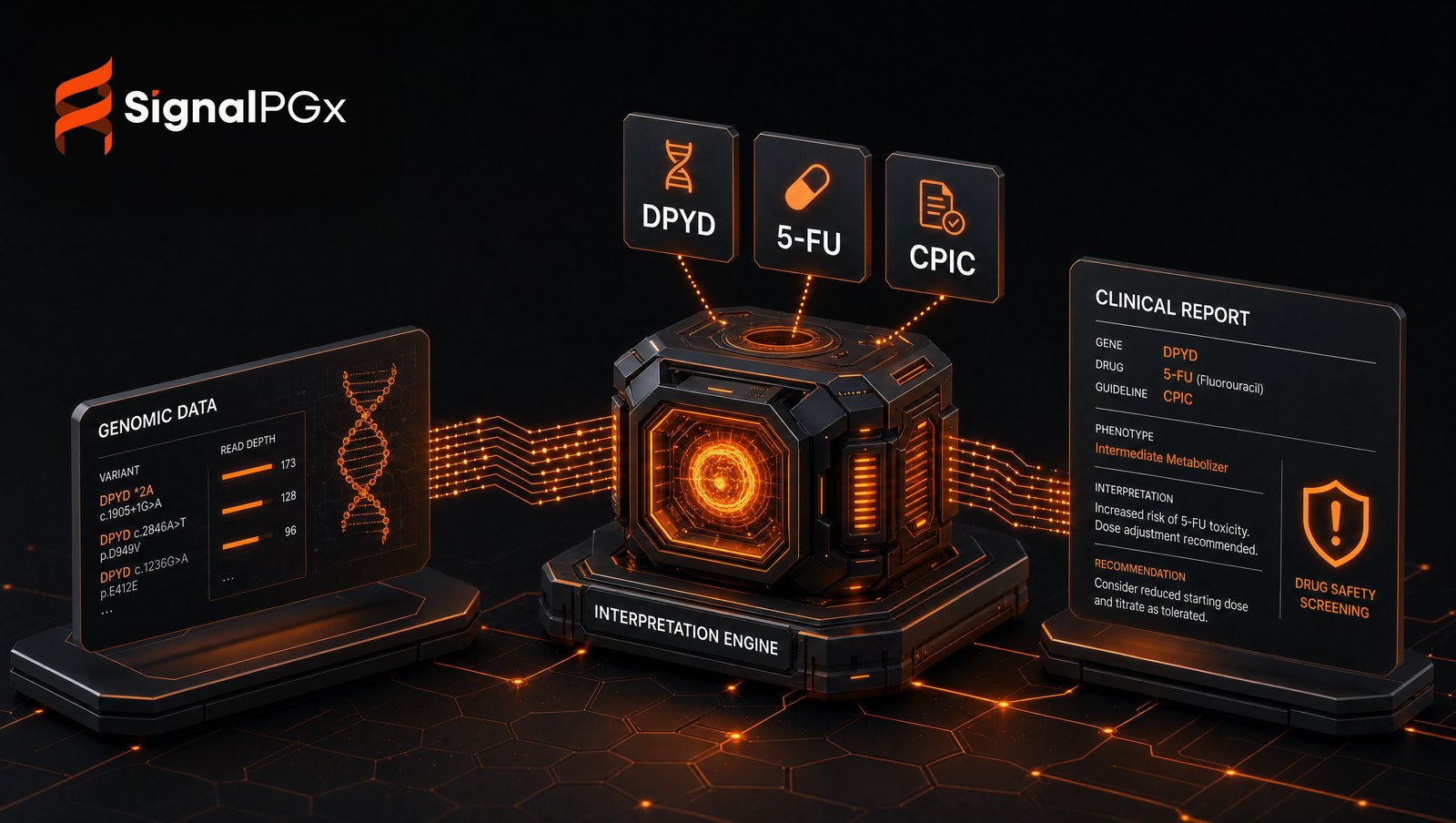
Automating a DPYD testing report for 5-FU (fluorouracil) and capecitabine means ingesting already-called DPYD genotypes, scoring the diplotype to a metabolizer phenotype with CPIC activity-score logic, matching current CPIC and FDA guidance, and generating a draft report your CLIA lab's medical director signs out. SignalPGx is interpretation software downstream of variant calling.
Why Is DPYD Testing Urgent Now? The FDA Boxed Warning and Lab Adoption
In 2025-2026 the FDA approved boxed-warning label updates for capecitabine and fluorouracil stating that serious adverse reactions or death may occur in patients with complete dihydropyrimidine dehydrogenase (DPD) deficiency, and recommending DPYD genetic testing prior to initiating treatment unless immediate therapy is necessary. You can read the agency's safety labeling update directly. NCODA, a professional oncology-pharmacy association, describes an October 2025 action elevating the capecitabine warning to boxed status, following 2024 strengthened DPD-deficiency warnings; the fluorouracil injection labeling was reported as a separate action on a different timeline, so confirm exact dates against the primary FDA pages before citing them.
Two facts drive the operational scramble. Fluoropyrimidines are contraindicated in complete DPD deficiency, and tests for DPYD variants are available from clinical laboratories but none currently carry FDA marketing authorization. Oncology practices now expect a pre-treatment DPYD result, and referring physicians are calling labs that can turn a genotype into a signed, physician-ready report fast. Note: this article is not legal, billing, or regulatory advice.
What Do DPYD Variants Tell You? From Genotype to Metabolizer Phenotype
DPD is the rate-limiting enzyme in fluoropyrimidine catabolism, clearing the large majority of administered 5-FU before it can accumulate. Germline loss-of-function DPYD variants reduce or abolish that clearance, so a standard dose behaves like an overdose — mucositis, myelosuppression, neurotoxicity, and, in complete deficiency, death. Germline variants causing partial or complete deficiency are commonly cited as affecting roughly 3-8% of patients, though published estimates vary materially by ancestry and detection method.
The reporting logic is a chain: genotype to diplotype to activity score to phenotype. CPIC assigns each allele an activity value (normal-function = 1, decreased-function = 0.5, no-function = 0). The gene activity score is the sum of the two alleles, and that score maps to normal metabolizer, intermediate metabolizer, or poor metabolizer / complete deficiency. This is the same diplotype-to-phenotype spine described in our genotype-to-guidance pipeline overview. SignalPGx applies this logic to genotypes your pipeline has already called — it does not call variants or align reads.
Which DPYD Variants Belong in a 5-FU and Capecitabine Testing Report? The Four CPIC/AMP Tier 1 Variants
A clinically defensible DPYD report is anchored to the four CPIC/AMP Tier 1 core actionable variants, which is the panel CPIC's DPYD guidance is built around:
- c.1905+1G>A (DPYD*2A, rs3918290) — a no-function splice-site variant.
- c.1679T>G (DPYD*13, rs55886062) — a no-function missense variant.
- c.2846A>T (rs67376798) — a decreased-function variant.
- c.1129-5923C>G / HapB3 (rs56038477) — a decreased-function intronic variant.
Homozygosity or compound heterozygosity for no-function alleles produces complete deficiency; a single no-function or decreased-function allele produces intermediate metabolism. This distinction is what the phenotype call turns on, so the report has to distinguish no-function from decreased-function precisely.
A caution worth building into your template: numerous DPYD SNPs (for example, markers identified in GWAS toxicity-association cohorts) are studied in research settings but are not part of the standard CPIC-actionable panel. If your assay reports them, label them explicitly as research-context findings so a prescriber never mistakes an association marker for an actionable diplotype call.
How Does SignalPGx Automate DPYD Interpretation? Diplotype Scoring and CPIC Matching
SignalPGx sits downstream of your molecular pathology pipeline. It ingests already-called DPYD genotypes in the formats your bench produces — VCF, PharmCAT star-alleles, Agena MassARRAY output, or CSV — and never performs the genetic test itself. From there, the platform automates the interpretation steps your team would otherwise do by hand:
- Diplotype scoring. It resolves the called alleles into a CPIC activity score and the corresponding metabolizer phenotype, applying the no-function / decreased-function values consistently across every case.
- Guideline matching. It maps the phenotype to current CPIC and FDA guidance. CPIC's foundational fluoropyrimidine guideline (Amstutz et al., 2018, titled the "2017 Update") recommends roughly a 25-50% starting-dose reduction for intermediate metabolizers and avoidance or alternative therapy for poor metabolizers and complete deficiency.
- Draft generation. It assembles a structured draft report.
Your licensed medical director then reviews, edits, and signs out that draft — the software supports the reviewer, it does not sign out as a service. The SignalAI assistant that surfaces evidence is guardrailed to cite or refuse, never to act autonomously, and final prescribing decisions rest with the treating physician.
How Should You Structure DPYD Reports for Oncology and Surgical Teams?
Oncologists and surgical teams reading a pre-treatment result need the interpretation at the top and the evidence underneath. A well-structured DPYD report carries a consistent set of elements:
- The called genotype and resolved diplotype, with the computed activity score.
- The phenotype call (normal / intermediate / poor metabolizer or complete deficiency), stated plainly.
- The CPIC dose-adjustment recommendation and the relevant FDA labeling context for 5-FU, capecitabine, and other fluoropyrimidines.
- An explicit contraindication flag when the result indicates complete DPD deficiency.
- A director attestation and sign-out block.
Because your lab's name, logo, and disclaimers belong on that document, white-label report templates let you brand the output as your own while keeping the interpretive structure standardized. Delivery matters as much as content: EHR and LIS integrations hand the discrete phenotype and recommendation back into the ordering workflow, so the result lands where the prescriber is already working rather than as a PDF that gets lost in an inbox.
How Do You Avoid DPYD Reporting Pitfalls? Diplotype Ambiguity, Version Drift, and Compliance
Three failure modes trip up manual DPYD reporting.
Diplotype ambiguity. Compound heterozygotes require phasing to know whether two variants are in cis or trans, and unphased genotype data can leave that unresolved. Your interpretation rules should make the conservative call and flag the ambiguity for director review rather than silently guessing a phenotype.
Version drift. Guidance moves. Beyond the 2018 CPIC guideline, CPIC/AMP joint variant-selection recommendations (dated 2024) and a January 2025 implementation guide exist as distinct documents. A report generated against last year's logic can quietly diverge from current guidance. Living re-analysis re-scores prior cases when guidance changes, and our note on preventing CPIC version drift walks through the version-control mechanics.
Regulatory and billing. CPT 81232 is associated with DPYD common-variant analysis, but CPT assignment, ICD-10 medical-necessity pairing, MolDX Z-code registration, and payer coverage are determined by your lab and its MACs — not by SignalPGx, which produces the structured output your lab uses in its own MolDX and billing process. Director qualifications remain governed by 42 CFR 493.1443 under your CLIA license. Confirm codes and local LCDs against current-year references; none of this is legal or billing advice, and reimbursement is never guaranteed.
How Do You Scale DPYD Testing Without Adding Headcount?
Standing up single-gene DPYD is the entry point, not the destination. Once your interpretation engine reliably turns a called diplotype into a signed report, the marginal cost of adding the next pharmacogene is largely configuration, not new headcount. The same scoring-and-matching pipeline that handles DPYD extends to the rest of an oncology-supportive panel — UGT1A1 for irinotecan, TPMT and NUDT15 for thiopurines — and beyond into broad pharmacogenomics.
That breadth is where a reporting layer earns its place: SignalPGx spans 50+ pharmacogenes and 950+ medications, with drug-drug interaction context across 7,700+ drugs, reconciled from 15+ evidence sources including CPIC, DPWG, FDA, DailyMed, PharmVar, and PharmCAT. Whether you build that reconciliation in-house or adopt a white-label layer is a real decision with real trade-offs, which we lay out in build vs. buy for PGx reporting.
The strategic point for a lab director is this: the FDA warning made DPYD a near-term compliance priority, but the interpretation infrastructure you stand up to meet it is the same infrastructure that lets you launch the next test without hiring the next interpreter. The urgency is DPYD; the leverage is everything downstream of it.
← Back to InsightsSee how SignalPGx fits your lab
White-label pharmacogenomics interpretation and reporting for CLIA laboratories — your medical director signs out, your brand ships.
Book a demo