
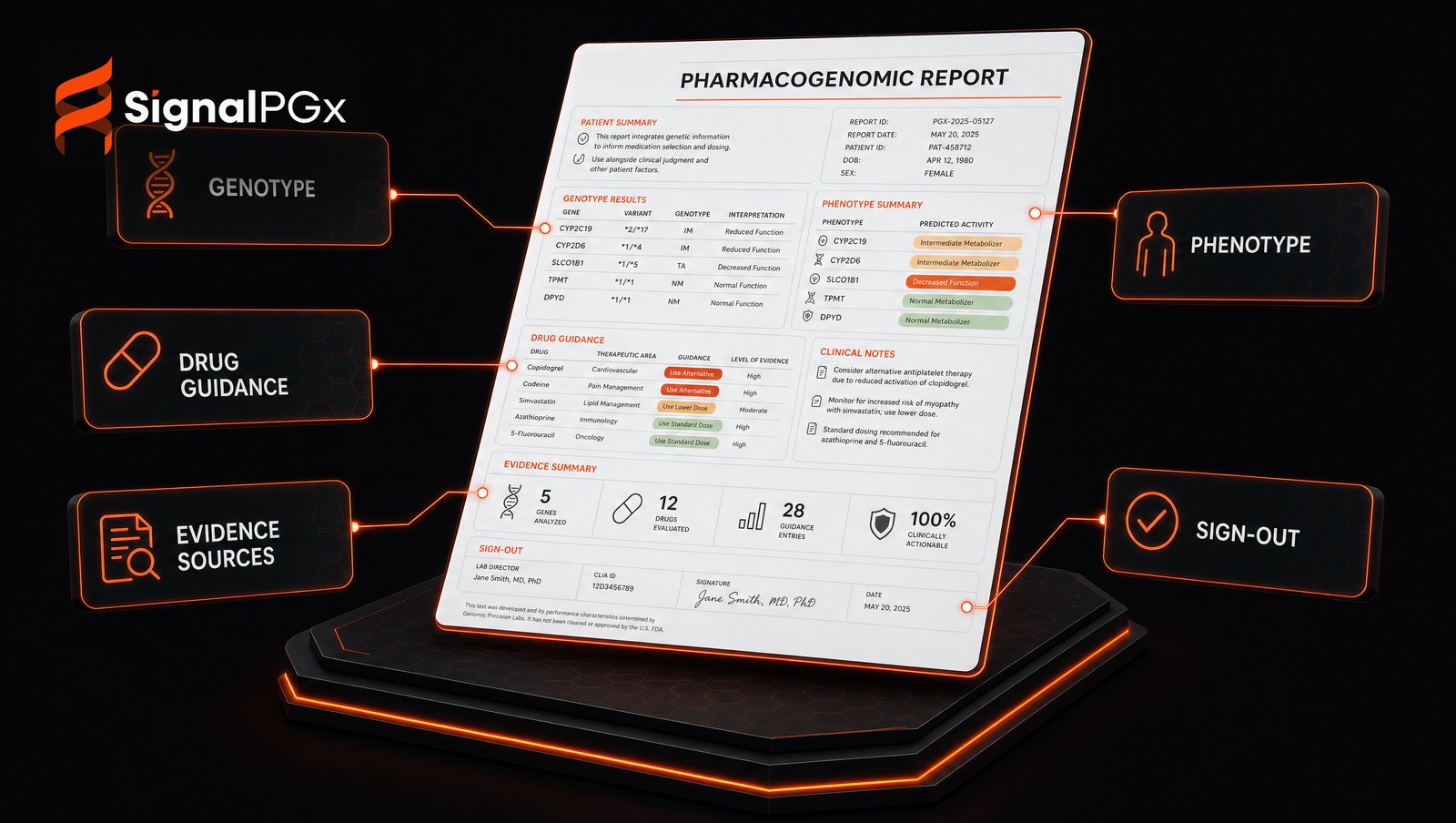
A pharmacogenomic (PGx) report is a clinical laboratory document that translates a patient's genotype in drug-metabolizing and drug-response genes into predicted metabolizer phenotypes and evidence-based prescribing guidance. It informs a clinician's medication selection and dosing decisions — it does not diagnose disease — and is reviewed and signed out by the performing lab's medical director.
What is a pharmacogenomic report?
If you have ever asked what is a pharmacogenomic report, the short answer is that it connects what a patient's genes say about drug handling to actionable prescribing guidance. Pharmacogenomics studies how inherited variation in genes such as the cytochrome P450 enzymes (for example CYP2C19, CYP2D6, and CYP2C9) changes how a person activates, clears, or reacts to a medication.
A PGx report packages the tested genes, the detected genotype, a predicted phenotype (metabolizer status), and guideline-based recommendations into a single document a prescriber can use at the point of care. Two boundaries matter from the outset: the report supports a treatment decision rather than making one, and it is not a diagnostic test. The treating clinician weighs it against the full clinical picture, and because it is a laboratory result, the lab's medical director signs it out. That reporting layer is the focus of dedicated PGx reporting software.
What are the core components of a PGx report?
Every clinically useful PGx report shares a common anatomy. Whether the panel covers three genes or fifty, the same building blocks appear:
- Patient and specimen identifiers — name/MRN, specimen type (commonly buccal swab or whole blood), collection and report dates, and the ordering provider.
- Genes and alleles tested — the pharmacogenes on the panel and the specific variants or star alleles interrogated, which defines the assay's scope.
- Genotype / diplotype — the two inherited alleles called for each gene (for example, CYP2C19 \*1/\*2). This is the raw genetic result.
- Predicted phenotype — the metabolizer status derived from the diplotype (poor, intermediate, normal, rapid, or ultrarapid).
- Drug-gene guidance — the affected medications with a recommendation (standard dosing, adjust, use with caution, or consider an alternative) tied to each phenotype.
- Evidence and guideline citations — the sources behind each recommendation, so a claim can be traced to primary evidence.
- Interpretive summary and limitations — a plain-language narrative plus an explicit statement of what the test did and did not assess.
- Medical-director sign-out — the attestation that turns a data output into a validated clinical result.
The formatting, ordering, and branding of these components are exactly what a lab controls when it issues white-label reports under its own name.
What do metabolizer statuses (poor, intermediate, normal, rapid, ultrarapid) mean?
The predicted phenotype is the part most prescribers read first. CPIC standardizes this language through an expert Delphi consensus process so that a term carries the same meaning across labs and guidelines:
- Poor metabolizer (PM) — little to no enzyme activity; substrate drugs may accumulate, while prodrugs that need the enzyme to activate may under-form.
- Intermediate metabolizer (IM) — reduced activity, between poor and normal.
- Normal metabolizer (NM) — expected, typical activity and the reference point for the others. "Normal" replaced the older term "extensive metabolizer."
- Rapid metabolizer (RM) — higher-than-normal activity.
- Ultrarapid metabolizer (UM) — substantially increased activity; substrate drugs may clear too quickly to reach effect, while prodrugs may over-activate.
Whether a given status warrants a higher dose, a lower dose, or a different drug depends entirely on the specific medication's pharmacology — which is why a phenotype label alone is not prescribing advice. Always consult current CPIC/DPWG guidance and FDA labeling for the drug in question. The terminology above is generic and educational, not medical advice.
How are drug-gene recommendations determined?
Recommendations are generated by a defined translation chain, not by clinician intuition at the bench:
- Diplotype to function — each star allele is assigned a functional status (no function, decreased, normal, or increased) from curated allele-definition sources.
- Function to phenotype — the two allele functions combine into the metabolizer status.
- Phenotype to recommendation — the phenotype is matched to the relevant gene-drug guideline, which states the prescribing implication.
CPIC grades each gene-drug pair on an actionability scale, where CPIC Level A denotes the highest actionability and the evidence supports changing prescribing; this is distinct from CPIC's separate evidence-strength ratings. Interpretation software automates this lookup at scale and keeps it consistent across every case, but the output is a faithful restatement of published guidance, and the medical director confirms it before sign-out. You can see this full path walked end to end in the genotype-to-guidance pipeline overview, and the curated evidence layer that powers the matching is described in the medication intelligence graph.
What evidence and guidelines belong in a PGx report?
A defensible report cites its sources so any recommendation can be traced back to primary evidence rather than a black box:
- CPIC — the Clinical Pharmacogenetics Implementation Consortium publishes free, peer-reviewed, evidence-based gene-drug prescribing guidelines that translate genotype into prescribing decisions.
- PharmGKB — the pharmacogenomics knowledge base of gene-drug-phenotype relationships. Note that CPIC and PharmGKB have been consolidated under the ClinPGx platform as of 2025; the legacy links still resolve, but readers now land on ClinPGx branding.
- FDA labeling and the FDA Table of Pharmacogenetic Associations — the FDA maintains a Table of Pharmacogenetic Associations cataloging gene-drug pairs it has evaluated as having sufficient evidence of altered metabolism or response, organized by strength of evidence and updated periodically. Being listed there reflects FDA's assessment of the underlying science; it is not FDA clearance or approval of any specific test, software, or report format.
- DPWG and other international bodies extend coverage where regional guidance exists.
As a concrete example: for some drugs — such as the fluoropyrimidine chemotherapy capecitabine — FDA-approved prescribing information specifically instructs testing for gene variants (DPYD) before treatment begins, with an exception for cases where immediate treatment is necessary. This is educational context, not legal, billing, regulatory, or medical advice; always check current labeling and guidelines directly.
How do laboratories produce a PGx report?
Producing a PGx report is a multi-stage laboratory workflow, and each stage has a clear owner:
- Specimen collection and accessioning — the sample enters the lab's chain of custody.
- Genotyping on a validated assay — array, NGS, MassARRAY, or targeted PCR. Under CLIA, the performing laboratory (not any software vendor) establishes and validates the assay's analytical performance, including accuracy, precision, analytical sensitivity and specificity, reportable range, and reference interval.
- Variant and star-allele calling — converting raw signal into called genotypes and diplotypes, typically emitted as a VCF or PharmCAT output.
- Interpretation and report generation — downstream software translates the called genotypes into phenotypes and guideline-matched recommendations, then formats the report.
- Medical-director review and sign-out — the qualified, licensed director reviews the case and attests to it under the lab's CLIA license.
SignalPGx operates at step 4. It ingests already-called genotypes (VCF, PharmCAT, Agena MassARRAY, or CSV) — it does not align reads or call variants — and produces the structured, guideline-cited report the director reviews. A guardrailed, cite-or-refuse assistant can support reviewers without ever acting autonomously, but the human sign-out remains the control point. It is not a diagnostic test and is not FDA-cleared. See exactly how a called VCF becomes a signed report in converting a VCF to a clinical PGx report, and how the reporting layer fits the broader platform.
What are the limitations of a PGx report?
Reading a PGx report well means respecting its boundaries:
- It predicts, it does not measure. Metabolizer status is inferred from genotype. Drug-drug interactions, organ function, adherence, and phenoconversion can move real-world response away from the genotype-predicted phenotype.
- It covers only what was tested. Variants and alleles not on the panel, and no-call regions in the data, are not assessed; rare or novel alleles can be missed.
- It is not a diagnosis. A PGx report informs medication selection and dosing; it does not diagnose or rule out disease.
- Guidance evolves. Allele-function assignments, consortium guidelines, and FDA labeling change over time, so any recommendation reflects the evidence as of the report date. Reanalysis workflows exist precisely to surface when new guidance would change a prior result — see living reanalysis.
- The clinician decides. The report is decision support. The treating physician makes the final prescribing choice for the individual patient.
Bringing it together
A PGx report is a disciplined translation of raw genotype into guideline-based prescribing guidance, assembled from a predictable anatomy: identifiers, genes and alleles tested, diplotype, predicted metabolizer phenotype, drug-gene guidance, cited evidence, an interpretive summary with limitations, and a medical-director sign-out. Its value rests on two things — the quality and traceability of the evidence behind each recommendation, and the rigor of the human review that closes the loop.
For a lab, that means the report is only as strong as its weakest citation and its sign-out discipline. Standardized metabolizer terminology, transparent CPIC/FDA/DPWG sourcing, and a clear separation between what the software computes and what the director attests to are what make a PGx report clinically defensible rather than merely informative. Understanding this anatomy is the foundation for evaluating any PGx report you receive, order against, or produce — and for deciding what a well-built report should look like before it ever reaches a prescriber.
← Back to InsightsSee how SignalPGx fits your lab
White-label pharmacogenomics interpretation and reporting for CLIA laboratories — your medical director signs out, your brand ships.
Book a demo