
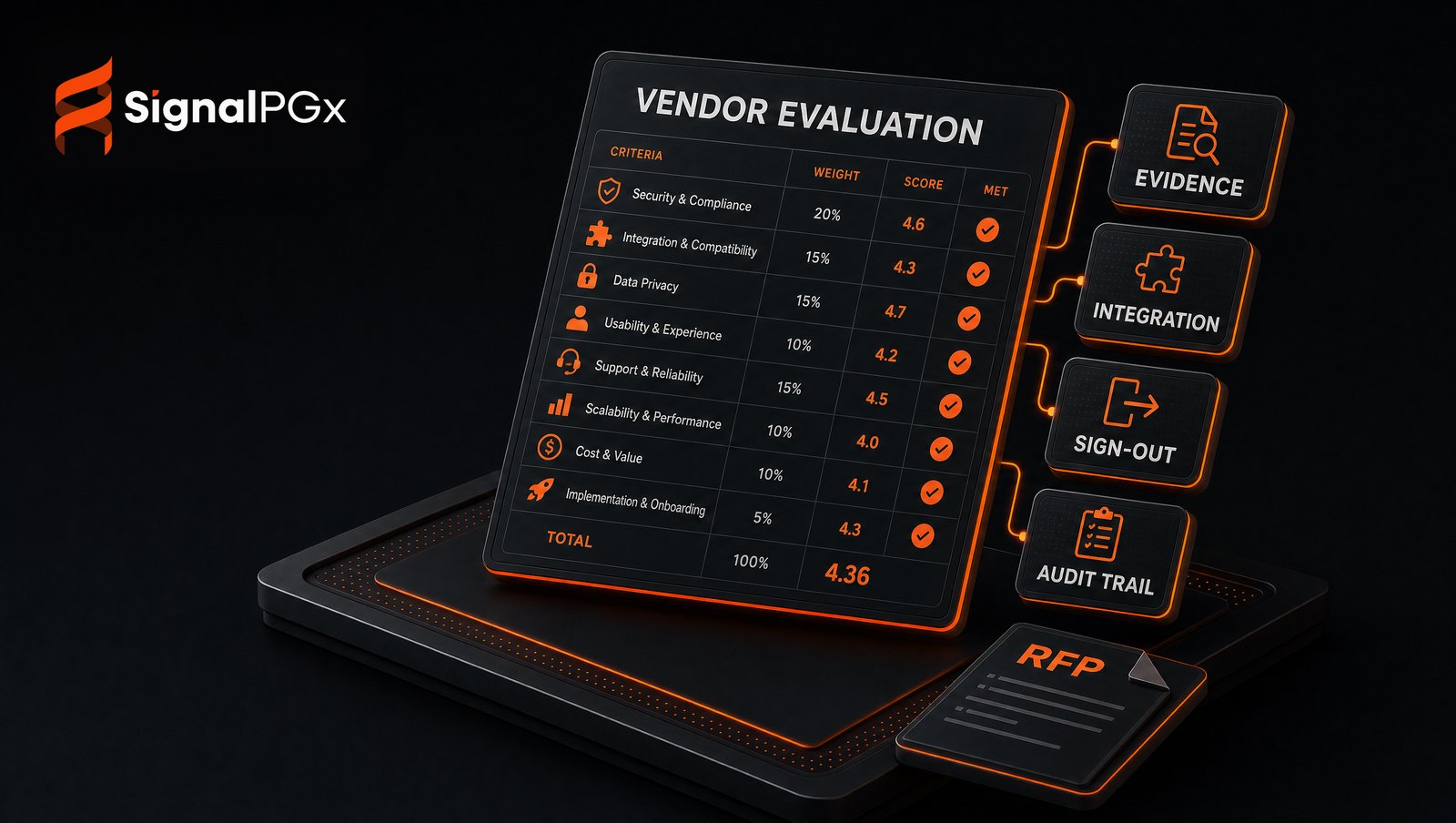
Evaluating pharmacogenomics reporting software means scoring each vendor across four dimensions: functional depth (genes, drugs, evidence sources), regulatory alignment (CPIC, FDA labeling, MolDX documentation), workflow integration (VCF ingestion, LIS/EHR, sign-off), and cost transparency. Because PGx software is not an FDA-cleared diagnostic, require every vendor to prove how its output supports your CLIA lab's own validation and sign-out.
This guide is written for the people who actually sign the contract and the reports: lab directors, lab owners and managers, and molecular pathologists at CLIA laboratories. Physicians and patients are the end-users of the report you produce, but they are not the buyer. Your job is to select a tool that makes your medical director's sign-out faster and more defensible without ever pretending to replace it. Everything below is framed as *what to ask every vendor*, not as an argument for any single product. A brief but important caveat: nothing here is legal, billing, or regulatory advice, and coverage, codes, and labeling change — verify current requirements with your MAC, your accreditor, and counsel before relying on them.
Why Does Pharmacogenomics Reporting Software Selection Matter for CLIA Labs?
The PGx report is the clinical deliverable your licensed medical director reviews and signs. The software that assembles it therefore shapes three things you cannot afford to get wrong: clinical defensibility, turnaround time, and your reimbursement posture. A tool that maps genotypes to outdated guidance, obscures its evidence trail, or cannot document methodology for a payer will cost you far more than its license fee. Selection is a risk-management decision as much as a purchasing one.
Regulatory gravity is increasing. In October 2025, FDA approved a boxed-warning update to the capecitabine (Xeloda) label directing prescribers to "test patients for genetic variants of DPYD prior to initiating capecitabine unless immediate treatment is necessary," because of the risk of severe or fatal toxicity in patients with complete DPD deficiency. Separately, on March 21, 2024, FDA approved safety labeling changes for fluorouracil injection products, adding a Pharmacogenomics subsection and strengthening DPD-deficiency warnings — but that change encouraged discussion of testing rather than mandating it. Keep those two actions distinct; conflating them is a common error.
Demand is real, but reimbursement is never guaranteed, and it can move under you. UnitedHealthcare announced in November 2024 that it would no longer cover GeneSight (Myriad Genetics/Assurex Health) under commercial and individual-exchange plans effective January 1, 2025 — a neutral illustration that payer policy for PGx can change regardless of a product's merits. Your software choice should make you resilient to that volatility, not dependent on a single billing assumption. For the broader economics of tooling versus building in-house, see the SignalPGx analysis on build vs. buy PGx reporting.
What Is the 7-Step PGx Software Evaluation Framework?
A disciplined evaluation of pharmacogenomics reporting software follows seven steps in order, because later steps depend on decisions made earlier. Skipping to a feature demo before you have defined intended use is how labs end up with tools that impress in a sandbox and fail in production. Work the sequence, score each step, and weight the steps by what matters to your lab's menu and payer mix.
- Define scope and intended use. Name the genes, drug classes, and populations you will report today and in 18 months. Decide whether you need specialty framing (psychiatry, cardiology, pain) and whether you accept research-use-only software that supports a laboratory-developed test under your own CLIA license.
- Assess functional depth. Evidence sources, star-allele and phenotype nomenclature, drug-gene pair coverage, and how ambiguous or no-call genotypes are handled.
- Verify regulatory and guideline alignment. CPIC, FDA labeling, and DPWG concordance, plus how quickly the vendor propagates guideline changes.
- Test MolDX and billing documentation support. What structured artifacts the software produces that your lab uses in its own medical-necessity and Z-code work.
- Map workflow and integration. VCF/PharmCAT/CSV ingestion, LIS/EHR/FHIR connectivity, and how the medical-director sign-off step is enforced.
- Interrogate implementation and validation support. What the vendor supplies versus what your lab must perform under CLIA.
- Model total cost of ownership. License, per-report, integration, maintenance, and support over a multi-year horizon.
Score each vendor 1–5 per step, weight by priority, and let the total drive the shortlist. The framework's value is that it forces functional, compliance, integration, and cost trade-offs into the same comparable scale. The SignalPGx platform overview is a useful reference point for what "functional depth" looks like end to end.
PGx Software Evaluation Checklist: What Are the Mandatory Vendor Requirements?
Below is a mandatory-requirements checklist you can hand to any vendor. Treat every item as a pass/fail gate before you spend time on nice-to-haves. Group your scoring so that no single strong dimension (a slick UI, an aggressive price) can hide a fatal gap in compliance or evidence traceability.
Functional and scientific
- Uses transparent star-allele nomenclature (PharmVar) and CPIC-style phenotype terms (e.g., poor, intermediate, normal, rapid, ultrarapid metabolizer) consistently across genes.
- Documents the evidence source behind every gene-drug recommendation, not just a final call.
- Handles no-calls, indeterminate diplotypes, and copy-number events explicitly rather than silently defaulting.
- States clearly that it operates downstream of variant/star-allele calling and ingests already-called genotypes.
Compliance and defensibility
- Provides a complete, exportable audit trail of inputs, versions, and the human review step.
- Preserves the medical-director sign-off as a required, attributable action — never an autonomous or "AI-signed" output.
- Produces structured documentation your lab can use in its own MolDX and medical-necessity work.
Integration and security
- Ingests VCF, PharmCAT, and CSV (and instrument outputs such as Agena MassARRAY) without bespoke engineering for each case.
- Supports LIS/EHR interfaces and standards-based exchange (HL7 FHIR, CDS Hooks).
- Meets HIPAA expectations with role-based access, encryption in transit and at rest, and tenant isolation — see how SignalPGx frames security and compliance documentation.
MolDX Compliance Checklist: What Must Your PGx Software Prove?
No software is "MolDX-compliant" on your behalf — MolDX participation, Z-code registration, and medical-necessity documentation are actions your laboratory performs under its own CLIA license and MAC jurisdiction. What good software does is produce the structured, defensible output your lab uses to do that work. So the right question is not "are you MolDX-compliant?" but "show me exactly what documentation your tool generates that I can put behind a claim." This section is not billing or regulatory advice; confirm every code and policy with your MAC.
Under the MolDX program, labs register molecular and PGx tests in the DEX Diagnostics Exchange registry and receive a unique Z-code identifier that payers use to adjudicate claims based on the test's registered methodology and intended use. MolDX coverage policy is currently applied by four MACs — Palmetto GBA, Noridian Healthcare Solutions, WPS Government Health Administrators, and CGS Administrators — across their combined jurisdictions, a footprint often cited as roughly 28 states; confirm the current MAC list and state count directly with Palmetto/CMS, as adoption has expanded over time. The governing billing rules live in CMS Article A57384, "Billing and Coding: MolDX: Pharmacogenomics Testing", associated with LCD L38335, which sets requirements such as documenting the drug(s) under consideration and generally limiting reimbursement to one PGx test per date of service.
On coding, ask the vendor how its output maps to the codes you will actually bill. Representative PGx-relevant CPT codes include 81225 (CYP2C19), 81226 (CYP2D6), 81227 (CYP2C9), and 81355 (VKORC1); these fall within the tier-1 molecular pathology series but do not form an exclusive contiguous "PGx block," since that numeric span also contains unrelated single-gene codes. Where no specific CPT code exists for a gene, MolDX guidance allows CPT 81479 (unlisted molecular pathology procedure). Because Article A57384 is revised periodically, insist on:
- Machine-readable methodology and gene-list documentation you can attach to a Z-code submission.
- Per-report capture of the drug(s) under consideration so Item 19 / medical-necessity narratives are supportable.
- Versioned evidence citations so a payer audit can be answered from the report itself.
Software that gives you clean, exportable documentation strengthens your position; it does not register, validate, or bill for you. For how this connects to protecting earned revenue, see revenue defense.
Workflow Integration: How Should VCF Ingestion, LIS/EHR, and Medical-Director Sign-Off Actually Work?
Integration is where PGx software either disappears into your workflow or becomes a daily tax. The first principle to verify is scope: interpretation-and-reporting software sits *downstream* of variant and star-allele calling. It should ingest already-called genotypes — VCF, PharmCAT output, instrument exports such as Agena MassARRAY, or CSV — and it should not claim to align reads or call variants itself. Open-source PharmCAT is a useful neutral reference for this boundary: it processes VCF genotype data, infers star-allele diplotypes, predicts phenotypes, and reports CPIC, DPWG, and FDA-label-based guidance. For a concrete walkthrough, see convert VCF to a clinical PGx report.
Downstream of ingestion, the report has to travel. Ask how the software exchanges results with your LIS and with ordering EHRs. The relevant standard is HL7's Genomics Reporting Implementation Guide (v3.0.0, on FHIR R4), which includes explicit pharmacogenomics guidance and is commonly paired with the separate CDS Hooks specification to deliver medication-prescribe alerts inside EHR workflows. A vendor that can speak FHIR and CDS Hooks natively saves you a custom interface project per client. SignalPGx documents its approach on the integrations page, and the PGx EHR integration deep-dive covers the FHIR and CDS Hooks mechanics in detail.
The non-negotiable is the sign-off step. The software helps your medical director; it does not interpret or sign out as a service, and it does not replace a clinician — final prescribing decisions rest with the treating physician. Confirm that human review is an enforced, attributable gate in the workflow, and that any AI assistance is guardrailed to cite sources or refuse rather than free-generate. SignalPGx's assistant, SignalAI, is designed as a cite-or-refuse aid to the reviewer, never an autonomous sign-out. If a vendor markets "AI-signed" or autonomous reports, treat it as a red flag against your CLIA responsibilities.
Vendor Landscape: How Do Golden Helix, Emgenex, PGx Software, and White-Label Options Compare?
The PGx software market spans several distinct scopes, and confusing them is the fastest way to a mismatched purchase. Some tools do star-allele calling; others sit purely downstream in interpretation and reporting. Nearly all of them — including SignalPGx — are research-use-only software with a human-in-the-loop model rather than FDA-cleared diagnostics. That shared status is an industry norm, not a point of superiority for anyone. Evaluate on fit and scope, and rely only on each vendor's own stated claims.
- Golden Helix VSPGx. Part of the VarSeq Suite, VSPGx performs star-allele identification (PharmVar nomenclature), diplotype/phenotype assignment, and CPIC/FDA-label mapping from VCF or microarray genotype input, and supports LDT development and method validation. Per Golden Helix's own site, VSPGx is licensed Research Use Only and is not offered as a cleared in vitro diagnostic — a neutral, attributable fact. Note the scope difference: it includes calling functions upstream of pure reporting tools.
- Emgenex. Emgenex markets itself as cloud-based PGx interpretation and reporting software for CLIA labs, describing its output as "MolDx-ready" reports powered by CPIC/FDA guidelines, with EHR and LIS/LIMS integration and a provider portal. These are Emgenex's own marketing claims, not independent regulatory certifications, and should be probed and attributed as such.
- PGx Software (pgxsoftware.com). The site describes a cloud-based portal where labs upload genomic results to generate PGx reports. However, a third-party company-intelligence database (Tracxn) lists PGx Software as inactive/"deadpooled" despite the live website, so re-verify current operating status directly before shortlisting it.
- White-label alternatives (the SignalPGx category). These sit downstream, ingesting already-called genotypes and producing interpretation and reporting under your laboratory's own brand and sign-out. This is a different value proposition from calling-plus-reporting suites — see white-label reports and the positioning discussion in white-label PGx reporting.
Implementation Reality: What Do Timeline, Staffing, Validation, and Go-Live Actually Require?
Implementation is where optimistic sales timelines meet CLIA reality. The honest framing is that the software vendor configures and integrates; your laboratory validates and signs out. Analytical validity, verification, and the decision to put a test into clinical use are your lab's responsibilities under its own CLIA license — no vendor performs those for you. Build your project plan around that division of labor so nothing critical falls into a gap between "the vendor said" and "the lab must."
A realistic sequence runs: contracting and scope lock, data mapping (defining exactly which genotype inputs and formats you send), configuration of report templates and guideline logic, the lab's own validation and parallel testing, then a controlled go-live with monitoring. Rather than trust an invented number of weeks, ask the vendor which of these phases they support and where their responsibility ends. The main timeline drivers are input-format heterogeneity, interface complexity, and your internal validation cadence — not the software's demo speed. For a structured roadmap, see how clinical labs launch PGx reporting; this guide won't re-derive that playbook.
Staffing and credentialing are part of the gate. Under 42 CFR 493.1443, a CLIA high-complexity laboratory director generally must hold an earned doctoral degree in a chemical, biological, clinical, or medical laboratory science (or medical technology) — with an alternate pathway under 493.1445 — be certified by an HHS-approved board, have at least two years directing or supervising high-complexity testing, and complete at least 20 CE hours; a grandfather provision protects directors already qualified and serving as of December 28, 2024. If you pursue CAP accreditation, CAP's Molecular Pathology checklist addresses pharmacogenomic testing among several application areas and requires documented analytical validity, a quality management system, and appropriately credentialed personnel, consistent with CLIA. (Do not rely on any specific checklist item numbers a vendor quotes; CAP numbering and content change between editions — verify against the current checklist.) Plan for a director, a molecular technologist, LIS/IT support, and compliance involvement from day one.
Pharmacogenomics Software Cost Models: How Do Licensing, Per-Test, and Hidden Costs Compare?
PGx software pricing comes in a few recognizable shapes, and the sticker model rarely tells the whole story. The common structures are per-report or per-test pricing, flat subscription or platform licensing, tiered volume pricing, and implementation or setup fees charged separately. Each aligns incentives differently: per-report scales with your volume (good when you're small, painful at scale), while a flat license favors high-throughput labs but can strand a low-volume menu. Map the model to your realistic annual volume, not the vendor's best-case pitch.
The costs that wreck a business case are usually the ones not on the first quote. Probe explicitly for:
- Integration and interface fees — per-LIS or per-EHR connection charges, and who pays for FHIR/CDS Hooks work.
- Validation support — whether help with your CLIA validation is included, extra, or absent.
- Guideline maintenance — how the vendor keeps CPIC, FDA-label, and DPWG content current, and whether updates cost extra. Stale content creates version drift and defensibility risk; see automating CPIC guideline updates to prevent version drift.
- Branding and templates — custom report design, especially for white-label use.
- Support SLAs and overages — response-time tiers and per-report charges above a tier cap.
Because I will not invent reimbursement rates, ROI figures, or adoption counts — none are verified — build your model on your own confirmed costs and payer mix, and treat coverage as never guaranteed. Compare the multi-year total against the internal-build alternative using the build vs. buy analysis, and hold vendor list pricing next to the published SignalPGx pricing approach as a transparency benchmark.
RFP Template for PGx Reporting Software (Reusable Checklist)
Use the following as a copy-and-send RFP skeleton. Every question is designed to force a specific, verifiable answer rather than a marketing adjective. Ask each vendor to respond in writing, attribute their claims, and provide artifacts (sample reports, documentation exports, interface specs) rather than assertions.
A. Company and viability
- Provide current operating status, ownership, and years the PGx product has been in clinical production use.
- List reference laboratories willing to speak to their production experience.
- Describe your product roadmap and guideline-update commitments in writing.
B. Functional and scientific depth
- Which genes and how many drug-gene pairs do you report, and how is each pair counted?
- Which evidence sources back each recommendation, and can you cite the source per pair?
- How do you represent star alleles and phenotypes, and how do you handle no-calls and copy-number events?
- Confirm you operate downstream of variant/star-allele calling and list accepted input formats (VCF, PharmCAT, CSV, instrument exports).
C. Regulatory and guideline alignment
- State plainly whether the product is an FDA-cleared diagnostic. (Expect "no" — it should be RUO software.)
- How current is your CPIC, FDA-label, and DPWG content, and what is your update latency after a guideline change?
- How do you preserve the medical director's sign-off as a required, attributable step?
D. MolDX and billing documentation support
- What structured, exportable documentation do you produce that we can use in Z-code registration and medical-necessity narratives?
- How does the report capture the drug(s) under consideration per case?
- How are evidence citations versioned for a payer audit?
E. Integration and security
- Detail LIS/EHR connectivity, FHIR (HL7 Genomics Reporting IG), and CDS Hooks support.
- Describe HIPAA safeguards: access controls, encryption, tenant isolation, and audit trails.
F. Implementation, validation, and support
- Specify exactly which implementation phases you own and where our lab's CLIA validation responsibility begins.
- What are your support tiers, SLAs, and escalation paths?
G. Commercial
- Provide the full pricing model including per-report, license, integration, validation, branding, and overage components.
Because the site template appends its own next steps, this checklist ends here rather than with a call to action.
Common Vendor Claims to Probe Deeper: Feature Parity vs. Real Compliance
Feature-list parity is not compliance parity. Two products can list the same genes and the same guideline names and still differ enormously in defensibility. The following claims deserve a second, harder question every time — not because vendors are dishonest, but because the language of PGx marketing routinely blurs what software does versus what your laboratory does.
- "FDA-approved" or "FDA-cleared." No PGx interpretation software in this category is a cleared diagnostic, and FDA itself notes that for DPYD, "an FDA-authorized test... is not currently available." Any claim of clearance for interpretation software should be treated skeptically and verified. FDA also maintains a public Table of Pharmacogenetic Associations and states that listing a gene-drug pair there does not mean FDA advocates pre-prescribing testing unless the test is a companion diagnostic — so the table is a source, not an endorsement.
- "MolDx-ready" or "MolDX-compliant." Compliance is achieved by your lab, not conferred by software. Ask precisely which documents the tool generates and how they map to Z-code and LCD requirements.
- "AI-generated" or "autonomous" reports. Reject anything that implies sign-out without your medical director. Ask how AI assistance is guardrailed — does it cite sources or refuse, or does it free-generate?
- "CPIC-compliant." Guidelines change; concordance is a moving target. Ask about update cadence and how the vendor prevents version drift. CPIC (now part of ClinPGx) publishes evidence-graded gene-drug guidance widely regarded as a global standard, spanning dozens of genes and 100+ drugs — so "compliant as of when?" is the real question.
- "Fully validated." Analytical validation is your lab's obligation under CLIA. Ask what validation *support* the vendor provides, and never accept validation as something the software did for you.
For the evidence-alignment side of these questions, the SignalPGx piece on clinically defensible PGx reports shows how CPIC, FDA-label, and DPWG concordance should be documented rather than asserted.
Conclusion: Turning the Checklist Into a Defensible Decision
The through-line of every section above is the same: pharmacogenomics reporting software is a force multiplier for your medical director, not a substitute for the director's judgment, your CLIA license, or your lab's validation work. When you evaluate vendors, you are really testing whether their structured output makes your sign-out faster and more defensible — and whether their claims survive a specific, written question. Neutral scoring across function, compliance, integration, and cost keeps a good demo from masking a bad fit.
Hold every vendor to the same standard, including the incumbents. Golden Helix, Emgenex, and white-label alternatives all sit within the same research-use-only, human-in-the-loop reality, so the differentiators worth paying for are evidence transparency, guideline currency, clean MolDX-supporting documentation, real FHIR/CDS Hooks integration, and honest cost modeling. Verify operating status, re-check MolDX and CPT requirements with your MAC, and treat coverage as changeable rather than guaranteed.
Run the 7-step framework, send the RFP template, and score the answers before you fall for a feature list. The lab that asks "show me the documentation, the evidence citation, and the sign-off gate" ends up with software it can defend in an audit — and a report its director is proud to sign. To see how one downstream, white-label approach implements these principles, review the SignalPGx platform and PGx reporting pages against the same checklist you'd apply to anyone else. Remember, finally, that this guide is educational and not legal, billing, or regulatory advice; your compliance decisions belong to your laboratory and its advisors.
← Back to InsightsSee how SignalPGx fits your lab
White-label pharmacogenomics interpretation and reporting for CLIA laboratories — your medical director signs out, your brand ships.
Book a demo