
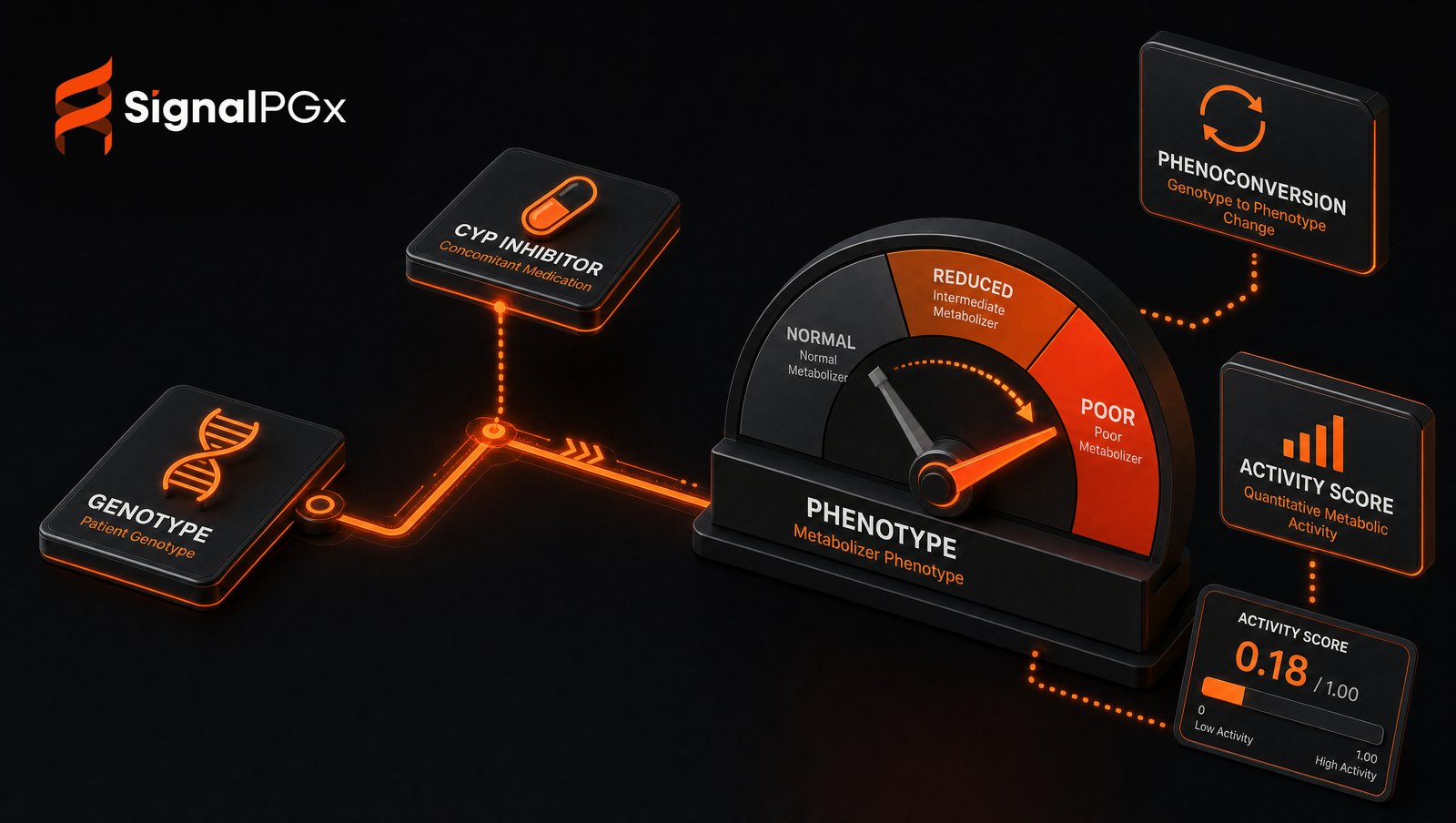
Phenoconversion in pharmacogenomic reporting describes a genotype-predicted metabolizer phenotype being functionally overridden at the time of dosing — usually by a co-administered CYP inhibitor or inducer. A genotypic normal metabolizer can behave like a poor metabolizer. Rigorous reports standardize phenotype and flag these drug-drug-gene interactions for a licensed medical director to review.
What is phenoconversion in pharmacogenomics?
Phenoconversion is a well-established pharmacology concept: intrinsic or extrinsic factors — most commonly co-administered CYP-inhibiting or -inducing drugs, but also organ dysfunction, systemic inflammation, or pregnancy — can shift a patient's genotype-predicted metabolizer phenotype at the moment of dosing. The underlying genotype does not change; the functional phenotype does.
For a laboratory, this is the gap between the genome your assay reports and the phenome the prescriber acts on. A CYP2D6 diplotype that scores as a normal metabolizer is a stable, lifelong fact. Whether that same patient actually clears a CYP2D6 substrate at a normal rate today depends on what else is on their medication list. The enzymes most often implicated — CYP2D6, CYP2C19, and CYP3A4/5 — sit at the center of many common prescriptions, from analgesics and antidepressants to antiplatelet and antifungal therapy. Phenoconversion is well documented in the peer-reviewed pharmacology literature, yet it is easy to lose in a report that prints only a static genotype-derived label.
Why does genotype-predicted phenotype sometimes mislead?
A pharmacogenomic report almost always presents genotype-predicted phenotype: the metabolizer category translated directly from the star-allele diplotype your pipeline called. That translation is correct as far as it goes, but it is a prediction made in isolation from the patient's concurrent regimen.
The mismatch surfaces in predictable ways. A genotypic normal or intermediate metabolizer taking a strong inhibitor of the same enzyme can be functionally poor. In real-world polypharmacy, co-prescription of a substrate and an inhibitor of the same enzyme is common rather than exceptional, so this is not an edge case. When a report shows only the genotype-derived label, a reviewer who does not cross-reference the medication list may sign out a phenotype that no longer reflects real-time metabolism. This is not a calling error — the genotype sits downstream of accurate variant calling — it is a limitation of genotype-only interpretation. And because a patient's medications change over time, the phenoconversion status tied to a report can shift even when the genotype cannot, which is one reason PGx results increasingly warrant periodic reanalysis.
How do CYP inhibitors and inducers cause phenoconversion?
A drug-drug-gene interaction (DDGI) describes a co-administered interacting drug — a CYP inhibitor or inducer — superimposed on a patient's drug-gene relationship, altering the expected phenotype. It is a drug-drug interaction layered on top of a drug-gene interaction, and it is the primary mechanism behind phenoconversion.
CPIC translates this into concrete guidance for specific CYP2D6-metabolized drug classes, including opioids, tricyclic antidepressants, tamoxifen, and atomoxetine. For those pairs, CPIC recommends accounting for a concomitant strong CYP2D6 inhibitor by treating it as effectively zeroing the patient's CYP2D6 activity, and a moderate inhibitor as roughly halving it — guidance offered for defined drug/gene pairs, not a universal rule for every substrate. Several common antidepressants are themselves potent CYP2D6 inhibitors, which is why psychiatric polypharmacy is a frequent phenoconversion scenario. Consider a prodrug like codeine, which relies on CYP2D6 to form its active metabolite: a genotypic normal metabolizer co-prescribed a strong CYP2D6 inhibitor may derive reduced effect — functionally behaving as a poor metabolizer for that drug — though the diplotype never changed. Inducers push the other way, raising enzyme activity toward an ultrarapid-like functional state and altering exposure to the parent drug or its active metabolite.
What is phenotype standardization and the CYP2D6 activity score?
Phenotype standardization is the practice of translating a genotype into a metabolizer category through a defined, citable, reproducible method rather than an in-house convention. For CYP2D6, CPIC and the Dutch Pharmacogenetics Working Group (DPWG) jointly published a standardized approach (Caudle KE et al., Clinical and Translational Science, 2020) for doing exactly this.
The method assigns each CYP2D6 allele a numeric activity value, sums the two alleles into a diplotype activity score, and maps defined score ranges onto poor, intermediate, normal, and ultrarapid metabolizer categories. Because secondary summaries describe the intermediate-to-normal boundary slightly differently, anchor to the current values published by CPIC and PharmGKB rather than a hard-coded table. CYP2D6 earns this rigor because it is uniquely complex — copy-number variation, gene deletions and duplications, and hybrid alleles mean two labs can reach different labels from identical data without a shared standard. Standardization also aids reproducibility and audit: when the score's provenance is explicit, a reviewer, or an inspector, can trace exactly how the label was derived. That same activity score is the object a strong inhibitor drives toward zero during phenoconversion.
How should a PGx report surface drug-drug-gene interactions?
A report should make the DDGI visible without overstepping. The genotype-predicted phenotype stays as the reported result, grounded in the lab's analytically validated genotype; alongside it, the report surfaces that the patient's current medication list contains an interacting inhibitor or inducer, names the affected gene-drug pair, and attaches the guideline citation — so the reviewer weighs a functional phenotype, not only a genotypic one.
Doing this consistently requires structured drug-interaction knowledge. SignalPGx draws on a medication intelligence graph spanning 950+ medications and 7,700+ drugs with documented drug-drug interactions, mapped across 15+ evidence sources including CPIC, DPWG, FDA, DailyMed, and PharmGKB. The software's role is to surface the phenoconversion context as a flag for review — it does not silently recalculate or reclassify the patient's phenotype on its own authority. The activity score and the final metabolizer call remain the reviewer's to confirm and sign out.
Where does the medical director fit?
Phenoconversion is exactly the kind of judgment that belongs to a licensed human. Deciding whether a flagged inhibitor is clinically meaningful for a given patient — its dose, duration, timing, and the rest of the regimen — is interpretation, not computation.
SignalPGx is decision-support software that fits your CLIA lab's workflow under your own license. Every report is reviewed and signed out by your laboratory's own qualified medical director; the platform assembles the evidence, standardizes the phenotype, and presents DDGI flags, but the director makes the call and owns the sign-out. Final prescribing decisions rest with the treating physician. That human-in-the-loop model is what keeps a report defensible — a theme we develop in our guide to clinically defensible PGx reports — and it keeps the lab, not the software vendor, as the accountable entity under CLIA.
How should software account for phenoconversion in pharmacogenomic reporting?
When you evaluate an interpretation platform for phenoconversion in pharmacogenomic reporting, look past the marketing to the mechanics:
- Standardized phenotype translation — does it use the CPIC/DPWG activity-score method for CYP2D6 and cite its provenance, or an opaque in-house mapping?
- Structured DDGI detection — can it ingest the patient's medication list and flag concomitant inhibitors and inducers against the affected gene-drug pairs, with citations attached?
- Surfacing, not silent overwriting — does it present phenoconversion as a reviewable flag that preserves the analytically validated genotype result, leaving reclassification to your director?
- Transparent, versioned evidence — does it draw on named sources and update as guidelines change?
SignalPGx is built on these principles. It ingests already-called genotypes (VCF, PharmCAT, and similar) downstream of your variant-calling pipeline, and its reporting platform pairs the evidence with SignalAI — a guardrailed, cite-or-refuse assistant that supports reviewers with sourced answers and never acts autonomously. SignalPGx is not a diagnostic test and is not FDA-cleared; it produces structured output your lab uses in its own reporting workflow. The right platform reduces the reviewer's cognitive load without removing the reviewer.
The bottom line for lab directors
Genotype-predicted phenotype is a necessary input, not the whole clinical picture. Phenoconversion — driven mostly by drug-drug-gene interactions, but also by organ dysfunction, inflammation, and pregnancy — means the same diplotype can behave differently depending on the patient's regimen on the day they are dosed.
The mitigation is not to abandon genotype reporting but to strengthen it: standardize the phenotype with the CPIC/DPWG activity-score method, flag DDGIs against a maintained evidence base, and keep a licensed medical director in the loop to weigh each flag and sign out. Software should make that work faster and more consistent, not take the decision away — the model behind SignalPGx's PGx reporting. This article is educational and is not medical, legal, or regulatory advice; verify current guideline values and drug labels against their primary sources before clinical use.
← Back to InsightsSee how SignalPGx fits your lab
White-label pharmacogenomics interpretation and reporting for CLIA laboratories — your medical director signs out, your brand ships.
Book a demo