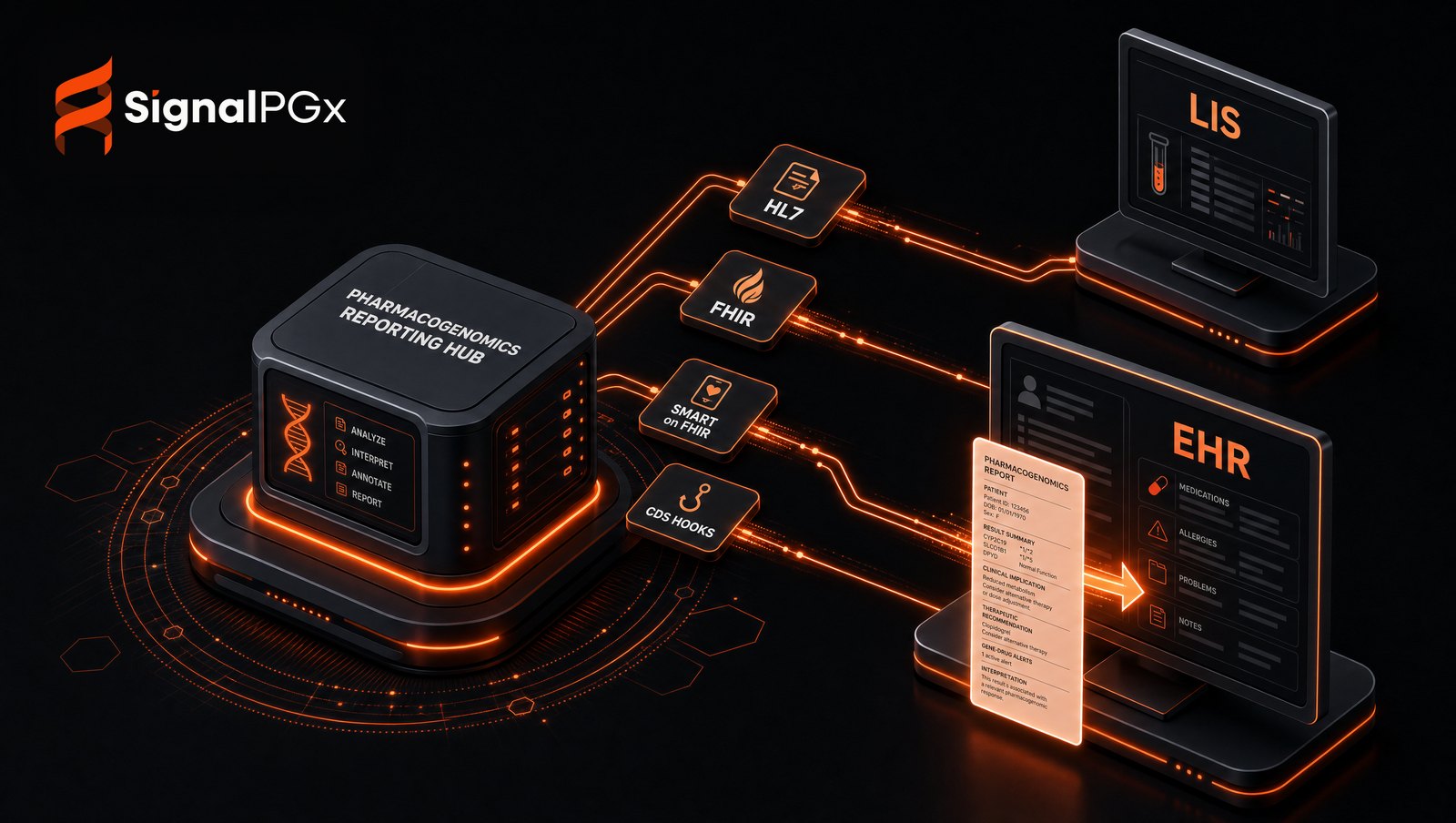
PGx LIS integration works through the open standards your incumbent systems already support: HL7 v2 result messages (ORU), FHIR R4 Genomics resources, SMART on FHIR app launch, and CDS Hooks. A white-label reporting layer produces structured, discrete output; your lab's medical director reviews and signs out every report.
How does PGx LIS integration get reports into your LIS and EHR?
Start from the data flow, because it determines where a reporting layer sits. Variant and star-allele calling happens upstream in your pipeline. A reporting layer sits strictly downstream of that step. SignalPGx intakes already-called genotypes — VCF, PharmCAT JSON, Agena MassARRAY exports, or CSV — matches them against curated evidence spanning CPIC, DPWG, FDA, DailyMed, and other sources, and returns a structured interpretation.
That interpretation then moves in two directions. It renders as a human-readable report your director reviews and signs out, and it serializes into discrete data your LIS and EHR can ingest. The platform never calls variants or signs out on its own; it hands your reviewer a defensible draft and hands your interface engine machine-readable results. The integration question is therefore narrow and answerable: how does that second output — the discrete, standards-based payload — travel from the reporting layer into a specific named system. If you are starting from raw sequence, the mechanics of turning a VCF into a clinical PGx report sit one step before this handoff.
What integration standards do the major systems support?
Every major LIS and EHR converges on a small set of interoperability standards, and a reporting layer that speaks them integrates without bespoke, per-vendor plumbing. Four standards do almost all the work.
- HL7 v2 order and result messaging (ORU^R01) remains the workhorse for lab result delivery across virtually every platform, old and new.
- The HL7 FHIR Genomics Reporting Implementation Guide (currently v3.0.0, based on FHIR R4) defines discrete genomic observations, including genotype and therapeutic-implication resources.
- SMART on FHIR / SMART App Launch (currently v2.2.0, based on FHIR R4) lets a report render as an embedded app inside the clinician's chart, authenticated against the EHR.
- CDS Hooks (currently v2.0.1, STU2, built on FHIR R4) surfaces PGx guidance at the moment of prescribing, as a card rather than a buried document.
We cover these standards end-to-end in our FHIR and CDS Hooks integration guide; this article maps them onto named systems rather than re-explaining them from scratch.
Integrating PGx with Epic, including Beaker
Beaker is Epic's built-in laboratory information system module, so pharmacogenomics Epic Beaker integration is really integration with Epic itself. Epic connects to outside systems primarily through Epic Bridges for HL7 v2 interfaces and Epic Interconnect for FHIR R4 APIs, with technical specifications and a developer sandbox published at open.epic.com.
In practice, a PGx reporting layer integrates via the standards Epic supports. Discrete results flow in as HL7 v2 ORU messages or FHIR R4 Genomics observations, mapped by your Epic team into Beaker result components and orderables. The signed PDF attaches as a result document for the legal record. A SMART on FHIR launch can embed the interactive report inside the patient chart, and CDS Hooks can fire prescribing-time guidance where the organization enables it.
SignalPGx claims no partnership, endorsement, certification, or marketplace listing with Epic or Beaker. It produces standards-compliant output that your Epic analysts configure into Beaker structures under your own build governance and change control.
Integrating PGx with Oracle Health (Cerner)
Cerner, acquired by Oracle in 2022 and now Oracle Health, runs on the Cerner Millennium platform. Millennium exposes HL7 FHIR R4 APIs, SMART on FHIR app launch, and Bulk FHIR, supported through what was the Cerner Code developer program (code.cerner.com), now folded into the Oracle Health Developer Program. That standards surface is what makes PGx Oracle Health Cerner integration tractable without a proprietary bridge.
The pattern mirrors Epic closely. Structured PGx results arrive as HL7 v2 ORU messages or FHIR R4 Genomics resources; the signed report attaches as a document; and a SMART on FHIR app can render the interactive interpretation inside Millennium PowerChart. Prescribing-time alerts are possible through CDS Hooks where your organization configures them.
As with Epic, this is integration via the open standards Oracle Health supports — not a certified connector or an endorsed listing. Your Oracle Health analysts retain control over how discrete results and orderables map into the environment, and your governance owns the build.
Integrating PGx with Sunquest, Orchard, and other LIS platforms
Standalone LIS platforms lean more heavily on HL7 v2, and the framing has to follow what each vendor actually documents. For Sunquest PGx integration, Sunquest environments commonly interface via standard HL7 v2 order and result (ORU) feeds; FHIR-based connectivity, where used, is typically provided through a third-party interface engine rather than a first-party Sunquest FHIR API. Anchor Sunquest work to HL7 v2 and layer FHIR only where your interface engine supplies it.
For Orchard LIS pharmacogenomics, Orchard (now part of Clinisys, following Clinisys's July 2025 acquisition of Orchard Software) publishes documented HL7 v2.3 outbound result (ORU) interface specifications for Orchard Harvest LIS and related products, which a reporting layer can target directly. For any other LIS, the same rule holds: integrate via the documented HL7 v2 interfaces the system exposes, and use FHIR where the platform or interface engine supports it. Our integrations overview describes how this reporting layer plugs into an existing interface engine rather than replacing it.
Discrete data vs. PDF: what to deliver back
The single most consequential integration decision is what you send back: a PDF, discrete data, or both. This is where PGx report HL7 FHIR delivery to the EHR earns its keep.
A PDF, or an embedded SMART app view, is the human-readable, signed-out report — the record your medical director attests to. Discrete data is the machine-readable payload: FHIR R4 Genomics observations or HL7 v2 result segments carrying genotype, phenotype, and therapeutic-implication fields as structured elements the EHR can index, trend, and act on.
Discrete delivery is what makes downstream automation possible — filtering by gene, triggering CDS Hooks alerts, and reconciling results over time as guidelines evolve. The practical answer is almost always both: attach the signed PDF for the record and send discrete data for the machine. SignalPGx generates both from one reviewed interpretation, so your white-label report and its underlying discrete fields stay consistent on the trip into the chart. This is not legal, billing, or regulatory advice; confirm discrete-data mapping and retention with your own compliance team.
A phased LIS and EHR integration checklist
Treat integration as a staged rollout, not a single cutover. A predictable sequence keeps risk contained and keeps your director in control at every step.
- Scope and inventory. Confirm your LIS and EHR versions, the interface engine in play, and whether the project targets HL7 v2, FHIR R4, or both.
- Define the interface contract. Agree on message types (ORU^R01, FHIR Genomics profiles), the discrete fields to carry, and how the signed PDF attaches to the record.
- Build in a non-production environment. Map orderables and result components, then exchange sample messages through the interface engine before touching live data.
- Validate against real cases. Run representative genotypes end-to-end and have your medical director review sign-out, discrete mapping, and chart rendering together.
- Address security and access. Confirm encryption in transit and at rest, role-based access, tenant isolation, and audit logging align with your security posture and CLIA workflow requirements.
- Pilot, then scale. Go live at limited volume, monitor discrete-data fidelity and turnaround, then expand once the interface holds under real throughput.
None of these steps put SignalPGx inside your CLIA license or your sign-out authority. The software fits your existing lab workflow while your director owns the result and the treating physician owns the prescribing decision.
What integration actually buys your lab
The point of connecting a PGx reporting layer to Epic Beaker, Oracle Health, Sunquest, or Orchard is not novelty. It is eliminating the manual re-keying, PDF-shuffling, and copy-paste that quietly cap the volume a PGx program can carry. When interpretation arrives as both a signed document and discrete, standards-based data, your reviewers spend their time on clinical judgment instead of transcription, and prescribers see guidance where they already work.
Because that connection rides on open standards — HL7 v2, FHIR R4 Genomics, SMART on FHIR, and CDS Hooks — you are not betting on a proprietary bridge that breaks at the next platform upgrade. You are building on the same interoperability layer your incumbent systems are already committed to maintaining. SignalPGx supplies the structured output and the standards conformance; your lab supplies the medical director, the CLIA license, and the final signed report. That division of labor is what keeps the integration both clinically defensible and durable as the systems on either end keep changing.
← Back to InsightsSee how SignalPGx fits your lab
White-label pharmacogenomics interpretation and reporting for CLIA laboratories — your medical director signs out, your brand ships.
Book a demo