
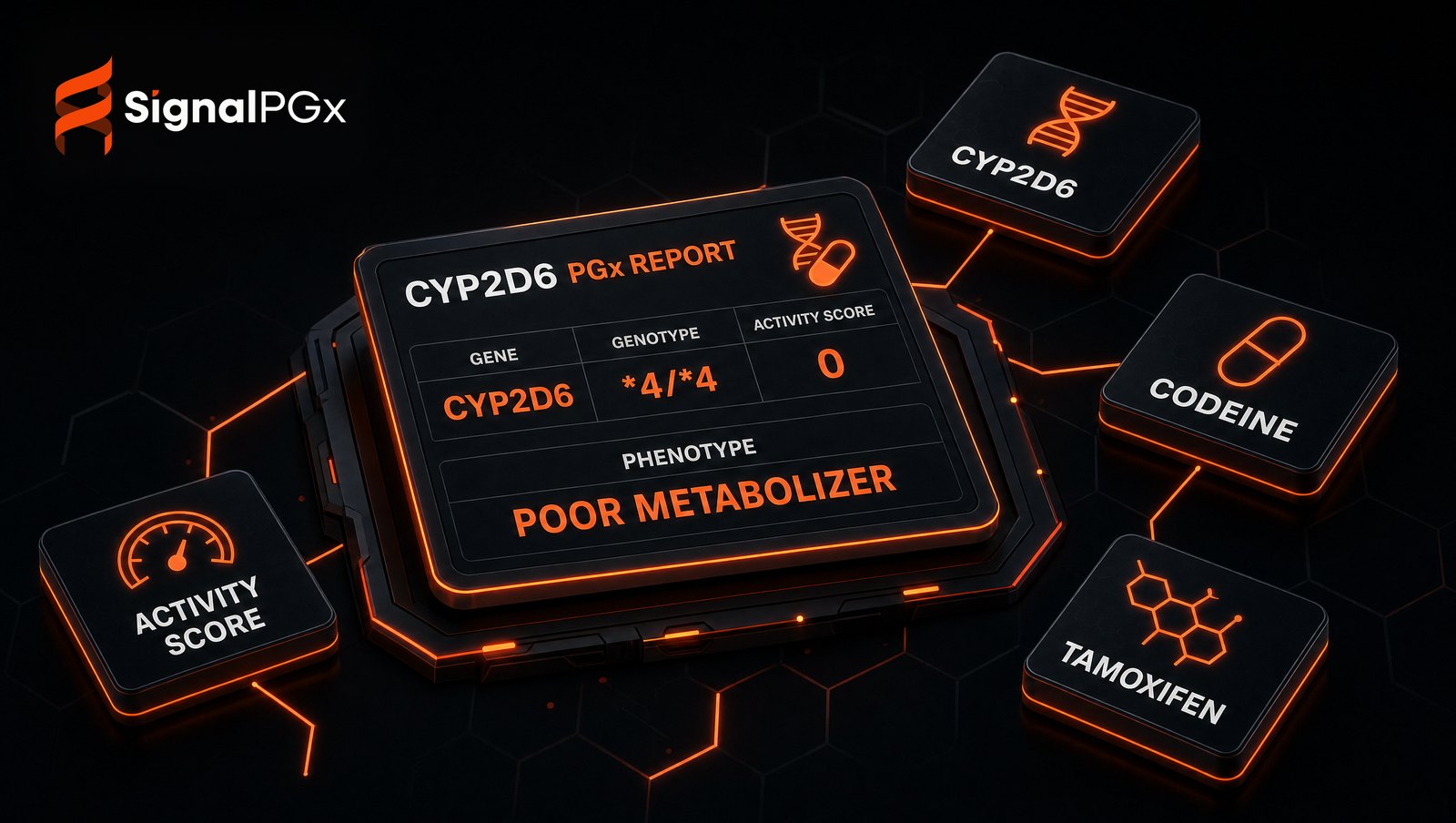
A CYP2D6 pharmacogenomic report translates an already-called diplotype, including copy-number variants, into an activity-score phenotype and drug-specific CPIC and FDA guidance for opioids, tamoxifen, antidepressants, and atomoxetine. Your lab's licensed medical director reviews and signs out every report; it is decision-support, not a diagnostic test, and not FDA-cleared.
Why is CYP2D6 the most important pharmacogene?
CYP2D6 is among the most structurally complex genes you will report. It carries well over 100 PharmVar-catalogued star alleles, including copy-number deletions and duplications and CYP2D6/CYP2D7 hybrid alleles, and the literature estimates it is involved in the metabolism of roughly one-fifth to one-quarter of commonly prescribed drugs.
That complexity is why CYP2D6 accounts for a disproportionate share of clinically actionable pharmacogenomics. It has multiple CPIC Level A (actionable) gene-drug pairs, including codeine and tamoxifen, and it appears in the pharmacogenomic sections of numerous FDA-approved drug labels. Because the live pair lists and label tables are revised periodically, point clinicians to the primary sources rather than a frozen count, such as the FDA Table of Pharmacogenomic Biomarkers.
The reporting challenge is that a single gene drives guidance across pain management, oncology, and psychiatry at once, and the phenotype logic behind all of it starts with copy number.
How does the CYP2D6 activity-score phenotype work?
CPIC and the Dutch Pharmacogenetics Working Group (DPWG) jointly standardized the CYP2D6 activity-score system. Each allele is assigned a numeric function value; the two allele values are summed into a diplotype activity score, and that score maps to a metabolizer phenotype: poor, intermediate, normal, or ultrarapid.
Copy number is what makes CYP2D6 distinct from most other pharmacogenes. A duplication of a fully functional allele raises the total score and can push a patient into the ultrarapid category, while a gene deletion lowers it. Your report has to carry the star-allele diplotype, the copy-number state, and the derived score, not just a phenotype label.
Treat the exact allele values and score cutoffs as a moving target. They are periodically revised by CPIC, PharmVar, and the consolidated ClinPGx resource, so pull them from the current allele-function table at publication time rather than hard-coding boundaries. This mapping runs downstream of variant and star-allele calling: your instrument or caller produces the diplotype, and the report layer applies the current activity-score logic on top of it. A structured medication intelligence graph is what keeps that translation consistent across every drug in the report.
CYP2D6 and codeine/tramadol: the opioid analgesic concern
Codeine is the textbook CYP2D6 case because it is a prodrug: CYP2D6 converts it to morphine. In ultrarapid metabolizers, that conversion is excessive and can be dangerous; in poor metabolizers, it barely happens and the drug is ineffective.
The safety signal is documented at the highest regulatory level. The FDA added a boxed warning and contraindication to codeine labeling (2013, expanded 2017) restricting use after tonsillectomy or adenoidectomy and in children under 12, citing life-threatening respiratory depression in CYP2D6 ultrarapid metabolizers, with a related warning covering breastfeeding mothers who are ultrarapid metabolizers.
CPIC's guideline for CYP2D6, OPRM1, and COMT and opioid therapy, which updates and expands the original codeine guideline, recommends avoiding codeine and tramadol in ultrarapid metabolizers because of toxicity risk and in poor metabolizers because of reduced efficacy, with an alternative analgesic recommended in both cases. Your report should state this CPIC codeine and CYP2D6 guidance factually as decision-support. It is not an opioid-risk predictor and not a prescribing instruction; the treating physician makes the therapeutic decision.
CYP2D6 and tamoxifen: endoxifen formation
Tamoxifen is the oncology counterpart, and it turns on the same prodrug logic. CYP2D6, together with CYP3A4/5, biotransforms tamoxifen into endoxifen, a metabolite with substantially greater antiestrogenic potency than the parent drug. Reduced CYP2D6 function is associated with lower endoxifen concentrations, which some studies link to a higher risk of recurrence.
CPIC's guideline for CYP2D6 and tamoxifen recommends considering alternative hormonal therapy, such as an aromatase inhibitor, for CYP2D6 poor metabolizers. It notes that higher-dose tamoxifen (40 mg/day) can be considered if an aromatase inhibitor is contraindicated, while acknowledging that the higher dose does not fully normalize endoxifen exposure.
For a lab, tamoxifen raises the reporting bar because the intermediate-metabolizer and phenoconversion nuances matter clinically. A report should surface the phenotype, the endoxifen mechanism, and the CPIC tamoxifen recommendation with its caveats intact, then let the oncologist weigh it against the individual clinical picture.
CYP2D6 and antidepressants and atomoxetine
Psychiatry is where CYP2D6 shows up most often, and it rarely acts alone. CPIC's 2023 guideline for serotonin reuptake inhibitor antidepressants, updating its 2015 predecessor, provides CYP2D6- and CYP2C19-informed guidance for SSRIs, SNRIs, and related agents, while noting that SLC6A4 and HTR2A data do not currently support clinical use. CPIC's tricyclic antidepressant guideline adds dosing guidance in which nortriptyline and desipramine are driven primarily by CYP2D6, and amitriptyline, clomipramine, doxepin, imipramine, and trimipramine by both CYP2D6 and CYP2C19.
Atomoxetine is a clean single-gene example: the FDA-approved Strattera label notes that CYP2D6 poor metabolizers have substantially higher exposure, on the order of 10-fold higher AUC and 5-fold higher peak concentration, than normal metabolizers at the same dose, and that dose adjustment may be needed in poor metabolizers or when a potent CYP2D6 inhibitor is co-administered. DPWG publishes a companion guideline covering CYP2D6 (and COMT) with atomoxetine and methylphenidate.
Psychiatry is also where phenoconversion bites hardest. Strong CYP2D6 inhibitors such as paroxetine, fluoxetine, bupropion, and quinidine can convert a genotypic normal or ultrarapid metabolizer into a phenotypic poor or intermediate metabolizer, so a genotype-derived phenotype can diverge from a patient's actual metabolizing capacity when interacting medications are on board. This is a documented, clinically meaningful phenomenon; report it qualitatively and flag interacting drugs rather than quoting a discordance rate, since published rates vary widely by population and regimen.
One regulatory caution belongs on the record. In November 2018 the FDA issued a safety communication warning that pharmacogenetic tests claiming to predict antidepressant response had not been FDA-reviewed and that the genotype-to-antidepressant-outcome relationship has not been established as a basis for changing therapy; that communication was general and did not single out any specific named test. Combinatorial psychiatric panels exist in this space, and if you name one as an example, keep the reference attributed and strictly factual (for instance, GeneSight Psychotropic from Myriad Genetics/Assurex Health includes CYP2D6 among the genes it assesses) without disparagement and without tying it to that FDA communication. The practical takeaway for a report is restraint: cite the CPIC and FDA-label facts, and avoid outcome-prediction claims the evidence does not support.
What a CYP2D6 pharmacogenomic report should contain
A defensible CYP2D6 pharmacogenomic report is more than a phenotype label. At minimum it should carry:
- The called star-allele diplotype, including copy-number state (deletions, duplications, and hybrid alleles).
- The derived activity score and the resulting metabolizer phenotype, with the version of the allele-function table used.
- Drug-specific guidance for the relevant agents (codeine/tramadol, tamoxifen, atomoxetine, SSRIs/SNRIs, TCAs), each traceable to its CPIC, DPWG, or FDA source.
- A phenoconversion note flagging any concurrent strong CYP2D6 inhibitors that could shift the effective phenotype.
- Explicit scope language: decision-support only, not diagnostic, with the final prescribing decision resting with the treating physician.
On the billing side, if you cite a CPT code for CYP2D6 genotyping, use 81226 (CYP2D6 common variants including copy number). Do not conflate it with 81225, which is the CYP2C19 code and a different gene entirely, though both can legitimately appear together on a combined panel. Under the MolDX program, your lab registers a molecular test in the DEX Diagnostics Exchange to receive a Z-code submitted alongside the CPT code, and MolDX applies its own coverage determinations to that Z-code. That registration, validation, and billing is your lab's own operation; coverage is payer- and Z-code-specific and never guaranteed. None of this is legal, billing, or regulatory advice.
Assembling the report downstream of calling, with director sign-out
SignalPGx sits at the interpretation layer, downstream of variant and star-allele calling. It intakes already-called CYP2D6 diplotypes from VCF, PharmCAT, Agena MassARRAY, or CSV; it does not align reads or call variants. From those diplotypes it derives the activity score and phenotype and assembles the drug-specific guidance, drawing on 15+ evidence sources including CPIC, DPWG, FDA, OpenFDA, DailyMed, PharmVar, and PharmGKB. Because the underlying tables move, an automated guideline-update workflow and living reanalysis help flag when a signed-out report's guidance has been superseded.
The output is a structured, white-label report draft, not an autonomous verdict. Your lab's licensed medical director reviews the phenotype call, the guidance, and the phenoconversion flags, then signs out under your CLIA license; the software supports that reviewer and never replaces the clinician. This is the design principle across the platform: keep interpretation consistent and traceable, keep the human in the loop, and keep the final therapeutic decision with the treating physician.
CYP2D6 rewards that discipline. It is the gene where copy number, an activity-score phenotype, phenoconversion, and CPIC Level A guidance across four therapeutic areas all converge in a single report. Getting the diplotype-to-guidance translation right, then routing it to a qualified medical director for sign-out, is what turns a complex genotype into a report a prescriber can actually use.
← Back to InsightsSee how SignalPGx fits your lab
White-label pharmacogenomics interpretation and reporting for CLIA laboratories — your medical director signs out, your brand ships.
Book a demo