
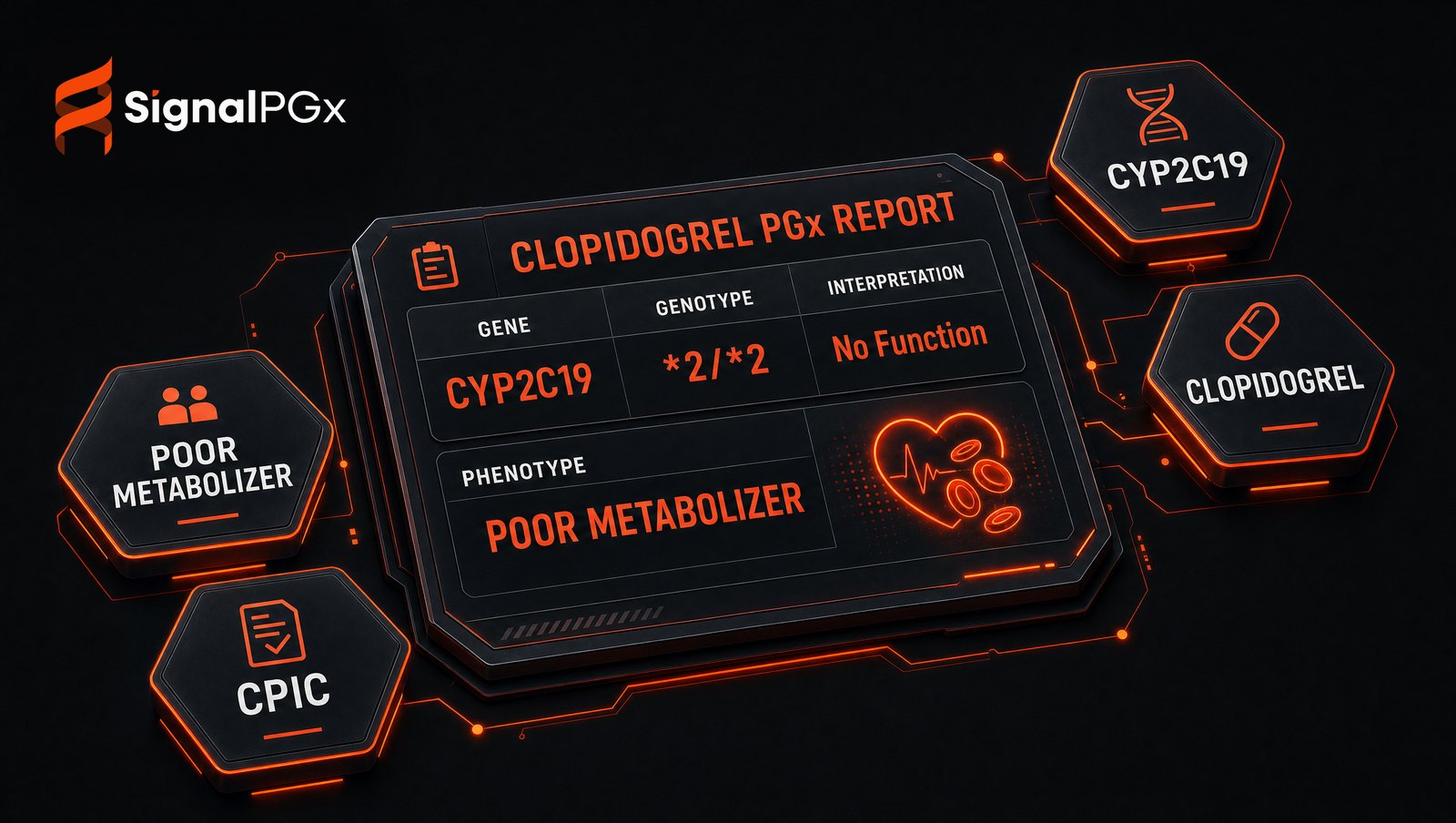
A CYP2C19 clopidogrel pharmacogenomic report translates an already-called CYP2C19 diplotype into a metabolizer phenotype and the matching CPIC-guided antiplatelet considerations. In your CLIA lab, reporting software assembles that structured output — star alleles, phenotype, guideline context, and alternatives per CPIC — for your own licensed medical director to review and sign out. This is not medical advice.
Why does CYP2C19 matter for clopidogrel?
Clopidogrel is a prodrug. It is inactive as swallowed and depends on hepatic CYP2C19 to convert it into its active thiol metabolite — the form that irreversibly inhibits the platelet P2Y12 receptor. When a patient carries loss-of-function CYP2C19 alleles, that bioactivation step is impaired, less active metabolite is formed, and antiplatelet effect is reduced. This is the mechanistic basis for the "CYP2C19 loss-of-function clopidogrel" concern that drives testing.
It is not a theoretical worry. Clopidogrel's FDA label carries a Boxed Warning — first added in 2010 and still present in labels reviewed through the 2022 supplement — noting that the drug is less effective in patients who are CYP2C19 poor metabolizers, and that genetic tests are available to identify them. A common drug, a well-characterized enzyme, and a label that points explicitly to genotype are why CYP2C19 is one of the most-requested targets in any antiplatelet PGx testing report.
What does CPIC recommend for CYP2C19 and clopidogrel?
The Clinical Pharmacogenetics Implementation Consortium maintains a dedicated guideline for CYP2C19 and clopidogrel, most recently updated in 2022. (CPIC and PharmGKB now operate under the unified ClinPGx resource, so those links resolve to clinpgx.org equivalents.)
Per that 2022 update: for CYP2C19 poor metabolizers being treated for ACS/PCI, peripheral artery disease, or stable CAD after MI, CPIC recommends an alternative antiplatelet — for example prasugrel or ticagrelor — where not contraindicated, because those agents do not depend on CYP2C19 for activation. For intermediate metabolizers, CPIC raised the strength of its recommendation to strong for avoiding standard-dose clopidogrel in the ACS/PCI setting.
Because the recommendation turns on indication as well as phenotype, a report should tie each statement to that context. Your report presents all of this as published CPIC guidance and considerations — it is not prescribing or dosing advice, and the therapeutic decision rests with the treating physician.
From CYP2C19 diplotype to metabolizer phenotype
CPIC classifies CYP2C19 into five phenotype categories: poor (PM), intermediate (IM), normal (NM), rapid (RM), and ultrarapid (UM). The category follows from the diplotype. The **\*17 allele is an increased-function allele associated with the rapid and ultrarapid ends, while \*2, \*3, \*4, and \*8** are the no-function or decreased-function alleles that produce the PM and IM phenotypes most relevant to clopidogrel. These are the same common variants covered under CPT 81225, the CYP2C19 gene-analysis code — which is why a clean CYP2C19 star-allele report is the substrate for everything downstream.
Poor-metabolizer prevalence varies by ancestry, from roughly the low single digits in European-ancestry populations up into the low-to-mid 20% range in some East Asian subpopulations, per published pharmacogenomic literature; exact figures differ by study and subpopulation. The phenotype translation itself is downstream of variant calling: the software intakes an already-called diplotype — from a VCF or PharmCAT output, Agena MassARRAY, or CSV — and applies the CPIC translation and evidence layer rather than aligning reads or calling star alleles.
What should a CYP2C19 clopidogrel pharmacogenomic report contain?
A clinician-ready CYP2C19 clopidogrel pharmacogenomic report is more than a phenotype label. At minimum it should carry:
- The observed CYP2C19 diplotype and the star alleles detected, ideally alongside the variants the assay interrogated
- The assigned metabolizer phenotype (PM / IM / NM / RM / UM)
- The relevant CPIC recommendation, tied to the indication context (ACS/PCI vs PAD vs stable CAD post-MI)
- Guideline alternatives such as prasugrel or ticagrelor, presented as considerations for the treating physician
- The evidence sources and their versions behind each statement, so the interpretation is auditable
- Provenance and sign-out metadata identifying the reviewing medical director
The framing matters as much as the fields. Everything is stated as CPIC- and FDA-derived information the physician can weigh, never as a directive from the lab or the software. Standardizing that structure is the core of consistent clopidogrel pharmacogenomics reporting across every order your lab handles.
How is the report assembled downstream of variant calling?
The reporting layer begins where variant and star-allele calling ends. It ingests an already-called CYP2C19 result, maps the diplotype to a CPIC phenotype using standardized translation tables, and pulls the indication logic, guideline context, and alternatives from a maintained evidence layer that draws on CPIC, DPWG, FDA labeling, DailyMed, PharmGKB, and other curated sources. The output is a structured, consistent report rather than a hand-assembled document.
Because guideline evidence moves, the assembly step is versioned: each statement records which guideline release and allele-function definitions it was built from, so an interpretation can be traced and re-checked later. This is the mechanics covered in our genotype-to-guidance pipeline overview, and it is what lets a lab scale antiplatelet reporting across a whole reporting platform without re-deriving each interpretation by hand.
Where does the medical director sign out?
Nothing reaches a clinician until your lab's own licensed medical director reviews and signs it. Under CLIA, high-complexity laboratory directors must meet the qualifications set in 42 CFR 493.1443 — and that director, not the software, owns the interpretation that leaves your lab. SignalPGx is decision-support and reporting software: it drafts the structured, cited interpretation and presents it for review, but it does not interpret or sign out as a service, and it does not replace the reviewer.
That human-in-the-loop boundary is deliberate. The reviewer sees the diplotype, the phenotype logic, the CPIC citations, and the evidence versions in one place, and the guardrailed assistant that supports review is built to cite its sources or decline rather than volunteer unsupported claims. Every report carries the reviewer's sign-out and a full audit trail, which is what makes defensible white-label output something your lab can stand behind under its own CLIA license.
How does this fit cardiology and stroke workflows?
Antiplatelet PGx lands in two main clinical settings: interventional cardiology, where CYP2C19 status informs P2Y12 selection around ACS and PCI, and neurology, where it factors into secondary stroke prevention. In both, the report is most useful when it reaches the ordering clinician inside their existing system rather than as a loose PDF. That is a delivery problem solved with open standards — HL7/FHIR resources, SMART on FHIR, and CDS Hooks — not proprietary partnerships, and it is the focus of our integrations approach.
A note on coding and coverage: CYP2C19 testing for drug metabolism is billed under CPT 81225, which covers common variants such as \*2, \*3, \*4, \*8, and \*17. Programs such as MolDX may require your lab to register the test and obtain a Z-code under your own CLIA certification. SignalPGx does not register tests, obtain Z-codes, perform analytical validation, or guarantee reimbursement — it produces the structured output your lab uses in its own billing and reporting workflow. None of this is legal, billing, or regulatory advice, and codes and coverage should be reverified at time of use.
The report is a translation layer your lab owns
A CYP2C19 clopidogrel pharmacogenomic report does one thing well: it turns a called genotype into an honest, cited, phenotype-to-guidance translation that a clinician can act on and a medical director can defend. It does not call variants, it does not prescribe, and it does not replace the treating physician's judgment or your director's sign-out.
Built that way — downstream of variant calling, anchored to current CPIC and FDA guidance, versioned against a maintained evidence layer, and gated by human review — antiplatelet reporting becomes a repeatable, auditable line your CLIA lab can stand behind. The clinical decision stays with the physician; the consistent, defensible report is what your lab contributes.
← Back to InsightsSee how SignalPGx fits your lab
White-label pharmacogenomics interpretation and reporting for CLIA laboratories — your medical director signs out, your brand ships.
Book a demo