
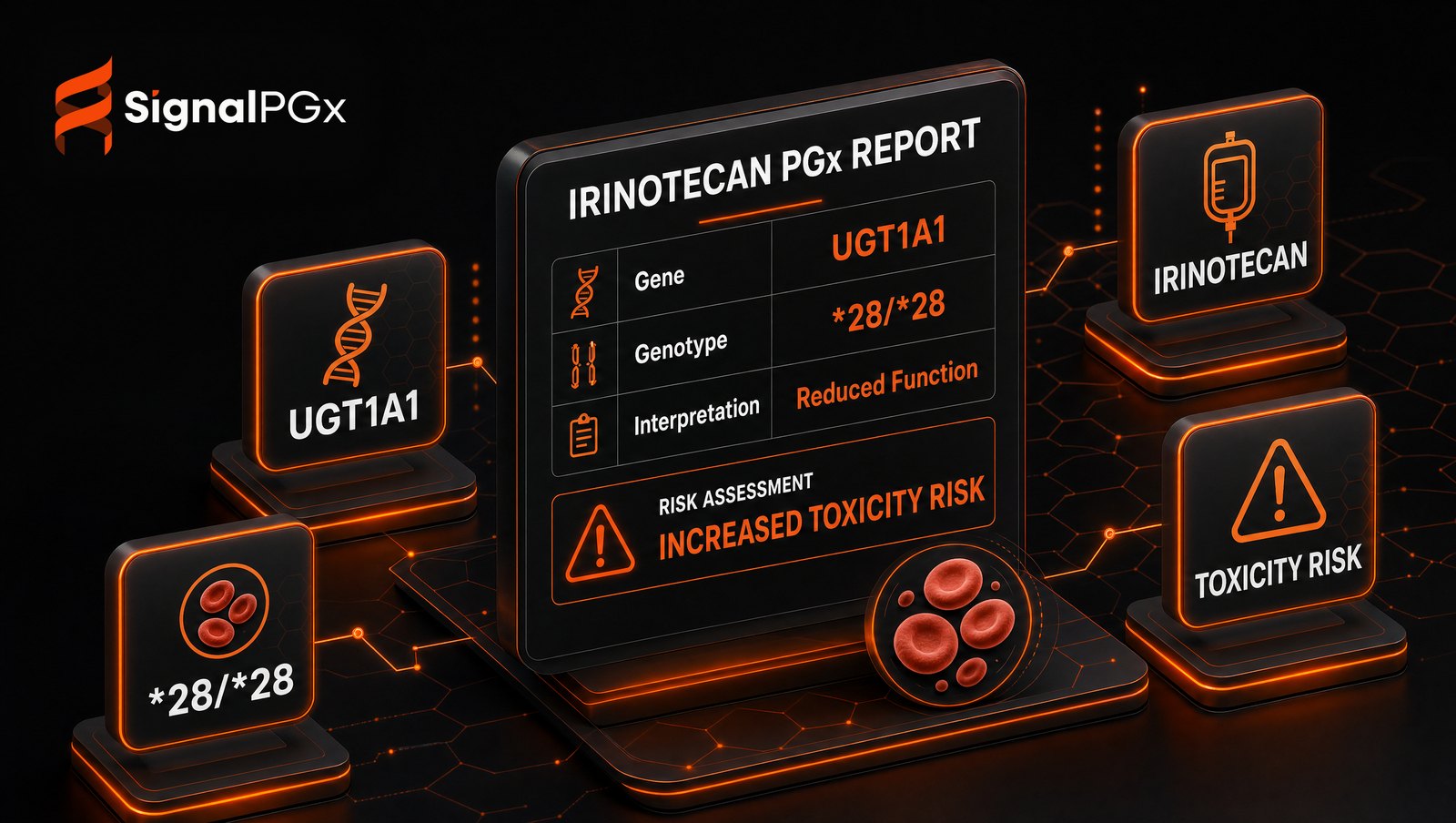
A UGT1A1 irinotecan pharmacogenomic report translates an already-called UGT1A1 genotype — such as *28 or *6 — into a metabolizer phenotype and the FDA-label and DPWG toxicity context your director needs at sign-out. Reduced-function alleles slow SN-38 clearance, raising the risk of severe neutropenia and diarrhea. The report supports review; it is not diagnostic and not FDA-cleared.
Why does UGT1A1 matter for irinotecan?
Irinotecan is a prodrug. Carboxylesterases convert it to SN-38, its active topoisomerase-I-inhibiting metabolite, and SN-38 is then inactivated primarily through glucuronidation by the enzyme UGT1A1. When a patient carries reduced-function UGT1A1 alleles, that clearance pathway slows, systemic SN-38 exposure rises, and the risk of dose-limiting toxicity — severe neutropenia and delayed-onset diarrhea — climbs with it. This mechanism is well established in the pharmacogenomics literature and curated in resources such as PharmGKB.
The most-studied variant, UGT1A1*28, is a TA-repeat expansion in the promoter (TA7 instead of the reference TA6) that lowers enzyme expression. Roughly 10% of the general population is homozygous for *28, with meaningful variation by ancestry; reported homozygosity ranges from about 5% to over 30% across studied populations. Because irinotecan anchors widely used colorectal regimens, this is a high-frequency, high-consequence gene-drug pair your oncology clients encounter routinely — exactly the kind of relationship a structured medication intelligence graph exists to encode and keep current.
What do the FDA label and dosing guidelines say about UGT1A1?
Per the FDA-approved prescribing information for irinotecan (Camptosar), most recently revised April 2024, UGT1A1 genotype and neutropenia risk are addressed in Dosage and Administration, Warnings and Precautions, and Clinical Pharmacology — not in the Boxed Warning, which covers diarrhea and myelosuppression generally. The label states that patients homozygous for *28 or *6 (or compound heterozygous for both) are at increased risk of severe neutropenia, and that a starting-dose reduction of at least one level should be considered for known homozygotes, with the precise reduction left to clinical judgment and subsequent tolerance. Label-referenced single-agent data (350 mg/m² every three weeks) show grade 4 neutropenia in 50% of *28 homozygotes versus 12.5% of heterozygotes.
On formal dosing guidance, be precise about the source. CPIC has not published a clinical dosing guideline for the irinotecan-UGT1A1 pair; the body with a published guideline is the Dutch Pharmacogenetics Working Group (DPWG), which recommends a reduced starting dose (about 70% of standard) for poor metabolizers and neutrophil-guided titration thereafter, with no routine starting-dose change for intermediate metabolizers. NCCN has historically noted that firmly established clinical-use guidelines for UGT1A1 testing are not fully standardized, while advising caution in patients with Gilbert syndrome or elevated bilirubin. For the broader catalog of gene-drug dosing guidance, CPIC remains a primary curator — just not the source for this specific pair. Your report should present each of these positions factually and attributed; none of it is medical or dosing advice, and prescribing decisions remain the treating physician's.
From UGT1A1 genotype to metabolizer phenotype
Reporting starts from an already-called genotype and assigns a metabolizer phenotype. In the standard scheme, two normal-function alleles give a normal metabolizer, one reduced-function allele an intermediate metabolizer, and two reduced-function alleles (for example *28/*28, *6/*6, or the compound *6/*28) a poor metabolizer — the group the FDA label and DPWG flag for elevated toxicity risk.
Ancestry matters for which alleles you interrogate. *28 is informative across populations, while UGT1A1*6 is substantially more common in East Asian populations than in European-ancestry ones, which is why current FDA labeling addresses *6 alongside *28. It is also worth flagging for reviewers that *28 homozygosity (TA7/TA7) is the same genotype that underlies Gilbert syndrome, a common benign cause of mild unconjugated hyperbilirubinemia — useful clinical context, not a separate finding. The phenotype call, its allele definitions, and the assay's reportable range all sit downstream of variant and star-allele calling on your validated assay; see converting a VCF into a clinical PGx report for how that hand-off is handled cleanly.
What a UGT1A1 irinotecan pharmacogenomic report should contain
A defensible report gives your director everything needed to review and sign out without re-deriving guidance from primary literature. At minimum it should carry:
- The called diplotype (for example *1/*28) and the assigned metabolizer phenotype, stated plainly.
- The toxicity mechanism and risk framing — reduced SN-38 glucuronidation, elevated severe-neutropenia risk — in phenotype-appropriate language.
- The relevant guidance, correctly attributed: the applicable FDA label sections and DPWG, each cited to source, with NCCN's more cautious stance noted where useful.
- Explicit caveats: the assay's reportable alleles and limits, ancestry considerations for *6, and a note that final decisions rest with the treating physician.
The organizing principle is traceability. Every statement in a white-label PGx report should link back to a named evidence source so the reviewer can confirm rather than trust. Structured, consistent PGx reporting is what lets a director sign out UGT1A1 cases at volume without rebuilding the same interpretation by hand each time.
How the report is assembled downstream of calling
SignalPGx is interpretation and reporting software: it consumes already-called genotypes — from VCF, PharmCAT, Agena MassARRAY, or CSV — and never calls variants or aligns reads itself. Genotyping happens upstream in your lab, on your validated assay and under your quality management; the software takes the called UGT1A1 result and assembles the phenotype, risk context, and cited guidance into a structured draft. It does not perform your assay validation, coding, or accreditation — it produces output your lab uses within its own workflow.
That draft is built against a curated evidence layer spanning 15+ sources — including FDA, DailyMed, CPIC, DPWG, and PharmGKB — so the UGT1A1 narrative is generated from maintained references rather than re-typed each run. Because label and guideline content changes over time, keeping citations current is its own discipline; automating guideline updates to prevent version drift is what keeps a previously signed-out UGT1A1 report from quietly going stale. The reporting engine runs under your CLIA license and fits your existing process rather than replacing any part of it.
Director sign-out and oncology context
Every UGT1A1 report is reviewed and signed out by your lab's own licensed medical director — the software drafts, the director decides, and the treating oncologist makes the prescribing call. Where SignalAI assists, it operates as a guardrailed, cite-or-refuse aid to the reviewer, never an autonomous interpreter. This human-in-the-loop model is precisely what keeps the report decision support rather than a diagnostic claim; SignalPGx is not a diagnostic test and is not FDA-cleared.
On operational context: CPT 81350 is the code used for UGT1A1 common-variant gene analysis, but code assignment and coverage are your compliance team's determination, not the software's. Reimbursement for UGT1A1 genotyping varies by payer and Medicare contractor and is never guaranteed — some Medicare Administrative Contractors have historically treated UGT1A1 gene analysis as excluded from coverage on limited clinical-utility grounds — so verify current LCD/MolDX status and payer policy before billing. None of this is legal, billing, or regulatory advice.
Reported accurately and signed out under your director's authority, a UGT1A1 irinotecan pharmacogenomic report turns a high-frequency toxicity gene into routine, defensible, source-linked output your oncology clients can act on — with the mechanism made explicit, the FDA and DPWG guidance attributed correctly, and every clinical decision left where it belongs, with the physician at the bedside.
← Back to InsightsSee how SignalPGx fits your lab
White-label pharmacogenomics interpretation and reporting for CLIA laboratories — your medical director signs out, your brand ships.
Book a demo