
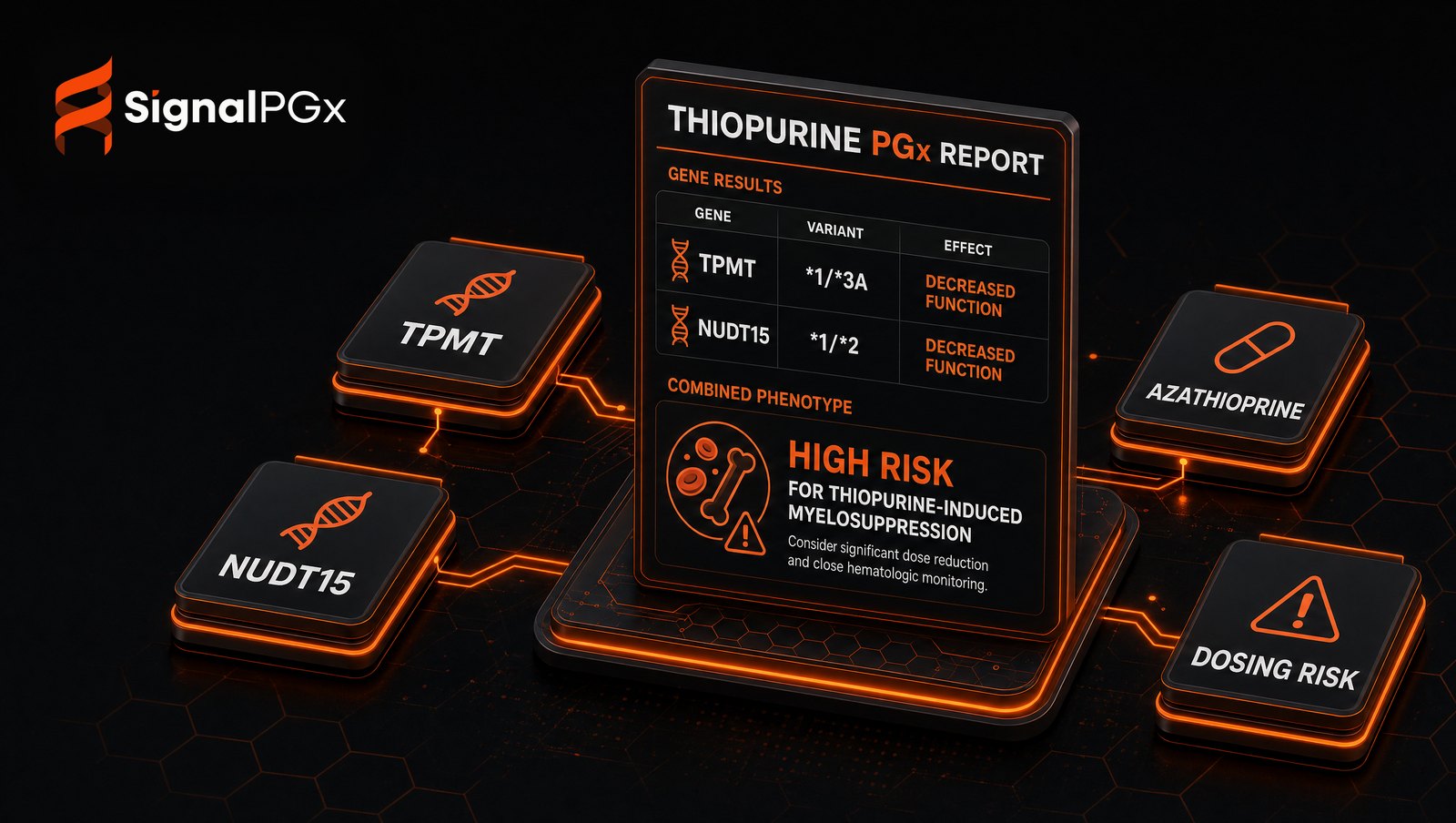
TPMT and NUDT15 are the two pharmacogenes that govern thiopurine tolerance. Loss-of-function alleles reduce enzyme activity and predict severe myelosuppression on azathioprine, mercaptopurine, and thioguanine at standard doses. A TPMT NUDT15 thiopurine pharmacogenomic report combines both called genotypes into a single phenotype and dosing-risk summary that your lab's own director reviews and signs out.
Why do TPMT and NUDT15 matter for thiopurines?
Thiopurines — azathioprine, mercaptopurine, and thioguanine — are workhorse immunosuppressants and antileukemic agents, but their therapeutic window is narrow. Both TPMT and NUDT15 sit on the pathway that limits accumulation of active thioguanine nucleotides. CPIC states that decreased- or no-function alleles in either gene are predictive of pronounced adverse effects, including severe myelosuppression, at standard doses.
The two genes matter for different patients. Published pharmacogenomic references (NIH/NCBI Medical Genetics Summaries) report that roughly 0.3% of people of European or African ancestry are TPMT poor metabolizers and about 10% are intermediate metabolizers. NUDT15 loss-of-function variants, by contrast, are markedly more common in East Asian, South Asian, and Latino populations. Testing only TPMT would systematically under-detect risk in those groups — which is why a defensible report models both genes together, the way a medication intelligence graph links a genotype to every affected drug rather than to one gene in isolation.
What do CPIC and FDA say about TPMT/NUDT15 and thiopurines?
CPIC's guideline for thiopurines and TPMT/NUDT15 was most recently updated in 2025 (with a subsequent correction) and provides genotype-guided starting-dose recommendations for azathioprine, mercaptopurine, and thioguanine based on the combined TPMT/NUDT15 phenotype. The 2025 update specifically refined guidance for patients who are intermediate metabolizers on both genes. PharmGKB/ClinPGx lists TPMT and NUDT15 with thiopurines as Level 1A clinical annotations — its highest evidence tier, reserved for variant-drug pairs backed by a CPIC or medical-society-endorsed guideline already in clinical use.
FDA labeling reinforces the signal from a different angle. FDA-approved azathioprine labeling advises clinicians to consider TPMT and NUDT15 genotyping or phenotyping in patients with severe myelosuppression, recommends dosage reduction for known heterozygous TPMT or NUDT15 deficiency, and states that alternative therapy should be considered for known homozygous deficiency in either gene, with more substantial reductions considered for patients heterozygous in both. Mercaptopurine labeling states that patients with inherited little or no TPMT activity are at increased risk for severe toxicity and generally require dose reduction; thioguanine labeling warns that inherited TPMT deficiency can require substantial dosage reduction to avoid severe bone-marrow suppression.
One nuance worth encoding in how the report frames guidance: FDA's thiopurine labeling uses "consider" language tied to observed severe myelosuppression, not a blanket pre-treatment testing mandate, whereas CPIC is oriented toward pre-emptive, genotype-guided starting-dose selection. These are related but distinct sources and should not be conflated into a single "FDA requires testing" claim. For contrast, FDA's October 2025 capecitabine update instructs DPYD testing before treatment with a boxed warning — a materially stronger posture that thiopurine labeling has not reached. Report CPIC and FDA guidance factually; the dosing decision itself remains the treating physician's.
Combining TPMT and NUDT15 into one phenotype
Each gene is called independently — star alleles resolve to an activity value, which maps to a metabolizer phenotype (normal, intermediate, or poor). The thiopurine recommendation then hinges on the combination: for most patients the more severe of the two phenotypes drives risk, and CPIC's 2025 update added specific handling for the combined intermediate/intermediate case, where risk is additive across both genes.
This is where a single-gene result falls short and a combined interpretation earns its place. SignalPGx intakes both already-called genotypes and assembles the merged phenotype and its CPIC-aligned narrative, rather than leaving a reviewer to reconcile two separate result lines by hand. The mechanics of moving from a called file to structured clinical content are covered in converting a VCF to a clinical PGx report, so this article won't re-explain star-allele scoring — the point here is that the two genes must resolve into one answer before anyone signs.
What should a TPMT NUDT15 thiopurine pharmacogenomic report contain?
A thiopurine PGx report that a director can defend should carry, at minimum:
- Both called genotypes, with the detected star alleles or diplotype for TPMT and NUDT15
- The assigned phenotype for each gene, plus the combined interpretation that drives the risk statement
- A factual summary of CPIC guidance with a resolvable citation
- A reference to the relevant FDA labeling for the specific thiopurine ordered
- Ancestry and coverage caveats — which alleles were interrogated, and any no-call gaps that limit interpretation
- Methodology, limitations, and the director's attestation
White-label reports let this content carry your lab's letterhead while keeping the underlying evidence structure consistent from case to case. One framing point belongs on the page itself: the report presents guidance and risk, not a prescription. Final prescribing decisions rest with the treating physician, and nothing in the report — or in this article — is legal, billing, or regulatory advice.
How the report is assembled downstream of calling
The platform is downstream of variant and star-allele calling. It intakes already-called genotypes — VCF, PharmCAT, Agena MassARRAY, or CSV — and produces structured report content; it does not align reads, call variants, perform your CLIA validation, register Z-Codes, or bill on your behalf. Those remain your lab's responsibilities under your own license.
On the billing side, the codes are easy to get wrong. TPMT genotyping commonly maps to CPT 81335; NUDT15 maps to CPT 81306 — which sits outside the 81225–81355 range and should not be confused with 81355, the VKORC1 code. Where a lab bills the two together without a dedicated combined code, CPT 81479 (unlisted molecular pathology procedure) may apply, with the specific genes documented on the claim. MolDX (administered by Palmetto GBA) issues DEX Z-Code identifiers that, combined with the applicable CPT code, let payers identify exactly which test was run. Z-Code assignment and coverage are determined by the payer or MAC, never guaranteed, and none of this is billing or regulatory advice.
Medical-director sign-out and clinical context
Every report is human-in-the-loop: your lab's own licensed medical director reviews and signs it out. CLIA belongs to your lab, not to the software — high-complexity director qualifications are set out in 42 CFR 493.1443 (with continuing-education and grandfathering provisions updated by a CLIA Final Rule change effective December 28, 2024), and CAP-accredited labs validate analytical performance characteristics before clinical use, with the director approving the written procedure. SignalPGx fits inside that workflow; it does not replace the director or the qualifications behind the signature, and this is not legal or regulatory advice.
SignalAI — the guardrailed, cite-or-refuse assistant — supports the reviewer by surfacing sourced evidence, never acting autonomously. The platform is HIPAA- and GDPR-aligned with encryption in transit and at rest, RBAC, tenant isolation, and audit trails, all aligned to your CLIA workflows. For the fuller argument on what makes a report hold up under scrutiny, see clinically defensible PGx reports. This is decision-support content, not a diagnostic test, and it is not FDA-cleared.
Turning two genotypes into one defensible answer
TPMT and NUDT15 are a textbook case for combined pharmacogenomic reporting: two genes, two different at-risk populations, one shared drug class, and a Level 1A evidence base with active CPIC and FDA guidance behind it. The clinical value comes not from calling either gene in isolation but from resolving both into a single phenotype and a clear, cited statement of thiopurine risk that a reviewer can trust at a glance.
Done well, that report shortens the director's review rather than adding to it — the genotypes are merged, the guidance is assembled and sourced, and the caveats are explicit, leaving the reviewer to apply judgment and sign. That is the line a CLIA lab should hold: automate the assembly and citation of TPMT and NUDT15 guidance, and keep interpretation, sign-out, and the final prescribing decision exactly where they belong.
← Back to InsightsSee how SignalPGx fits your lab
White-label pharmacogenomics interpretation and reporting for CLIA laboratories — your medical director signs out, your brand ships.
Book a demo