
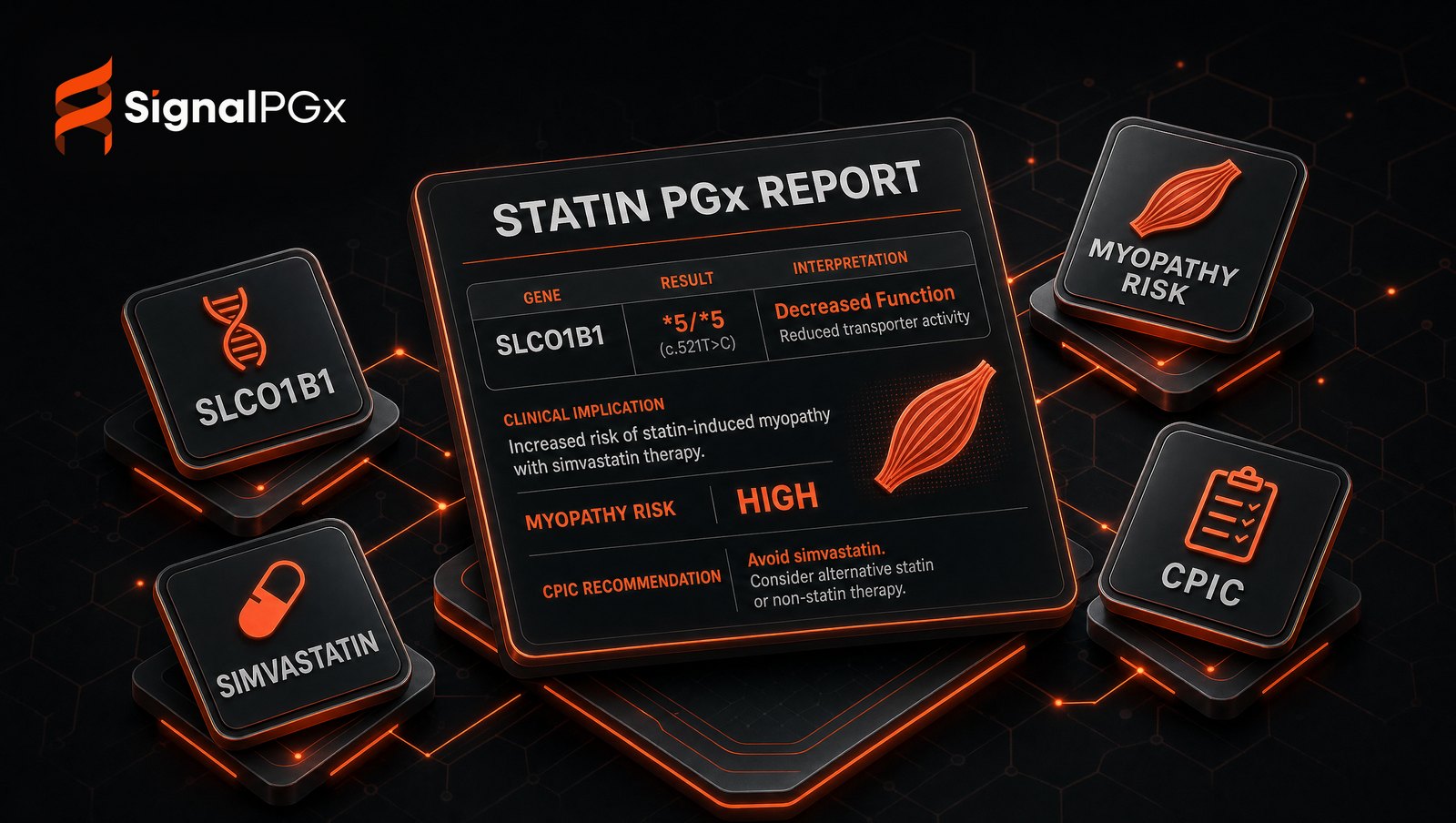
An SLCO1B1 statin pharmacogenomic report translates a patient's SLCO1B1 diplotype — anchored on the rs4149056 (*5) variant — into an OATP1B1 transporter-function phenotype and CPIC-sourced statin myopathy context. Your lab's medical director reviews and signs out every report; the treating physician makes the prescribing decision.
Why does SLCO1B1 matter for statins?
SLCO1B1 encodes OATP1B1, the hepatic uptake transporter responsible for clearing statins from the bloodstream into the liver. The variant rs4149056 (c.521T>C, p.Val174Ala) — commonly designated the *5 allele — reduces OATP1B1 transporter function. When hepatic uptake is impaired, systemic exposure to certain statins rises, and with it the risk of statin-associated musculoskeletal symptoms (SAMS). The effect is most pronounced for simvastatin, the statin around which the pharmacogenomic evidence was first established.
Not every statin depends on OATP1B1 to the same degree, which is why the current guideline addresses several statins rather than treating them as interchangeable. For a CLIA lab, SLCO1B1 is one of the cleaner stories in pharmacogenomics: a single, well-characterized variant with a clear mechanistic rationale and a large, replicated clinical evidence base. That makes it a natural inclusion in cardiovascular and preemptive PGx panels — and a genotype your director will be asked to contextualize against a patient's actual therapy. The reporting question is how to present that context defensibly, every time.
What does CPIC recommend for SLCO1B1 and statins?
The operative guidance is CPIC's statin guideline — Cooper-DeHoff et al., published in Clinical Pharmacology & Therapeutics in May 2022 (PMID 35152405). It covers SLCO1B1, ABCG2, and CYP2C9 genotypes in relation to SAMS across multiple statins, and it supersedes the original 2012/2014 guideline that addressed only SLCO1B1 and simvastatin. A report that cites the 2022 update — not the retired simvastatin-only paper — keeps your lab aligned with the standard a director is expected to defend.
CPIC characterizes the evidence linking SLCO1B1 decreased and poor function to simvastatin-associated myopathy as high-quality and strong, reproduced across randomized-trial and cohort data — among the most robust gene-drug safety associations in pharmacogenomics. The pairing is also heavily annotated in resources such as PharmGKB/ClinPGx. Notably, the genotype-guided recommendations originate with CPIC (and separately the Dutch Pharmacogenetics Working Group), not with FDA labeling.
Does the FDA require SLCO1B1 testing?
No. The FDA-approved simvastatin label does not specifically address SLCO1B1 genotype, and the FDA does not require or recommend pre-treatment SLCO1B1 testing. The actionable, genotype-guided recommendations come from CPIC and DPWG — not from FDA labeling. This is a distinction worth making explicit in a report: the genomic context you provide is guideline-derived decision support, and it neither claims nor implies FDA endorsement.
There is one FDA action in this space that is easy to conflate and worth separating out. In 2011, the FDA issued a safety communication restricting new patient starts on the 80 mg simvastatin dose because of elevated myopathy risk. That is a dose-based warning applicable to all patients — it is not genotype-specific and should not be presented as an SLCO1B1 testing recommendation. Keeping the two straight — the FDA's dose-based caution versus CPIC's genotype-based guidance — is exactly the kind of precision a signing director expects the report to get right.
From SLCO1B1 genotype to transporter function
Your instrument or bioinformatics pipeline calls the genotype; the report translates it into a phenotype. CPIC assigns SLCO1B1 diplotypes to one of three transporter-activity phenotypes:
- Normal Function — expected OATP1B1 activity.
- Decreased Function — reduced activity, typically one reduced-function allele such as *5.
- Poor Function — substantially reduced activity, typically two reduced-function alleles.
The rs4149056 C allele is the anchor variant, but robust diplotype-to-phenotype assignment depends on the full set of star alleles your assay interrogates and the reference definitions you map against. Getting that mapping right — and keeping it aligned to the current CPIC allele-function tables — is exactly the layer where errors creep in when labs hand-build spreadsheets.
SignalPGx performs this translation as software: it ingests already-called genotypes and produces a structured phenotype and evidence summary your director reviews. It does not call variants or star alleles — that happens upstream in your validated assay, under your CLIA license.
What should an SLCO1B1 statin pharmacogenomic report contain?
A defensible SLCO1B1 statin pharmacogenomic report gives the signing director everything needed to contextualize the result without leaving the document:
- The genotype and diplotype, with the specific variant(s) detected (rs4149056 / *5) and the assay's interrogated positions.
- The CPIC transporter-function phenotype — Normal, Decreased, or Poor Function.
- The affected statins and the OATP1B1 mechanism, framed as risk context for SAMS rather than a directive.
- The guideline source and version — the 2022 CPIC statin guideline — with a traceable citation.
- Clear scope language: decision support only, not a diagnostic result, with prescribing decisions left to the treating physician.
The report should present statin exposure and myopathy risk qualitatively — SLCO1B1 decreased and poor function are associated with markedly increased simvastatin exposure and a substantially elevated, dose- and genotype-dependent risk of muscle symptoms — and cite CPIC rather than a specific effect size. Structured, guideline-cited reporting is what keeps the output auditable when a result is later questioned.
How the report is assembled downstream of calling
SignalPGx sits downstream of variant and star-allele calling. Your lab runs its validated workflow — NGS, PharmCAT output, Agena MassARRAY, or a genotype CSV — and the already-called result is what the software ingests. It does not align reads or call variants; that boundary keeps your analytical validation squarely inside your CLIA license.
From the called genotype, the platform maps the diplotype to the CPIC phenotype, pulls the matching statin guidance from a maintained evidence layer spanning 15+ sources including CPIC, DPWG, FDA, and DailyMed, and assembles a draft report. The medication intelligence graph is where genotype, phenotype, drug, and guideline are connected, so a statin result surfaces alongside the patient's other pharmacogenes rather than in isolation.
For the mechanics of turning a raw file into a signable draft, see converting a VCF into a clinical PGx report and the genotype-to-guidance pipeline — this article links to those rather than repeating them.
Director sign-out and cardiology context
Every SignalPGx report is a draft until your lab's licensed medical director reviews and signs it out — the human-in-the-loop is the point, not a formality. The software's job is to reduce that review burden by pre-assembling the phenotype call, the guideline citation, and the affected-drug context, so the director is checking and approving rather than building from scratch. SignalAI, a guardrailed cite-or-refuse assistant, supports reviewers but never signs out autonomously.
Directors evaluating a statin result will weigh it against clinical frameworks they already use — for example, the National Lipid Association's clinical perspectives on assessing statin-associated muscle symptoms. The report supplies genomic context to that judgment; it does not implement, score, or replace any muscle-symptom index. Delivered under your brand through white-label reports, the signed document reflects your lab's authority and your director's name — not a third party's.
Where SLCO1B1 reporting fits your lab
SLCO1B1 is a low-risk, high-yield addition to a PGx menu: one well-replicated variant, a current CPIC guideline, and a clear transporter-function phenotype your director can defend. The reporting challenge is not the biology — it is keeping diplotype mapping, phenotype assignment, and guideline citations correct and current across every report you sign, and doing it without adding headcount each time CPIC issues an update.
On the operational side, SLCO1B1 common-variant analysis is described by CPT 81328 (a Tier 1 molecular pathology code), and labs in MolDX jurisdictions register applicable molecular tests for a DEX Z-Code used in claims processing and coverage review. Codes and coverage are payer- and contractor-specific, change over time, and are never guaranteed — confirm current status and billing rules with your own coding and compliance team. This is not legal, billing, or medical advice.
Handled as software downstream of your validated calling — under your CLIA license, with your director signing out and your brand on the page — SLCO1B1 statin reporting becomes a repeatable line on your menu rather than a spreadsheet your team rebuilds every time the guidance moves.
← Back to InsightsSee how SignalPGx fits your lab
White-label pharmacogenomics interpretation and reporting for CLIA laboratories — your medical director signs out, your brand ships.
Book a demo