
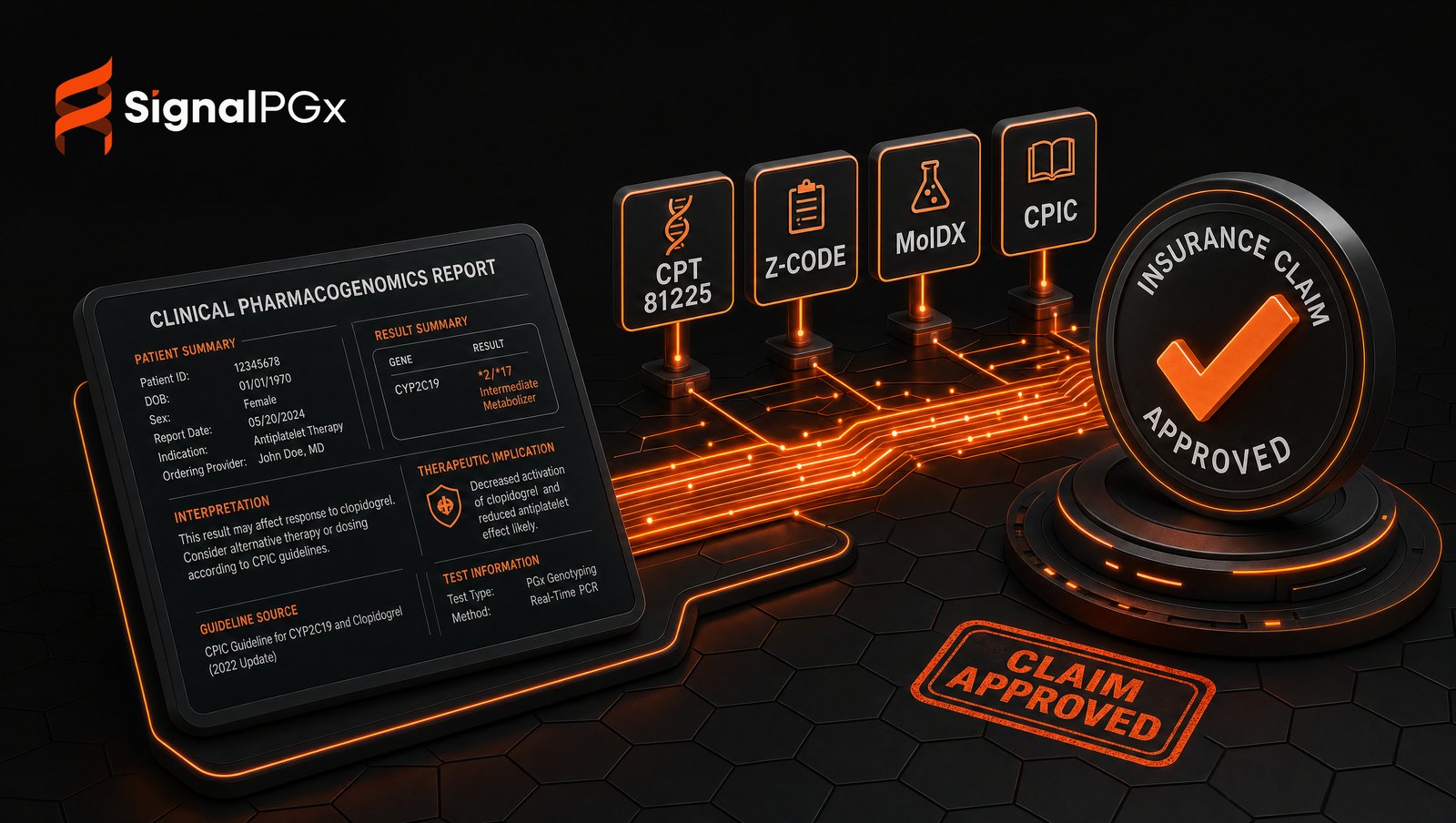
Pharmacogenomics CPT codes, billing, and insurance approval hinge on documentation. Payers are likelier to approve a PGx claim when a report ties each result to a covered CPT code (81225 CYP2C19, 81226 CYP2D6, 81227 CYP2C9, 81355 VKORC1, 81418 panels), a MolDX Z-code, CPIC Level A/B evidence, and documented medical necessity. Report structure supplies that evidence; your lab's sign-out and claim submission stay separate.
Most pharmacogenomics business cases fail at the same seam. A lab validates the assay, stands up a genotyping pipeline, starts reporting — and then discovers the line item doesn't collect. The science is sound and the clinical utility is real, but the claim comes back denied, downcoded, or stuck in a records request. Coverage, it turns out, is as much a documentation problem as a science problem, and the two meet on one page: the report.
This article is written for lab directors, owners, and molecular pathologists deciding whether a PGx line will actually reimburse. It covers the CPT and MolDX landscape, what payers require to call a test medically necessary, and where report structure quietly determines whether a claim clears. A note up front: SignalPGx is reporting software that sits downstream of variant and star-allele calling; it structures the evidence your lab feeds into its own billing workflow. It does not register Z-codes, submit claims, or replace your medical director's sign-out. This is educational content, not legal, billing, or regulatory advice — verify every code, policy, and effective date against current primary sources before you bill.
Why Do Labs Build PGx Pipelines, Then Discover Payers Won't Cover Them?
The reimbursement gap is real, and the cleanest way to see it is to read a payer's own policy. Cigna's Medical Coverage Policy 0500 (Pharmacogenetic Testing, effective 7/15/2026) states that pharmacogenetic screening in the general population is "considered not medically necessary," and that gene-expression classifiers for pharmacologic response "are not covered or reimbursable." Its explicit non-covered list names CPT 81230 (CYP3A4), 81231 (CYP3A5), 81283 (IFNL3), 81355 (VKORC1), 81418 (the 6-plus-gene panel), and roughly twenty PLA codes covering multi-gene psychiatric and drug-metabolism panels.
That is one commercial payer, and coverage varies widely between plans and Medicare contractors — you cannot generalize Cigna's list to every payer. But it illustrates the trap. The same panel a payer excludes as population screening may be payable when it is tied to a specific drug the patient is actually a candidate for. The excluded scenario is the broad, "just in case" preemptive panel; the payable scenario is the narrow, indication-anchored test. Labs tend to build for the first case because it is the more marketable product, then bill into the second policy environment and lose.
The panels most attractive to build — broad, multi-gene, psychiatry-oriented — are frequently the ones sitting on non-covered lists, and many plans layer prior authorization on top even where coverage exists. Coverage strategy therefore has to precede pipeline design. Which genes, which drugs, which indications, and which codes collect are questions to answer before you validate the assay, not after the first denial. Defending that revenue line is a documentation and coding discipline as much as a clinical one, and it starts with mapping your intended menu against real payer policies.
How Does Medicare Cover PGx? CPIC-Tier A/B Evidence, MolDX LCDs, and the Z-Code Requirement
Medicare coverage for pharmacogenomics runs through MolDX. The MolDX: Pharmacogenomics Testing LCD (L38337) and its companion billing-and-coding article describe coverage for genes carrying CPIC Level A or B gene-drug evidence — for example, CYP2D6 for drugs such as iloperidone, clozapine, and duloxetine, and CYP2C19 for certain SSRIs and TCAs. Coverage is anchored to a specific drug the patient is a candidate for, and the ordering or performing provider must document the drug(s) under consideration. It is not, as an older myth holds, warfarin-only; the current LCD framework covers additional CPIC Level A/B gene-drug pairs well beyond VKORC1.
Two operational points matter before you rely on any covered-code list. First, LCDs and their coding articles are living documents — the covered codes, indications, and effective dates are revised on a rolling basis, so confirm the current version directly on cms.gov rather than trusting a cached summary. Second, when a gene has no specific CPT code, labs report the unlisted molecular pathology code 81479 per MolDX guidance, which carries its own documentation burden and is adjudicated case by case.
The other Medicare gate is the Z-code. A DEX Z-Code is a unique five-character alphanumeric identifier assigned through the Palmetto GBA/MolDX DEX Diagnostics Exchange. Registration is required for laboratory-developed tests and for tests reported under Tier 1 or Tier 2 CPT codes — which covers most single-gene and multi-gene PGx panels. The process runs in stages: organization enrollment, test-specific registration, and a technical assessment in which the lab documents its method, validation, and intended use. It commonly takes on the order of two to three months.
That registration is your lab's responsibility and belongs to your CLIA license; software does not perform it for you. The practical lesson is sequencing: labs that treat Z-code registration and MolDX documentation as launch-critical path items are ready to bill their first Medicare claims cleanly, while labs that discover the requirement after go-live carry a backlog of unbillable specimens. Build the timeline before you open the menu.
Which Pharmacogenomics CPT Codes Drive Billing and Insurance Approval: 81225, 81226, 81227, 81355 & NCCI Edits
Getting the code-to-gene mapping right is foundational, and it is a place where secondary billing blogs are unreliable — at least one widely circulated source appears to reverse the 81225/81226 assignments. Verify against the current AMA CPT codebook and an authority such as AAPC rather than copying a mapping from a billing tutorial. The single-gene Tier 1 codes most relevant to PGx are:
- 81225 — CYP2C19 gene analysis (common variants)
- 81226 — CYP2D6 gene analysis (common variants)
- 81227 — CYP2C9 gene analysis (common variants)
- 81355 — VKORC1 gene analysis (warfarin-related)
For multi-gene panels, 81418 is the standard descriptor: "Drug metabolism (eg, pharmacogenomics) genomic sequence analysis panel, must include testing of at least 6 genes, including CYP2C19, CYP2D6, and CYP2D6 duplication/deletion analysis." When a tested gene has no specific CPT code, the unlisted code 81479 applies. Proprietary Laboratory Analyses (PLA) codes cover many named branded panels and are adjudicated under their own policies — several of which appear on payer non-covered lists, as Cigna's policy shows.
The billing decision that trips labs up is panel code versus component stacking. Reporting a 6-gene analysis under the single 81418 panel code is a different economic and compliance posture than reporting five or six individual Tier 1 codes for the same specimen. Stacking single-gene codes invites correct-coding scrutiny. CMS's National Correct Coding Initiative (NCCI) uses Procedure-to-Procedure edits and modifiers — modifier 59, or the more specific X{E,P,S,U} modifiers, used only when services are genuinely separate and distinct — to govern when codes may be reported together.
Do not assume a fixed edit pair exists between any two PGx codes, and do not adopt a blanket rule like "always append modifier 59." The NCCI tables are updated quarterly, and payers layer their own edits on top. Check the current edit tables and each payer's policy before you stack codes, and document why separately reported services are distinct. None of this is billing advice — your coder and compliance team own the final determination and bear the audit risk.
What Do Payers Actually Want Before They Call PGx "Medically Necessary"?
Medical necessity is not a matter of judgment calls a reviewer makes in a vacuum; payers spell out criteria, and a well-built report maps to them element by element. Cigna's policy, again as a concrete and citable example, considers pharmacogenetic testing medically necessary only when all of the following hold: the patient is a candidate for a targeted drug therapy tied to a specific gene or variant; the result will directly impact clinical decision-making; the testing method is scientifically valid; AND either (a) the gene-biomarker association has been shown to improve clinical outcomes, or (b) the FDA-approved prescribing label states the biomarker must be checked before starting therapy.
Two of these criteria decide most claims. "Candidate for a targeted therapy" is why reactive testing tied to a named drug clears more readily than broad preemptive panels — a reviewer needs to see the therapeutic decision the result informs. "Directly impacts clinical decision-making" is why a raw genotype with no linked drug fails: the reviewer cannot see the decision, so there is no necessity to approve.
Criterion (b) is where recent label changes carry real weight. In October 2025, the FDA updated the capecitabine (Xeloda) label with a boxed warning directing clinicians to test for DPYD genetic variants before initiating therapy unless immediate treatment is necessary — a stronger requirement than the prior "consider testing" language. Always confirm against the current FDA-approved label, since labels are revised. Separately, in March 2024 the FDA approved safety labeling changes for fluorouracil injection products, revising the Warnings and Precautions section and adding a new Pharmacogenomics subsection about DPD-deficiency risk — a Warnings and Precautions update, not a boxed warning, and a distinct action from the capecitabine change.
A report that names the specific drug, the gene and variant, the resulting phenotype, and the label or CPIC basis for action answers the payer's checklist directly, instead of leaving a reviewer to infer necessity from a bare molecular result. The criteria are public; the report either satisfies them on its face or it does not.
What Does a Payer-Ready PGx Report Look Like (vs. What Gets Denied)?
The difference between a claim that clears and one that stalls often lives in the report body. A denial-prone report shows a raw genotype or star-allele call and stops — no phenotype translation, no named drug, no cited guideline, no indication linking the test to a therapeutic decision. A reviewer sees a molecular result with no bridge to clinical action and defaults to "not medically necessary." The lab did real work; the report just didn't document it in the form the payer reads.
A payer-ready report closes every gap. In practice it includes:
- Genotype-to-phenotype translation stated plainly (for example, CYP2C19 intermediate metabolizer), not just the diplotype.
- The specific medication or medications the result informs, connected to the ordering indication.
- The CPIC evidence level and recommendation, or the relevant FDA-label basis, cited next to the actionable result.
- Documented drug-gene and drug-drug interaction context for the medications at issue.
- A methodology statement and reference to the lab's analytical validation, supporting scientific validity.
That is the design intent of structured PGx reporting: a consistent, phenotype-to-guidance layout where the medication-intelligence layer surfaces the interaction and evidence context a reviewer expects to see, drawn from a maintained base of guideline and label sources rather than assembled by hand each time. For labs reporting under their own brand, a white-label report carries the same evidentiary structure under the lab's letterhead and medical director.
None of this replaces clinical judgment. The report structures the evidence; your licensed medical director reviews and signs out every case, and the treating physician makes the final prescribing decision. Payer approval depends on both a defensible sign-out and a well-structured report — clinically defensible reporting is the clinical foundation the billing case is built on, and the two gates are separate. A perfect report on an unsigned or unvalidated result is not billable; a valid sign-out buried in an unstructured result invites denial.
How Does Structured CPIC Evidence Affect Claim Approval?
CPIC is the evidentiary currency payers and MolDX recognize, so how a report handles it matters. CPIC classifies gene-drug pairs into four actionability levels — A through D — and only Level A and B pairs with finalized guidelines carry a prescribing recommendation. Per CPIC, Level A means genetic information should be used to change prescribing because the preponderance of evidence favors action; Level B means it could be used to change prescribing on weaker or more conflicting evidence. Within finalized guidelines, recommendations also carry a strength — strong, moderate, or optional. Level C and D pairs generally do not support a coverage case on their own.
When a report embeds the CPIC level and recommendation strength next to each actionable result, it hands the reviewer the exact evidence the policy asks for, rather than forcing a records request to establish it. Structured, machine-consistent evidence blocks are designed to reduce that back-and-forth — the follow-up documentation requests and manual review cycles that delay adjudication. Coverage is never guaranteed and no specific time savings can be promised, but removing the reviewer's reasons to pause is the mechanism by which cleaner documentation moves claims through.
Structuring the evidence also imposes discipline where payers are skeptical. Combinatorial multi-gene psychiatric panels, in particular, draw expert-consensus caution about how much their proprietary algorithms add beyond individual CPIC gene-drug pairs. A report that grounds each recommendation in a citable CPIC or FDA basis — rather than an opaque composite score — is easier for a reviewer to accept and easier for your director to defend, and it reduces the director's review burden rather than substituting for clinical judgment.
The other half is staying current. CPIC guidelines are revised, and a report citing a superseded recommendation invites scrutiny. Keeping citations aligned with the current guideline version — the problem of preventing PGx guideline version drift — is part of keeping reports payer-ready over time, not just at launch, since an audit two years out will read the report against the guideline as it stands then.
How Should Your Lab Build a Credentialing and In-Network Strategy?
Report quality gets a claim adjudicated fairly; credentialing determines the rate at which it pays. In-network contracts with commercial payers generally reimburse more predictably than out-of-network claims, and an in-network status also affects prior-authorization pathways and patient balance exposure. Payer enrollment, NPI and CLIA credentialing, and contract negotiation therefore deserve the same rigor as assay validation — and that work is your lab's own program, not something reporting software performs.
Underneath the billing sits the analytical foundation payers assume is in place. Under 42 CFR 493.1253, CLIA high-complexity labs must establish or verify performance specifications before reporting patient results — accuracy, precision, reportable range, reference intervals, and, for laboratory-developed tests (which most PGx panels are), analytical sensitivity and specificity — with the documentation retained for as long as the test is offered, at minimum two years. That validation record is also the evidence behind the "scientifically valid method" prong of medical-necessity policies, so it does double duty.
Personnel qualifications matter too. Under 42 CFR 493.1443, a high-complexity laboratory director can qualify through several pathways, including a board-certified MD/DO in anatomic and/or clinical pathology, or a doctoral-level scientist certified by an HHS-approved board such as the American Board of Medical Genetics and Genomics or the American Board of Clinical Chemistry. CAP's molecular-pathology accreditation checklists, updated to track the CLIA Final Rule that took effect December 28, 2024, layer additional requirements on top.
The through-line is ownership. CLIA validation, laboratory-director qualification, MolDX registration, and CAP accreditation all belong to your laboratory. Reporting software works within that framework — it fits your CLIA lab workflow and your director's review process — but it does not hold, confer, or substitute for any of those credentials. A credentialing and in-network strategy is the revenue multiplier that report structure alone cannot provide; the two work together.
From Denial to Approval: Medical Necessity Letters and Appeal Strategy
When a claim is denied as "not medically necessary," the appeal is an evidence exercise, and the report is the primary exhibit. A letter of medical necessity, authored by the ordering clinician, typically needs to establish:
- The patient is a candidate for a specific drug tied to the tested gene or variant.
- The genotype result and the resulting phenotype (for example, poor or ultrarapid metabolizer).
- The CPIC level or FDA-label basis showing the result is actionable for that drug.
- The expected clinical impact — the prescribing change, alternative agent, or monitoring the result drives.
- Relevant history, including prior therapy failures or adverse events where applicable.
A well-structured report supplies items 2 through 4 almost verbatim: the phenotype call, the cited evidence, and the recommended action are already on the page. That is where report structure pays off in denial recovery — the clinician assembling the appeal is transcribing documented evidence, not reconstructing it from a bare result, and consistent reports mean the appeal template works the same way every time.
The appeal pathway itself depends on the payer. Medicare fee-for-service runs through redetermination, reconsideration, and, if needed, an Administrative Law Judge hearing; commercial plans have their own internal appeal levels and, in many cases, external review. Each has deadlines the lab and clinician must track. The submission, the timeline management, and the clinical attestation remain the lab's and the ordering clinician's responsibility; SignalPGx does not draft, submit, or manage appeals, and coverage outcomes are never guaranteed. What structured reporting contributes is the evidentiary backbone — so that when a claim is worth appealing, protecting that revenue line is a matter of assembling documentation that already exists rather than manufacturing it under a deadline. This is not legal or billing advice; appeal requirements and timelines vary by payer and plan and change over time.
Scaling PGx Revenue: Turnkey Reporting Software vs. Hand-Coded Claims
At one or two reports a week, a director can hand-assemble CPIC citations, phenotype calls, and interaction notes. At volume, that approach breaks — inconsistent evidence blocks, stale guideline references, and manual transcription errors are exactly the cracks payers exploit on audit and denial. The build-versus-buy question for PGx reporting is really a question about whether your payer-facing documentation stays consistent, current, and defensible as volume grows, and about where your director's scarce review time goes.
Turnkey reporting software addresses this by generating structured, repeatable output. Every report carries the same phenotype-to-guidance layout, the same current CPIC and FDA-label citations, and the same drug-interaction documentation, drawn from a maintained, multi-source evidence base rather than an individual's memory. Consistency is not cosmetic — it is what makes claims adjudicate predictably and audits go smoothly, because the payer sees the same complete evidence package on every case. Discrete, structured data also travels better into downstream systems, where EHR and FHIR integration can carry results into the ordering clinician's workflow and support the documentation trail the claim depends on.
Two boundaries stay fixed regardless of scale. SignalPGx is downstream of variant and star-allele calling — it interprets already-called genotypes from sources like VCF or PharmCAT output, it is not a diagnostic test, and it is not FDA-cleared. And every report is reviewed and signed out by your lab's licensed medical director. The software's job is to make that human review faster and the resulting report more consistently payer-ready; it never signs out on the lab's behalf, and final prescribing decisions rest with the treating physician.
It also helps to be clear-eyed about the market. Named commercial products span a range — Myriad's GeneSight Psychotropic and Mayo Clinic Laboratories' 23-gene PSYQP panel are both, per their own published materials, laboratory-developed tests that have not been cleared or approved by the FDA. The point is not comparison but calibration: in pharmacogenomics, clinical validity and coverage are established through evidence, validation, and documentation, not through a clearance shortcut. Whatever menu you run, the durable competitive asset is a report a payer can adjudicate and an auditor can defend — and that is a function of structure, currency, and citation, produced at a volume your team can actually sustain.
The Bottom Line: Report Structure Is Revenue Infrastructure
Pharmacogenomics reimbursement fails and succeeds on two independent gates, and a lab has to clear both. The first is clinical: a qualified medical director signs out a defensible result under the lab's CLIA license and validated assay. The second is administrative: the report documents the covered CPT-code context, the CPIC or FDA evidence, the named drug, the phenotype, and the interaction data a payer needs to process the claim. A flawless sign-out attached to a bare genotype still gets denied; a beautifully structured report on an unvalidated test still should not be billed. Both gates, every claim.
Report structure is the gate most labs underinvest in, because it looks like a formatting concern rather than a revenue one. It is a revenue one. The evidence a payer wants — phenotype translation, CPIC level and strength, FDA-label basis, drug-interaction context, methodology and validation — either lives on the page in a consistent, reviewable form or it becomes a records request, a delay, and too often a denial. The Cigna exclusions, the MolDX Z-code requirement, and the medical-necessity criteria are all public; a lab either builds its menu and its reports to meet them or discovers the mismatch one denied claim at a time.
Structuring that evidence well does not guarantee coverage, and it does not replace credentialing, Z-code registration, in-network contracting, or your director's judgment — those remain your laboratory's own workflows. What it does is remove the ambiguity that gives a reviewer a reason to say no, and it does so at a volume a growing PGx program can sustain. In a line of business where the science is settled but the collection is not, that is where the margin is won or lost. Verify your codes, policies, and label references against current primary sources, keep your CPIC citations aligned with the live guidelines, and treat the report as the billing instrument it actually is.
← Back to InsightsSee how SignalPGx fits your lab
White-label pharmacogenomics interpretation and reporting for CLIA laboratories — your medical director signs out, your brand ships.
Book a demo