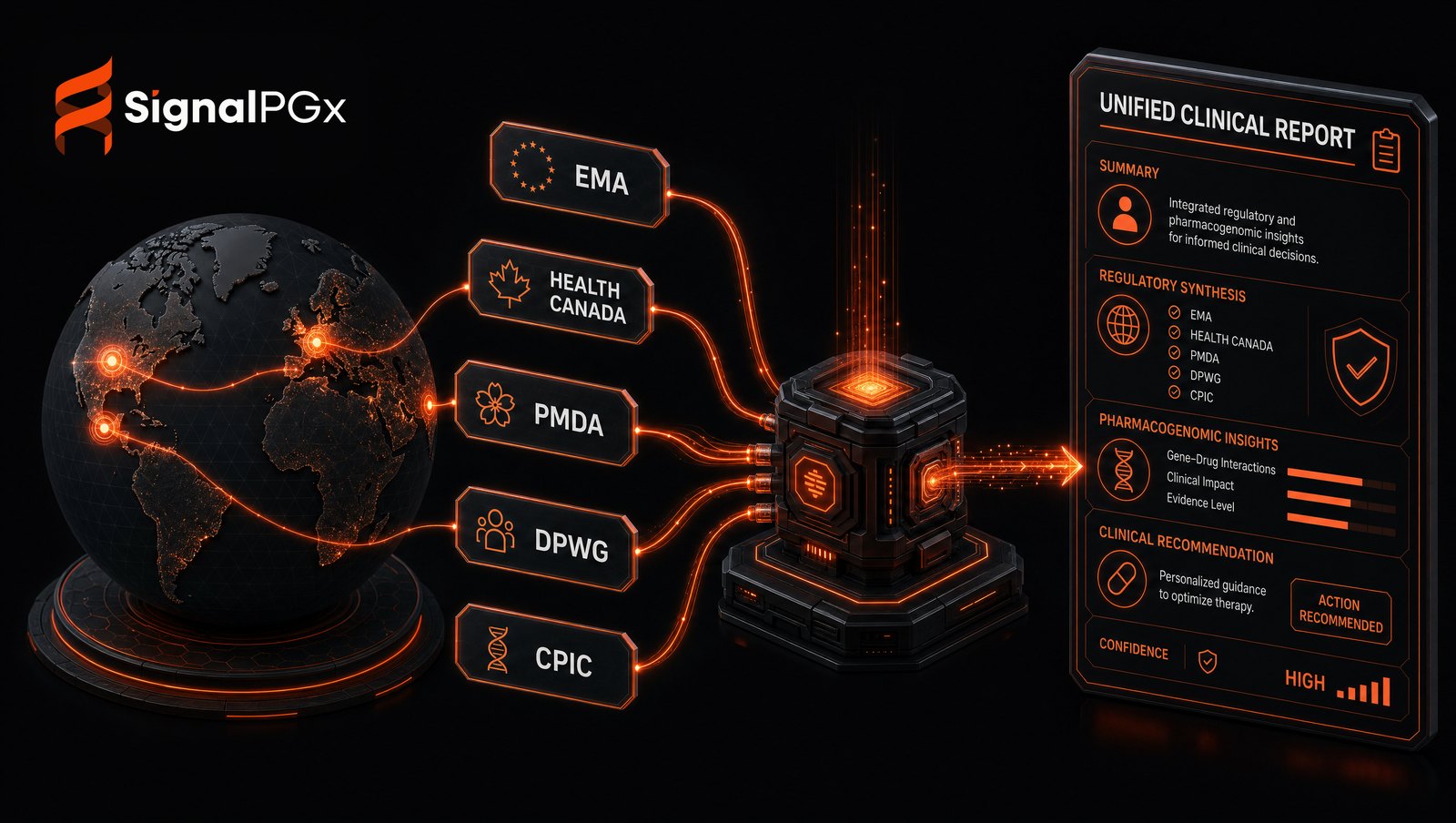
International pharmacogenomics reporting means aligning reports with drug labeling from non-US regulators — the EMA, Health Canada, Swissmedic, and Japan's PMDA — plus guideline bodies such as the Dutch DPWG alongside CPIC. Guidance differs by jurisdiction in method and dose recommendations, so multinational reports must reconcile several sources rather than defaulting to US labeling alone.
Do pharmacogenomic guidelines differ outside the United States?
Yes, and the differences are substantive enough to matter for a report a physician acts on. US practice tends to anchor on FDA labeling and CPIC guidelines, but a patient in Rotterdam, Toronto, Zurich, or Tokyo is prescribed a product carried under a different regulator's label, and that label may address a pharmacogenomic biomarker differently — or not at all.
The divergence shows up in three places: which gene-drug pairs a regulator flags, the strength of the language used (testing "recommended" versus "consider" versus a boxed warning), and the dose adjustment specified for a given phenotype. Across the major bodies, coverage overlaps only partially, and the wording rarely matches word-for-word. A report built solely on US sources can therefore understate, overstate, or simply omit guidance that is authoritative in the market where the patient is actually treated. That is the core problem international pharmacogenomics reporting has to solve.
Which international regulators and guideline bodies matter?
For a lab serving non-US or multinational markets, five external sources carry most of the weight beyond CPIC and FDA.
- EMA (European Medicines Agency) publishes multidisciplinary scientific guidance on pharmacogenomics, including a Guideline on Good Pharmacogenomic Practice, addressing how genomic biomarker data inform medicine labeling, risk management, and pharmacovigilance across the EU.
- Health Canada authorizes Product Monographs — the Canadian equivalent of a US drug label — and researchers have curated the pharmacogenomic content from those monographs alongside FDA, EMA, and PMDA labels.
- Swissmedic is Switzerland's therapeutic-products regulator; pharmacogenomic content from Swissmedic-approved labels has been independently curated and made available through public annotation projects.
- PMDA authorizes Japanese drug labels, which are among the regulatory label sources catalogued for pharmacogenomic annotations alongside the agencies above.
A critical framing point: each of these is the labeling of a medicinal product, authorized by that country's regulator. It is an evidence source a report can reference — not an approval, clearance, or endorsement of any interpretation or reporting software. SignalPGx ingests EMA, Health Canada (HCSC), Swissmedic, and PMDA labeling among its 15+ evidence sources, but doing so confers no regulatory status on the software in any of those jurisdictions.
How does DPWG differ from CPIC?
DPWG (the Dutch Pharmacogenetics Working Group) is a separate guideline body from CPIC, and the distinction is methodological, not hierarchical. DPWG was established in 2005 under KNMP, the Royal Dutch Pharmacists Association, and publishes systematic, evidence-based gene-drug guidelines. Its recommendations are curated and made available through public pharmacogenomic resources in addition to KNMP's own channel.
The two bodies reach recommendations differently. DPWG calculates genotype- or phenotype-specific dose adjustments from pharmacokinetic data — steady-state concentrations, AUC, and similar measures. CPIC issues consensus-based recommendations drawn from published literature and expert panels, assigning each guideline an evidence level and a recommendation strength. Neither approach supersedes the other; they reflect different national contexts and methodologies, and both cover dozens of gene-drug pairs with partial overlap.
For a report, this means DPWG and CPIC can point to the same gene-drug pair yet phrase the actionable dose differently. We unpack that interplay in more depth in our guide to CPIC, FDA, and DPWG reporting guidelines. The practical takeaway: a defensible report should represent both faithfully rather than silently picking one.
How multi-source reconciliation handles conflicting international guidance
When an EMA label, a DPWG guideline, and a CPIC guideline address the same gene-drug pair with different wording or different dose adjustments, the answer is not to average them or to let one overwrite the rest. It is to surface each source with its provenance so the reviewing director can weigh them for the market at hand.
This is the job of a structured evidence layer. SignalPGx maps a patient's already-called genotype to the relevant guidance across its 15+ evidence sources — CPIC, DPWG, FDA, OpenFDA, HCSC, EMA, Swissmedic, PMDA, and others — and presents the applicable recommendations side by side, each attributed to its origin, rather than collapsing them into a single unlabeled verdict. Our medication intelligence graph is where those cross-source relationships are modeled, and why a unified evidence source matters explains the reasoning behind consolidating them.
The software structures and surfaces this information; it does not autonomously reconcile guidance or decide which regulator "wins." That judgment — which sources are authoritative for a given patient and market — stays with the lab's licensed medical director, who reviews and signs out every report.
What changes for international pharmacogenomics reporting in non-US or multinational markets?
Reporting is only one layer of what differs across borders. Regulatory frameworks, reimbursement, and laboratory accreditation are country-specific and do not travel with the report content.
- Accreditation differs by jurisdiction. US labs operate under CLIA and may hold CAP accreditation; other countries have their own accreditation bodies and requirements. A report's evidence layer does not change which accreditation your lab must hold locally.
- Reimbursement and coverage are set nationally and are never guaranteed. Billing mechanisms that apply in one country have no bearing on another, and coverage of pharmacogenomic testing varies widely.
- Regulatory responsibility remains with the lab. SignalPGx is CLIA-workflow software for a lab's own use; it is not registered, licensed, or regulatory-approved in the EU, Canada, Switzerland, or Japan. Any non-US lab remains responsible for its own local regulatory and accreditation compliance.
What the software does change is the labor of keeping report content aligned to multiple international sources at once. White-label reports let you present that reconciled guidance under your own brand, and the underlying PGx reporting workflow is built to carry non-US labeling alongside CPIC and FDA content. None of the above is legal, billing, or regulatory advice; confirm your obligations with counsel and your accrediting body.
Where the medical director and local regulation fit
International alignment does not remove the human at the center of the report — it raises the value of that human's judgment. The more sources a report reconciles, the more it matters that a qualified reviewer decides which guidance is authoritative for the patient's market and clinical context.
SignalPGx keeps a human in the loop by design. It intakes already-called genotypes and structures the applicable multinational guidance, but the lab's own licensed medical director reviews and signs out every report under the lab's license. The platform supports that sign-out; it does not perform it, and it does not replace the treating physician, in whom final prescribing decisions rest. It is not a diagnostic test and is not FDA-cleared.
For a lab expanding beyond a single market, that division of labor is the point. The software absorbs the repetitive work of tracking how EMA, Health Canada, Swissmedic, PMDA, DPWG, and CPIC each treat a gene-drug pair, and presents it with provenance intact. The director then applies local regulatory knowledge — accreditation, scope of practice, and market-specific expectations — to a report that already reflects the relevant international evidence rather than US labeling alone. That is what makes multinational pharmacogenomic reporting defensible: not a single global answer, but transparent, attributed guidance a licensed reviewer can stand behind in each jurisdiction served.
← Back to InsightsSee how SignalPGx fits your lab
White-label pharmacogenomics interpretation and reporting for CLIA laboratories — your medical director signs out, your brand ships.
Book a demo