
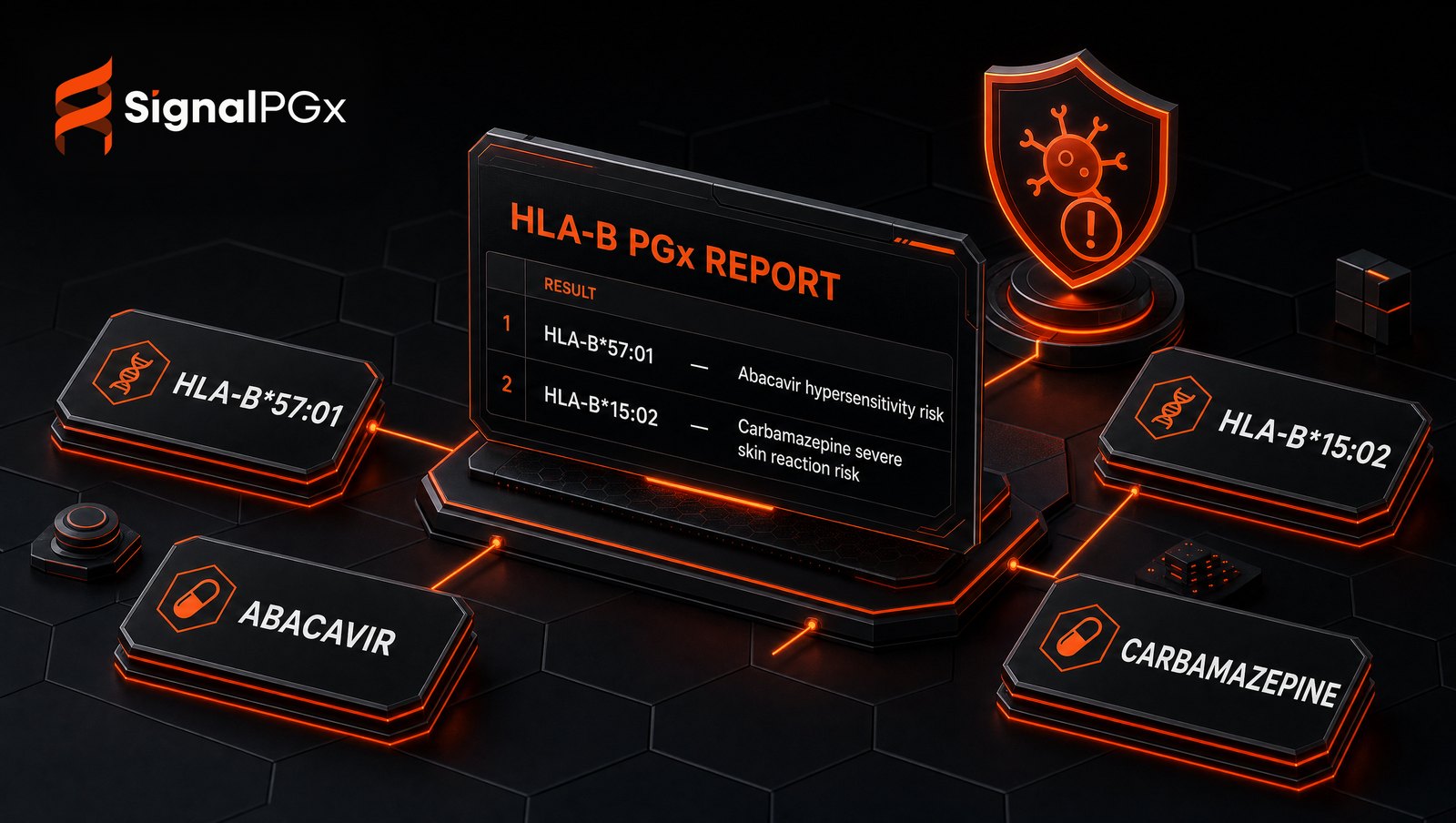
An HLA-B abacavir carbamazepine pharmacogenomic report flags two immune-mediated hypersensitivity risks: HLA-B*57:01 for abacavir hypersensitivity and HLA-B*15:02 for carbamazepine-induced Stevens-Johnson syndrome. Both are CPIC Level A gene-drug pairs and carry FDA boxed-warning screening guidance. The report states each risk allele as present or absent for your lab director to review and sign out.
Why do HLA-B alleles matter for abacavir and carbamazepine?
Unlike most pharmacogenes, HLA-B does not change how fast a patient metabolizes a drug. It predicts an immune-mediated hypersensitivity reaction. A specific HLA class I molecule presents the drug or one of its metabolites to T cells, provoking a severe, sometimes life-threatening response that has little to do with dose.
Two allele-drug relationships dominate practice. HLA-B*57:01 carriage is strongly associated with abacavir hypersensitivity reaction, a multi-organ syndrome that can be fatal on re-challenge. HLA-B*15:02 carriage is associated with carbamazepine-induced Stevens-Johnson syndrome (SJS) and toxic epidermal necrolysis (TEN). Because these are binary risk-allele questions rather than graded metabolic-activity questions, they occupy a distinct branch of reporting logic within your medication intelligence graph — one where a single present/absent call, not a dosing curve, drives the recommendation.
What do CPIC and FDA say about HLA-B*57:01 and HLA-B*15:02?
CPIC publishes a dedicated guideline for abacavir and HLA-B*57:01, one of its highest-actionability ("Level A") gene-drug pairs. FDA labeling for abacavir carries a boxed warning recommending HLA-B*57:01 screening before starting (or restarting) therapy, unless a prior negative result is already documented. Randomized controlled trial evidence — the PREDICT-1 study — found that prospective screening eliminated immunologically confirmed hypersensitivity reactions in the screened group and substantially reduced clinically diagnosed reactions versus no screening.
For carbamazepine, CPIC publishes a dedicated guideline for HLA-A*31:01 and HLA-B*15:02, also Level A and most recently revised in 2025. FDA labeling carries a boxed warning stating that patients with ancestry in genetically at-risk populations should be tested for HLA-B*15:02 before starting therapy, and that carbamazepine should generally be avoided in patients who test positive unless the anticipated benefit clearly outweighs the risk. CPIC, in turn, recommends avoiding carbamazepine (and oxcarbazepine) in drug-naive HLA-B*15:02-positive patients, and avoiding carbamazepine where alternatives exist — or using it with increased monitoring where they do not — in HLA-B*15:02-negative, HLA-A*31:01-positive naive patients. Note that CPIC "Level A" is CPIC's own actionability grading, distinct from FDA labeling status.
How HLA risk alleles differ from CYP metabolizer genes
Metabolizer genes such as CYP2D6 and CYP2C19 resolve to diplotypes, activity scores, and a phenotype on a spectrum from poor to ultrarapid metabolizer. The clinical action is usually a dose adjustment, and the report communicates a gradient.
HLA-B risk alleles work differently. The clinically relevant output is simply whether a defined risk allele — HLA-B*57:01 or HLA-B*15:02 — is present or absent. There is no activity score and no dosing gradient. A positive result is a contraindication-strength flag; a negative result substantially lowers, but does not entirely eliminate, risk. Your report logic therefore has to treat HLA distinctly from metabolizer genes, both in how the result is phrased and in how the recommendation is worded. A metabolizer result says "adjust the dose"; an HLA result says "consider a different drug entirely." Keeping that distinction explicit is part of producing clinically defensible PGx reports a director can stand behind, and it is one reason HLA pairs are worth handling as their own reporting category rather than bolting them onto metabolizer logic.
What an HLA-B abacavir carbamazepine pharmacogenomic report should contain
A defensible HLA-B report should make each of the following unambiguous:
- The specific risk allele interrogated (HLA-B*57:01, HLA-B*15:02, and where relevant HLA-A*31:01), stated plainly as present or absent.
- The associated drug and the nature of the risk — abacavir hypersensitivity; carbamazepine SJS/TEN.
- A concise, sourced summary of the matching CPIC recommendation and FDA labeling guidance.
- The upstream typing method and its limitations, including that a negative result lowers but does not eliminate risk.
- An ancestry and clinical-vigilance caveat (discussed below).
- A clear statement that the report is decision support, not a diagnosis, and that prescribing decisions rest with the treating physician.
- The sign-out block identifying the reviewing laboratory director.
White-label reports should carry these elements in the same order and layout across every gene-drug pair, so a reviewer is not re-learning the format each time an HLA case appears alongside the more familiar metabolizer results in the PGx reporting queue.
How the report is assembled when HLA typing is done upstream
An important operational point: HLA typing itself is performed upstream, in your own laboratory, using your validated method — sequence-based typing, SSO, or another approach under your CLIA license. The pharmacogenomic interpretation layer sits downstream of that call.
SignalPGx ingests the already-called HLA genotype — present or absent for each risk allele — the same way it ingests star-allele calls from a VCF, PharmCAT output, or a genotyping panel. It does not perform HLA typing, variant calling, or sequencing. Instead, it maps the result your lab has already produced to the relevant CPIC and FDA guidance and assembles the structured, sourced report your director then reviews. The general mechanics of moving from a called genotype to a finished clinical report are covered in converting a VCF to a clinical PGx report, and the interpretation-and-assembly layer is described on the platform overview. The division of labor stays clean: your lab owns the analytical call; the software structures the interpretation around it.
Director sign-out and ancestry considerations
Every HLA-B report is reviewed and signed out by your laboratory's own licensed medical director; the software supports that review rather than replacing it. Two clinical nuances deserve careful, non-stigmatizing wording.
First, ancestry. HLA-B*15:02 prevalence varies considerably across — and even within — populations broadly labeled "Asian ancestry," and is rare outside them. That is precisely why FDA frames ancestry as a trigger for testing, not a substitute for an individual patient's actual genotype result. For abacavir, FDA and CPIC recommend universal pre-treatment screening for all patients regardless of ancestry, which sidesteps population-prevalence assumptions entirely.
Second, vigilance. FDA's own carbamazepine label cautions that HLA-B*15:02 genotyping is a risk-stratification tool, not a substitute for clinical vigilance: most allele-positive patients will not develop SJS/TEN, and the reaction can still occur, infrequently, in allele-negative patients of any ancestry. Report language should reflect that reality rather than overstate what a negative result guarantees. This is not legal, billing, or regulatory advice.
Bringing HLA-B into a coherent reporting program
HLA-B*57:01 and HLA-B*15:02 are among the clearest cases in pharmacogenomics for acting on a genotype: high-actionability CPIC guidance, FDA boxed warnings, and severe outcomes when a risk allele is missed. What makes them operationally distinct is that they do not behave like the metabolizer genes that dominate most PGx panels — the result is binary, the typing happens upstream, and the recommendation reads closer to a contraindication than a dose tweak.
Reporting them well means treating that difference explicitly: ingesting the already-called HLA result, mapping it to current CPIC and FDA guidance, phrasing present/absent findings and their limits precisely, and routing every case to your director for sign-out. Handled consistently, HLA-B reporting slots into the same structured, sourced, human-reviewed workflow as the rest of your panel — one report format and one review discipline, whether the gene in front of the director is CYP2C19 or HLA-B. Because these two drugs carry some of the most severe reactions in the pharmacogenomic literature, that consistency is exactly where a lab earns and keeps clinical trust.
← Back to InsightsSee how SignalPGx fits your lab
White-label pharmacogenomics interpretation and reporting for CLIA laboratories — your medical director signs out, your brand ships.
Book a demo