
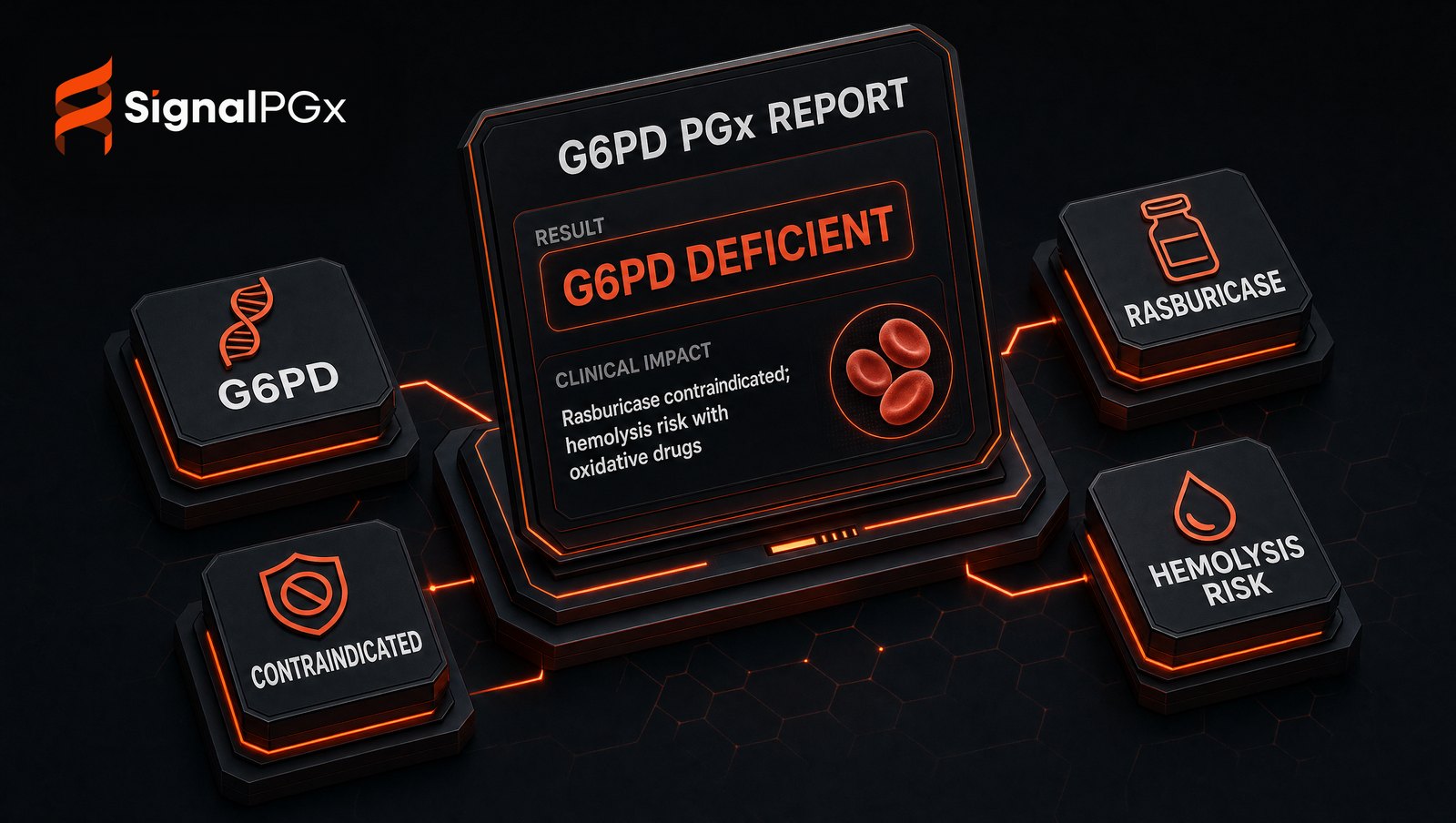
A G6PD deficiency pharmacogenomic report flags oxidative drugs — rasburicase, primaquine, tafenoquine, and methylene blue are FDA-contraindicated — that can trigger acute hemolysis. Because G6PD is X-linked, genotype has real interpretation limits; quantitative enzyme-activity testing remains the clinical standard, and your lab's medical director signs out every result.
Why does G6PD deficiency matter for oxidative drugs?
Glucose-6-phosphate dehydrogenase (G6PD) is the enzyme red blood cells depend on to regenerate NADPH and defend against oxidative stress. When it is deficient, red cells cannot neutralize the oxidative load that certain drugs impose, and the result can be acute hemolytic anemia. G6PD deficiency is one of the most common human enzyme disorders — published estimates cite roughly 400 million or more affected people worldwide, concentrated in regions historically endemic for malaria: sub-Saharan Africa, the Mediterranean, the Middle East, and South and Southeast Asia. Treat that figure as a literature estimate, not a precise current count.
For your lab, the practical consequence is direct. A patient's G6PD status materially changes the safety profile of a defined set of oxidative medications, and a pharmacogenomic report is a structured way to surface that risk to the ordering clinician before a drug is prescribed. Unlike many pharmacogenes where the question is dosing, here the question is often whether a specific drug can be given at all.
What do the FDA label and CPIC say about rasburicase and beyond?
Rasburicase is the clearest case. Its FDA label states it is contraindicated in patients with G6PD deficiency, because the drug's enzymatic conversion of uric acid to allantoin generates hydrogen peroxide, which can trigger hemolysis in G6PD-deficient red cells. The rasburicase label recommends G6PD screening in higher-risk populations — for example, patients of African or Mediterranean ancestry — before treatment, and immediate, permanent discontinuation with supportive care if hemolysis occurs.
Rasburicase is not alone. Primaquine's label identifies severe G6PD deficiency as a contraindication, recommends testing before use, and calls for baseline hematologic monitoring. Tafenoquine (Krintafel, Arakoda) requires G6PD testing before administration and is contraindicated in deficiency or unknown status, since its long half-life means it cannot be "stopped" if hemolysis begins. Methylene blue injection is likewise contraindicated in G6PD deficiency. By contrast, nitrofurantoin, dapsone, and sulfonamides such as trimethoprim-sulfamethoxazole carry hemolysis caution rather than absolute FDA contraindication language, and your reporting should frame them that way — not as equivalents to rasburicase or primaquine.
CPIC's original 2014 rasburicase/G6PD guideline has been superseded by the 2023 expanded guideline (Gammal et al., Clinical Pharmacology & Therapeutics 2023), which risk-tiers rasburicase and dozens of additional medications as high, medium, or low-to-no risk — the primary reference is worth reading in full. The literature does not support a single reliable incidence rate, so a responsible report describes hemolysis risk qualitatively — uncommon, dose- and variant-dependent — rather than inventing a precise number.
Why G6PD genotype-to-phenotype is uniquely limited
G6PD is a special case in pharmacogenomics, and it is important to say why on the face of the report. The gene is X-linked. Hemizygous males carry a single allele, so they are either deficient or normal, and genotype maps cleanly to phenotype. Heterozygous females are the problem. Because of random X-chromosome inactivation (lyonization), a heterozygous female carries a mosaic of normal and deficient red cells, and her measured enzyme activity can fall anywhere from deficient to normal. Genotype alone cannot reliably predict where she lands on that spectrum.
Layered on top of that is allelic heterogeneity. G6PD has many known variants of differing severity, and any genotype panel interrogates a defined subset of them. A "normal" genotype result on a targeted panel is not the same as normal enzyme activity — it means no interrogated variant was found, which is a narrower statement. For both reasons, quantitative G6PD enzyme-activity testing is the accepted clinical and confirmatory standard, and genotype is complementary: informative, but not a replacement. A report that blurs that line does the ordering clinician a disservice.
What should a G6PD deficiency pharmacogenomic report contain?
A defensible G6PD deficiency pharmacogenomic report does more than print a genotype. Because a G6PD result may ultimately drive a decision to withhold a contraindicated drug, the report your lab issues under its own brand should state its limits as prominently as its findings. At minimum it should carry:
- The called genotype and its interpreted implication, with the X-linked caveats stated plainly — especially the limits of genotype in heterozygous females.
- An explicit statement that quantitative enzyme-activity testing is the clinical standard and may be needed to establish phenotype, particularly in females and in ambiguous cases.
- Drug-level guidance drawn from current FDA labeling and CPIC risk tiers, distinguishing absolute contraindications (rasburicase, primaquine, tafenoquine, methylene blue) from caution-level agents.
- The identity and sign-out of your lab's licensed medical director.
If your report names billing codes, note that G6PD molecular testing is commonly associated with CPT 81247/81248/81249 and enzyme-activity testing with 82955 or 82960 — but have your billing and compliance team confirm current-year code validity and payer coverage, since this is not billing, coding, or regulatory advice. Coverage is never guaranteed, and codes and determinations change year to year.
How the report is assembled, and why activity testing still matters
SignalPGx is white-label PGx interpretation and reporting software that sits downstream of variant and star-allele calling. It ingests genotypes your lab has already called — from VCF, PharmCAT, Agena MassARRAY, or CSV — and does not align reads or call variants itself. If you want the upstream picture, see how a VCF becomes a clinical PGx report.
From a called G6PD genotype, the software maps drug-level implications using a medication intelligence graph spanning 950+ medications and 15+ evidence sources, including CPIC, FDA, and DailyMed. It assembles the structured, cited output — genotype interpretation, applicable FDA and CPIC guidance, and the required caveats — that your director then reviews. The evidence layer draws on public knowledge bases such as PharmGKB, now part of ClinPGx.
What the software does not do is perform an enzyme-activity assay. That distinction is the heart of responsible G6PD reporting: the genotype-based report should make explicit where genotype-derived inference ends and where quantitative activity testing is the appropriate confirmatory step. And because guidance evolves — the 2014-to-2023 CPIC shift is a live example — keeping interpretation current against the latest guideline versions is its own discipline, one worth handling systematically rather than by hand.
Director sign-out and clinical context
Every SignalPGx report is reviewed and signed out by your lab's own licensed medical director. The software is a decision-support and reporting tool that helps the director work faster and more consistently; it does not interpret or sign out as a service, and it does not replace a clinician. It is not a diagnostic test and is not FDA-cleared or approved. The FDA facts in this article concern drug labels — rasburicase, primaquine, tafenoquine, methylene blue — not any genetic test, enzyme assay, or software.
CLIA belongs to your lab. SignalPGx fits within your lab's CLIA-licensed, CAP-accredited workflow, consistent with your medical director's qualifications; it does not perform validation, accreditation, or billing on your behalf. And every downstream decision — whether to order enzyme-activity confirmation, whether to avoid or monitor a drug — remains with the treating physician. This article is informational and is not medical, legal, billing, or regulatory advice.
Reporting G6PD responsibly
G6PD deficiency is a reminder that a pharmacogenomic report is only as good as the caveats it carries. The pharmacology is unusually crisp — a short list of oxidative drugs, four of them FDA-contraindicated — but the genotype-to-phenotype mapping is unusually soft, especially for heterozygous females. A report that flags the drugs while overstating what a genotype panel can conclude is not a service to the ordering clinician; it is a liability wearing the costume of certainty.
The responsible pattern pairs a clearly interpreted genotype with an explicit pointer to quantitative enzyme-activity testing as the clinical standard, current FDA and CPIC guidance presented factually, and your medical director's sign-out anchoring it all. That is the difference between a data readout and a clinically defensible report — and for a gene like G6PD, where the caveats are the clinical content, it is the difference that matters most.
← Back to InsightsSee how SignalPGx fits your lab
White-label pharmacogenomics interpretation and reporting for CLIA laboratories — your medical director signs out, your brand ships.
Book a demo