
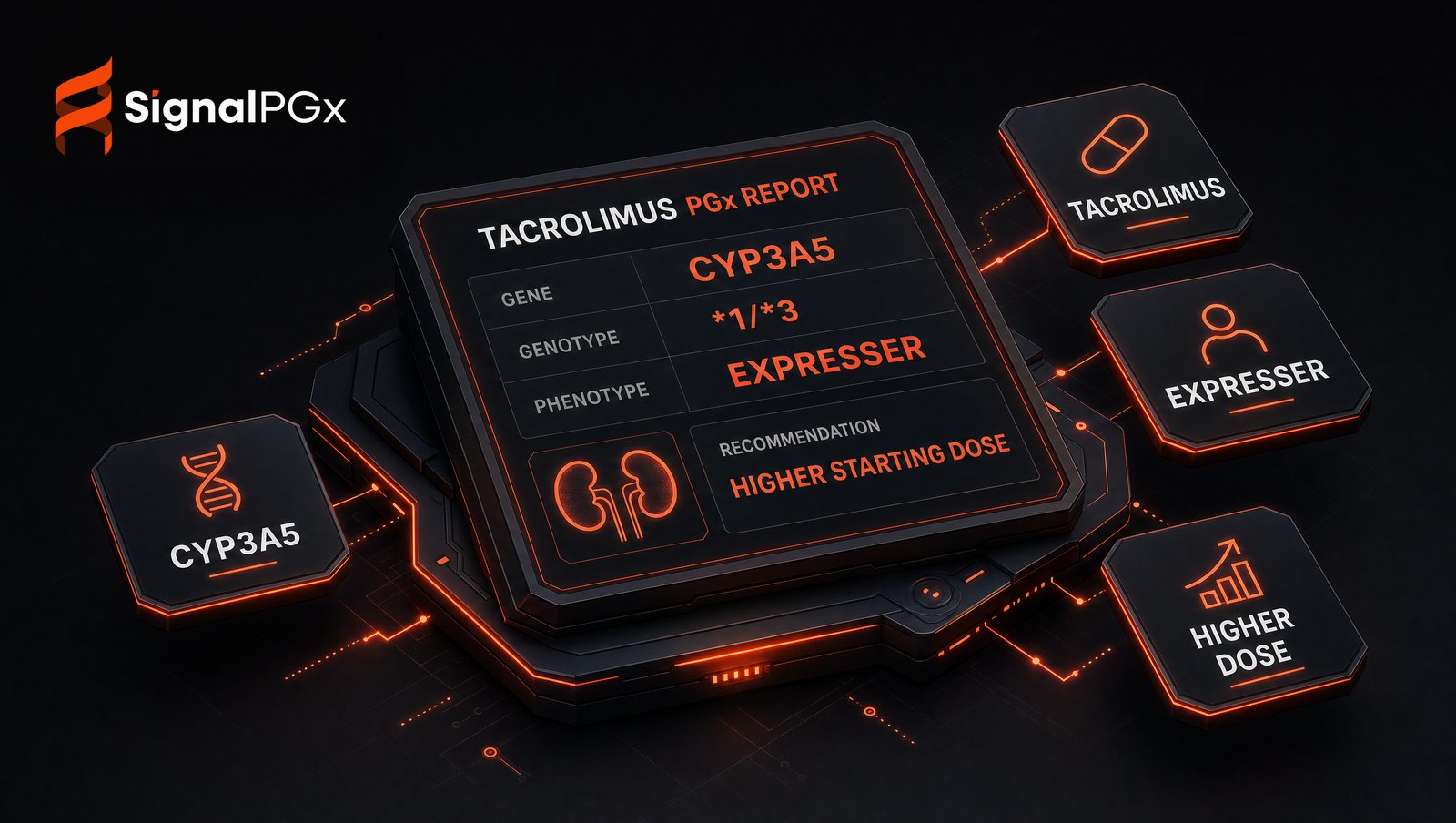
A CYP3A5 tacrolimus pharmacogenomic report classifies a transplant recipient as a CYP3A5 expresser or non-expresser and pairs that phenotype with CPIC's starting-dose guidance. Expressers, who carry a functional *1 allele, clear tacrolimus faster and typically need higher starting doses to reach target troughs. Your lab's medical director reviews and signs out every report.
Why does CYP3A5 matter for tacrolimus?
Tacrolimus is a calcineurin inhibitor with a narrow therapeutic index, and CYP3A5 is one of the primary enzymes that metabolizes it. The functional *1 allele produces active enzyme; the common *3, *6, and *7 alleles do not. Patients carrying at least one *1 allele metabolize the drug faster, so at an identical weight-based dose they tend to sit below the target trough.
The magnitude is not subtle. CPIC notes that the CYP3A5*1/*3 genotype is believed to explain up to 45% of the between-patient variability in tacrolimus dose requirements. CPIC also cites over 50 studies in kidney, heart, and lung transplant recipients showing that CYP3A5*1 carriers need roughly 1.5 to 2 times the dose of *3/*3 non-expressers to reach comparable blood concentrations. That is why CYP3A5 is widely regarded as one of the more actionable gene-drug pairs in transplant pharmacology.
What does CPIC recommend for CYP3A5 and tacrolimus?
CPIC's guideline for CYP3A5 genotype and tacrolimus dosing (Birdwell et al., *Clinical Pharmacology & Therapeutics*, 2015) gives a Strong classification to its dosing recommendations for both expressers and non-expressers. In plain terms:
- Expressers (carriers of at least one functional *1 allele): receive 1.5 to 2 times the standard tacrolimus starting dose, not to exceed 0.3 mg/kg/day, with therapeutic drug monitoring (TDM) guiding subsequent adjustments.
- Non-expressers (two nonfunctional alleles, most commonly *3/*3): initiate at the standard recommended starting dose, again with TDM guiding adjustments.
Two caveats belong in every report. CPIC is explicit that the guideline does not recommend for or against ordering CYP3A5 testing itself, and that altering initial dosing based on genotype "has not been shown to improve efficacy or reduce toxicity." The guideline supports faster attainment of target trough concentrations, not a proven long-term outcome benefit, and TDM remains required regardless of genotype. This article is decision-support context, not medical, billing, or regulatory advice.
Expresser vs non-expresser: reading the CYP3A5 genotype
Phenotype assignment follows the diplotype. CPIC groups CYP3A5*1/*1 as extensive metabolizers and *1/*3, *1/*6, and *1/*7 as intermediate metabolizers; both categories are expressers. Poor metabolizers, or non-expressers, carry two nonfunctional alleles: *3/*3, *6/*6, *7/*7, *3/*6, *3/*7, or *6/*7.
Ancestry context matters for interpretation. CPIC reports that 80 to 85% of white/Caucasian individuals are homozygous for CYP3A5*3, making them non-expressers, so expresser status is considerably more common in populations of African and other equatorial-ancestry origin. A report that surfaces population frequency helps a transplant team read the result in context.
One association is worth reporting carefully. A meta-analysis of 21 studies cited in the CPIC guideline found a statistically significant link between CYP3A5*1 carriage and increased kidney transplant rejection risk (odds ratio 1.32, P=0.04). That is an association drawn from the cited literature, not a CPIC guarantee that genotype-guided dosing prevents rejection.
What a CYP3A5 tacrolimus pharmacogenomic report should contain
A defensible CYP3A5 tacrolimus pharmacogenomic report is more than a phenotype label. To be useful to a transplant team and defensible on sign-out, it should carry:
- The called diplotype (for example, *1/*3) and the resulting phenotype stated as expresser or non-expresser.
- The CPIC starting-dose context, quoted faithfully with its "Strong" classification and its dose ceiling of 0.3 mg/kg/day for expressers.
- An explicit TDM caveat: CPIC states that CYP3A5 genotyping cannot replace therapeutic drug monitoring, and dosing decisions remain the treating physician's.
- Traceable sources, so a reviewer can follow each statement back to CPIC and PharmGKB.
Billing metadata belongs to your workflow, not to the narrative. CYP3A5 genotyping maps to CPT code 81231, and the companion gene CYP3A4 maps to 81230; these are billed by the testing lab. Structuring these outputs consistently is the core of white-label PGx reporting and a well-designed PGx reporting layer.
How the report is assembled downstream of calling
SignalPGx sits strictly downstream of variant and star-allele calling. It intakes an already-called genotype or diplotype from a VCF, a PharmCAT output, an Agena MassARRAY result, or a CSV; it does not align reads or call variants itself. That boundary keeps the analytical work where CAP and CLIA place it, in the testing lab.
From a called CYP3A5 diplotype, the software maps the phenotype and assembles the CPIC-sourced dosing context into a structured, reviewable report. The medication intelligence graph connects the genotype to tacrolimus and to the broader medication picture across 50+ pharmacogenes and 15+ evidence sources, so a recipient's full regimen is visible in one place. For the mechanics of moving from a raw file to a clinical report, see converting a VCF to a clinical PGx report and the genotype-to-guidance pipeline.
Where a reviewer needs supporting detail, SignalAI operates as a guardrailed, cite-or-refuse assistant: it surfaces referenced evidence to support the human reviewer and never signs out autonomously.
Director sign-out and transplant context
The report is a draft until your director signs it. Under CLIA (42 CFR 493.1443), a laboratory director for high-complexity testing must meet one of several defined qualification pathways, such as board certification in pathology or a relevant doctoral degree plus HHS-approved board certification. It is that director, operating under your lab's own CLIA license, who reviews and signs out every result. SignalPGx supports that review; it does not replace the director or the treating physician, and it is neither a diagnostic test nor FDA-cleared.
Transplant type shapes interpretation. CPIC's recommendation covers kidney, heart, lung, and hematopoietic stem cell transplant, and extends to liver transplant only where donor and recipient genotypes are identical, because the transplanted liver introduces a second CYP3A5 genotype. Note too that the core tacrolimus (Prograf) FDA label does not carry a CYP3A5 genotype-stratified dosing table; genotype-guided starting-dose context in this space comes from CPIC, while dosing continues to be directed primarily by TDM per the package insert.
Reimbursement is a separate, per-test question. Under the MolDX program, Medicare Administrative Contractors require a registered DEX Z-Code identifier reported alongside the CPT code, and coverage is evaluated test-by-test under the relevant Pharmacogenomics Testing LCD. Coverage is never automatic and varies by payer and jurisdiction; Z-code registration and billing are the lab's responsibility, not the reporting software's. None of this is legal, billing, or regulatory advice.
For labs standing up a transplant PGx line, the pattern is consistent: keep calling and validation in your CLIA-accredited workflow, let structured reporting handle the CPIC mapping and evidence traceability, and keep your director firmly in the loop on the reporting platform. CYP3A5 and tacrolimus is a well-characterized starting point precisely because the guidance is strong, the phenotype is binary, and the clinical audience already understands what an expresser result means at the bedside.
← Back to InsightsSee how SignalPGx fits your lab
White-label pharmacogenomics interpretation and reporting for CLIA laboratories — your medical director signs out, your brand ships.
Book a demo