
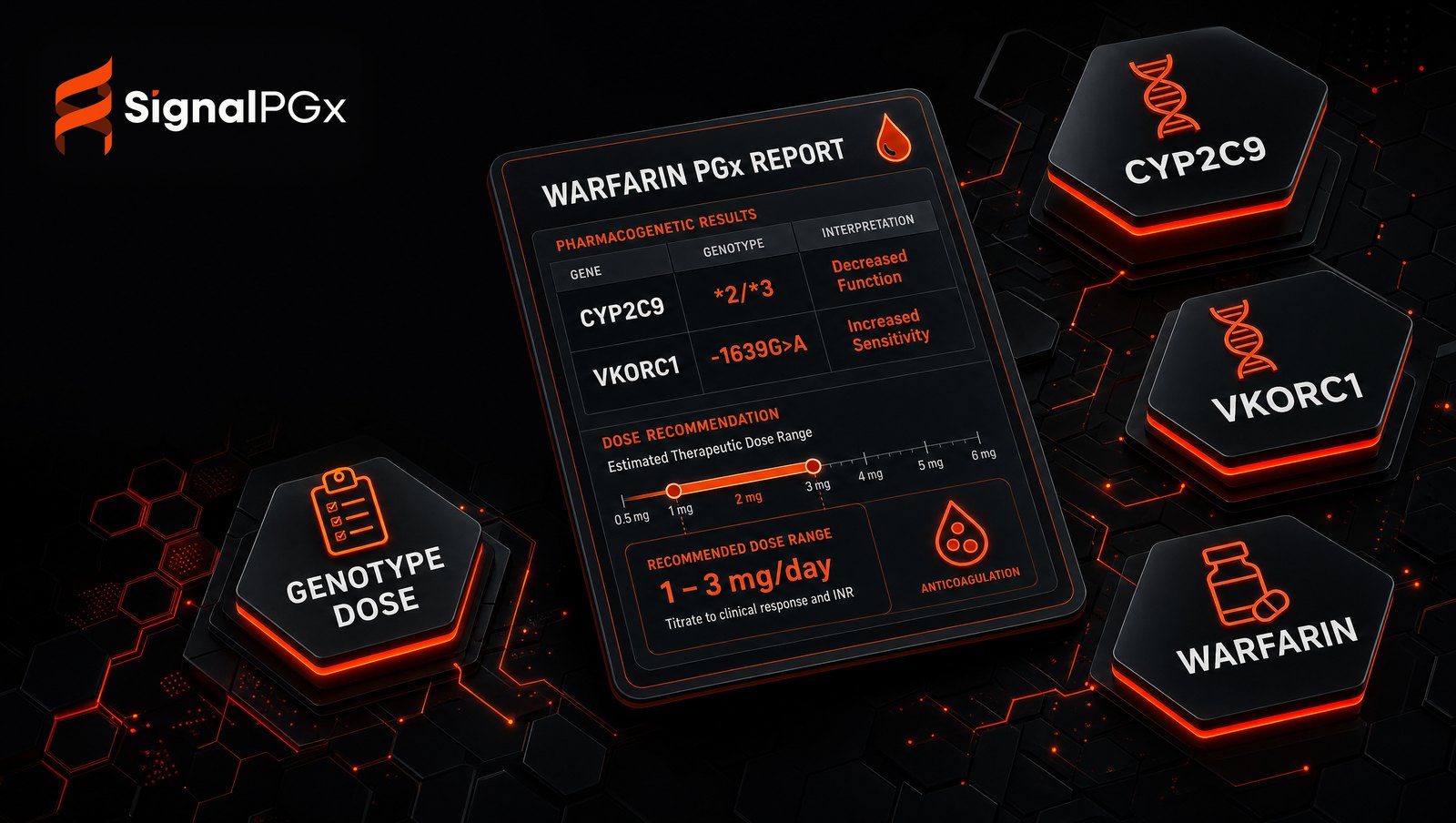
A CYP2C9 VKORC1 warfarin pharmacogenomic report presents genotype-guided dosing context — CYP2C9 metabolizer status, the VKORC1 c.-1639G>A sensitivity variant, and optionally CYP4F2 — alongside CPIC's Level A guidance and the FDA label's genotype dosing table. Your CLIA lab's medical director reviews and signs out each report; prescribing decisions remain the treating physician's.
Why do CYP2C9 and VKORC1 matter for warfarin?
Warfarin has a narrow therapeutic index and famously wide interpatient dose requirements, and two genes account for most of the heritable component. CYP2C9 governs metabolic clearance of the more potent S-enantiomer, so reduced-function alleles slow clearance and raise exposure. VKORC1 encodes the drug's pharmacodynamic target, vitamin K epoxide reductase; the regulatory variant c.-1639G>A (rs9923231) lowers enzyme expression and increases warfarin sensitivity.
Getting the initial dose wrong carries real risk in both directions — over-anticoagulation raises bleeding risk, while under-dosing leaves the patient exposed to thromboembolism during the vulnerable induction window. Published estimates attribute roughly a third to half of dose-requirement variability across patients to CYP2C9 and VKORC1 combined, with the exact fraction depending on study population. CYP2C9 metabolizer status is inferred from the diplotype using an activity-score approach that sums the functional impact of each inherited allele. That upstream calling and star-allele assignment is a separate step, covered in our genotype-to-guidance pipeline walkthrough, while background on the drug-gene biology is maintained in resources such as the NCBI Medical Genetics Summaries.
What does CPIC recommend for warfarin genotype-guided dosing?
The CPIC guideline for warfarin, CYP2C9, and VKORC1 carries CPIC's strongest actionability grade, Level A — meaning genetic information should be used to guide dosing when it is available. Critically, CPIC does not endorse a fixed genotype-to-dose chart.
Instead, CPIC recommends applying CYP2C9 and VKORC1 genotype through a validated pharmacogenetic dosing algorithm — such as the IWPC or Gage-based algorithms hosted at warfarindosing.org — that also incorporates clinical variables including age, body surface area, target INR, amiodarone use, smoking status, and race. This is a meaningfully different mechanism from a simple lookup table, and getting that distinction right matters for both accuracy and defensibility, so a report should frame it that way. The FDA-approved warfarin label separately includes pharmacogenomic information — a table relating CYP2C9 and VKORC1 genotype combinations to expected therapeutic dose ranges — that clinicians may consult as context when initiating therapy. Curated drug-gene evidence underlying these recommendations is aggregated at PharmGKB.
Combining CYP2C9, VKORC1, and CYP4F2
A third gene, CYP4F2, refines the picture but should never be presented as co-equal to the core pair. CPIC's CYP4F2 recommendation is graded optional — a lower strength tier than the Level A CYP2C9/VKORC1 guidance — and applies as a supplementary modifier rather than a primary driver.
For the CYP4F2 *3 variant (rs2108622), CPIC suggests a modest dose increase on the order of 5-10% in non-African-American carriers, reflecting reduced vitamin K recycling. Importantly, CPIC makes no recommended dosing change for individuals of African ancestry for this variant, so any report field that surfaces CYP4F2 must carry that population-specific caveat rather than applying the modifier universally. In practice, a warfarin report typically leads with CYP2C9 phenotype and the VKORC1 c.-1639G>A genotype, then notes CYP4F2 as an optional adjunct the clinician may weigh alongside the validated dosing algorithm.
What a CYP2C9 VKORC1 warfarin pharmacogenomic report should contain
A defensible warfarin report assembles the genotype evidence and the guideline context in one reviewable document. At minimum, it should present:
- The CYP2C9 diplotype and inferred metabolizer phenotype, with the activity-score basis stated.
- The VKORC1 c.-1639G>A (rs9923231) genotype and its sensitivity interpretation.
- CYP4F2 *3 status when tested, flagged as an optional modifier with the African-ancestry caveat.
- A pointer to CPIC's Level A recommendation and the validated dosing-algorithm approach, rather than a fabricated dose number.
- A note that the FDA label's genotype dose-range table exists as clinician context, without asserting FDA endorsement of any test or software.
- Source attributions and the evidence version used, so the interpretation is traceable.
Coding and coverage sit with the lab, not the report generator. The Tier 1 molecular pathology codes historically associated with these genes are 81227 (CYP2C9) and 81355 (VKORC1), but code selection, medical necessity, and reimbursement are the performing lab's determination with its payers. Coverage is never guaranteed and has historically been restricted for this exact gene pair — CMS NCD 90.1 limits Medicare coverage of warfarin CYP2C9/VKORC1 genotyping to coverage-with-evidence-development contexts — so verify current payer policy directly. None of this is billing, legal, or regulatory advice.
How the report is assembled downstream of calling
SignalPGx is white-label interpretation and reporting software that operates strictly downstream of variant and star-allele calling. It intakes already-called genotypes — VCF, PharmCAT output, Agena MassARRAY, or structured CSV — and does not align reads or call variants itself. The mechanics of turning a called file into a structured clinical report are detailed in our guide on converting a VCF into a clinical PGx report.
From that input, the software maps the CYP2C9 diplotype, VKORC1 genotype, and any CYP4F2 result to the relevant CPIC and FDA-label context, drawing on a unified evidence layer — spanning sources such as CPIC, the FDA label via DailyMed, PharmVar allele definitions, and PharmGKB — described in our medication intelligence graph. The result is a consistent, source-cited draft that fits your existing PGx reporting workflow and can be issued under your own branding through white-label reports. Because the evidence and templating are centralized, a guideline change propagates to future reports without hand-editing each layout — the broader platform mechanics are covered on the platform overview.
Director sign-out and anticoagulation context
Software assembles the draft; it does not practice medicine. Every warfarin report is reviewed and signed out by your lab's own licensed medical director under your CLIA license, keeping a qualified human in the loop for high-complexity testing. SignalPGx is not a diagnostic test and is not FDA-cleared; an ingested FDA label table is a cited source, not a clearance or endorsement of the software.
The report presents genotype-guided dosing context, but it does not replace clinical judgment or ongoing INR monitoring, and final prescribing decisions rest with the treating physician. Genotype informs the starting estimate through a validated algorithm; therapeutic monitoring still governs maintenance dosing as the patient stabilizes. Where reviewers want supporting detail, a guardrailed, cite-or-refuse assistant can surface the underlying guideline passages without inventing recommendations, keeping the director in control of what the final report says.
Building a defensible warfarin report
CYP2C9 and VKORC1 remain the two most actionable pharmacogenes for warfarin, with CYP4F2 as an optional refinement — a hierarchy your report layout should make visually obvious. The core discipline is representing CPIC's Level A guidance faithfully as an algorithm-plus-clinical-variables approach, citing the FDA label as context rather than clearance, and subordinating CYP4F2 to its optional, population-aware role.
Handled downstream of calling, with centralized evidence and your director's sign-out, a warfarin pharmacogenomic report becomes a repeatable, traceable deliverable rather than a manual assembly job. That combination — accurate guideline framing, transparent sourcing, and human-in-the-loop review under your CLIA license — is what makes the report clinically useful to the ordering physician and defensible for your lab.
← Back to InsightsSee how SignalPGx fits your lab
White-label pharmacogenomics interpretation and reporting for CLIA laboratories — your medical director signs out, your brand ships.
Book a demo