
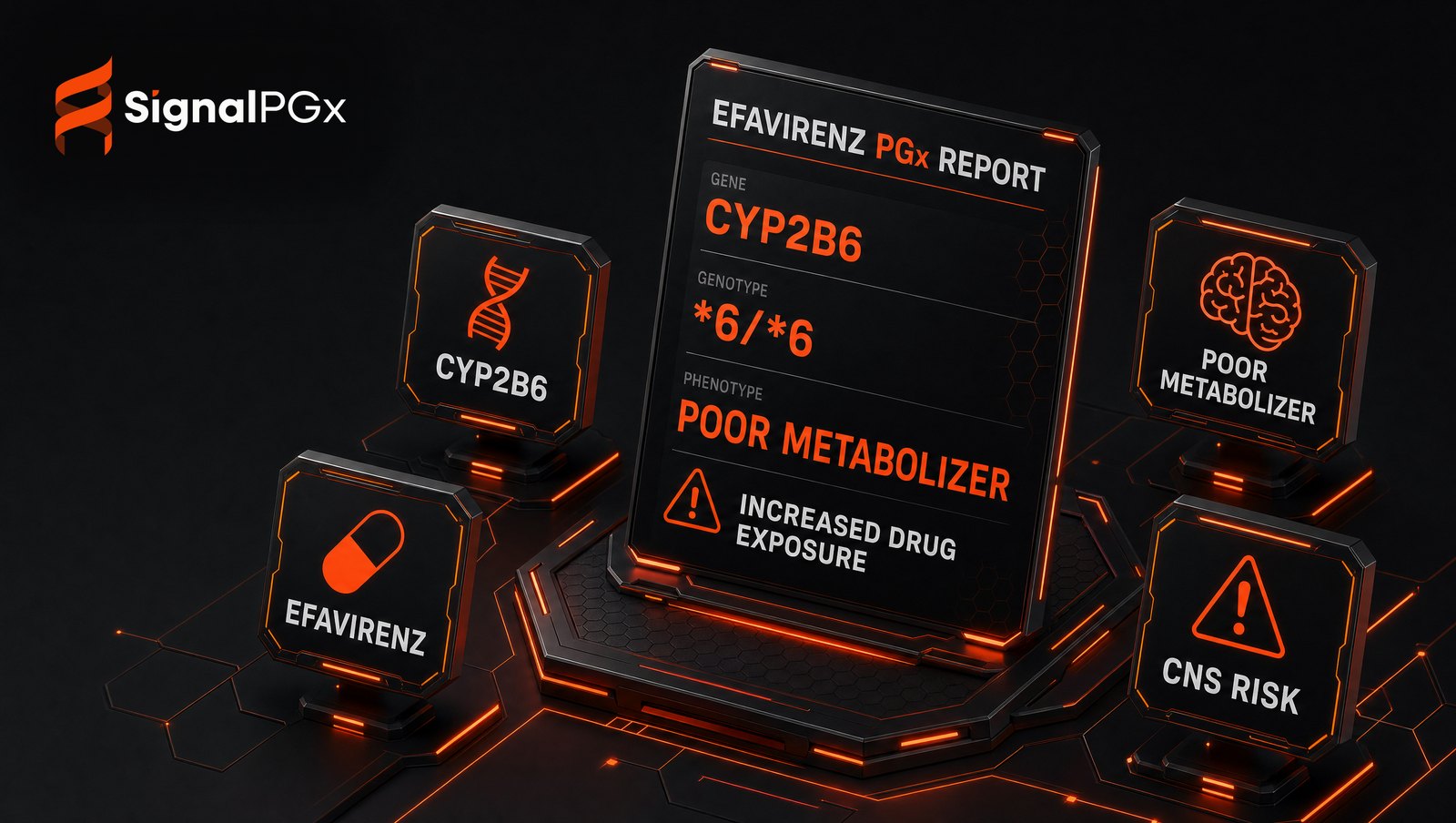
A CYP2B6 efavirenz pharmacogenomic report translates a patient's already-called CYP2B6 genotype into a standardized metabolizer phenotype and pairs it with CPIC's published efavirenz guidance. Reduced-function alleles raise plasma efavirenz exposure and central-nervous-system side-effect risk. Your lab's medical director reviews and signs out every report; the prescribing decision stays with the treating physician.
Why does CYP2B6 matter for efavirenz?
Efavirenz is metabolized primarily by CYP2B6 into inactive metabolites, so a patient's CYP2B6 function largely determines how much active drug circulates. Reduced-function alleles — most notably CYP2B6\*6 — are associated with higher plasma efavirenz exposure than normal-metabolizer genotypes, per both the FDA-approved efavirenz label and published CPIC literature.
That exposure difference is clinically meaningful, not academic. Central-nervous-system and neuropsychiatric effects — dizziness, insomnia, impaired concentration, abnormal dreams — and outright treatment discontinuation are documented efavirenz risks, and published pharmacogenetic studies associate higher risk with slower CYP2B6 metabolizer status and higher plasma concentrations. The FDA label also carries a Warnings and Precautions note on concentration-related QTc prolongation, alongside pharmacokinetic data specific to the CYP2B6\*6/\*6 genotype showing markedly elevated efavirenz concentrations relative to the \*1/\*1 genotype. For a lab, this combination — a well-characterized enzyme, a common reduced-function allele, and a documented exposure-toxicity link — makes CYP2B6 a high-value gene to report accurately, provided the phenotype is delivered with the drug context that gives it meaning.
What does CPIC recommend for CYP2B6 and efavirenz?
CPIC has published a formal, peer-reviewed, evidence-graded, and actionable guideline for CYP2B6 and efavirenz-containing antiretroviral therapy (Desta et al., 2019), and it remains the guideline currently in force as of this writing. The full text and supporting tables are available on the CPIC website.
The guideline's direction is genotype-stratified. For normal, rapid, and ultrarapid metabolizers it supports standard dosing. For intermediate metabolizers it raises consideration of a reduced starting dose, and for poor metabolizers it raises consideration of a further-reduced dose or an alternative agent — reflecting the higher plasma exposure and the greater CNS-adverse-effect and discontinuation risk seen in slower metabolizers. The recommendation strength varies by phenotype, which a faithful report should preserve rather than flatten. Critically, the genotype-guided dosing guidance comes from CPIC, not the FDA: the label contributes pharmacokinetic and warning data, not a testing mandate. A report should present this guidance factually and leave prescribing to the treating physician. This is not medical advice.
From CYP2B6 genotype to metabolizer phenotype
A defensible report starts from an already-called CYP2B6 diplotype and maps it to a standardized metabolizer phenotype using CPIC's allele-function and diplotype-to-phenotype tables. SignalPGx sits downstream of variant and star-allele calling — it ingests called genotypes rather than aligning reads or calling variants — so the star-allele scoring mechanics are resolved upstream in your assay pipeline. We cover that hand-off in detail in converting a VCF into a clinical PGx report, so it does not need re-explaining here.
Two nuances belong in the interpretation. First, alleles of uncertain or unknown function should be flagged rather than silently forced into a phenotype bucket, because an ambiguous diplotype changes what a reviewer can defensibly conclude. Second, population context matters: CYP2B6 poor-metabolizer frequency is higher in populations of African ancestry than in European-ancestry populations, according to published pharmacogenetic studies. For HIV cohorts, where ancestry distribution can shift the pretest probability of encountering a reduced-function diplotype, that caveat is directly relevant to how often a slower-metabolizer result appears. Anchoring each phenotype call to explicit, cited allele-function evidence — for example against PharmGKB and PharmVar records — keeps the report reproducible across analysts and shifts.
What a CYP2B6 efavirenz pharmacogenomic report should contain
A clinically useful CYP2B6 efavirenz pharmacogenomic report is far more than a phenotype label. At minimum it should carry:
- The called CYP2B6 diplotype and the resulting metabolizer phenotype, stated in standardized CPIC terms.
- The CPIC guideline recommendation direction for that phenotype, attributed to CPIC and dated to the guideline in force.
- The clinical rationale — higher plasma exposure and greater CNS and discontinuation risk in slower metabolizers.
- Explicit evidence citations to the source guideline and label, so a reviewer can trace every statement back to a primary source.
- Clear scope language: decision-support information for the treating physician, not a diagnosis and not a dosing directive.
Structuring the report this way is what makes it defensible under review and consistent from case to case. Deliberately absent from a well-scoped report is any specific milligram instruction — the report conveys phenotype, guideline direction, and rationale, and leaves the exact prescribing choice to the clinician who knows the whole patient. We walk through the broader principles in clinically defensible PGx reports and in the PGx reporting overview. The aim is a document your director can sign with confidence and a prescriber can act on without ambiguity.
How the report is assembled downstream of calling
SignalPGx is white-label PGx interpretation and reporting software that intakes already-called genotypes — VCF, PharmCAT, Agena MassARRAY, or CSV — and assembles a structured, cited report. It does not call variants or align reads; that remains your assay's responsibility. From the called CYP2B6 genotype, the software derives the phenotype and pulls the matched efavirenz guidance from its medication intelligence graph, which spans 50+ pharmacogenes, 950+ medications, 7,700+ drugs with drug-drug-interaction data, and 15+ curated evidence sources including CPIC, FDA, DailyMed, and PharmVar.
Because the same pipeline handles every gene-drug pair on the platform, efavirenz reporting reuses the same evidence layer, versioning, and audit trail as the rest of your menu — the CYP2B6 case is not a bespoke one-off. When guidelines or labels change, that shared evidence spine is what lets a lab keep interpretations current rather than frozen at report-generation time. Reimbursement and coding for CYP2B6 testing are payer-specific and determined case-by-case, and coverage is never guaranteed; the software produces structured output your lab uses inside its own workflow. None of this is legal, billing, or regulatory advice.
Director sign-out and HIV-care context
Every report is reviewed and signed out by your lab's own licensed medical director — the human-in-the-loop is a fixed part of the workflow, not an optional add-on. SignalPGx is not a diagnostic test and is not FDA-cleared; CLIA licensure belongs to your lab, and the software fits your CLIA lab workflow under your license rather than standing in for any part of it. Final prescribing decisions rest with the treating physician, and the report is framed accordingly as decision support.
The HIV-care context shapes how the result reads. Generic efavirenz remains available, but efavirenz-based regimens are used less often than in the past, given CNS-tolerability concerns relative to newer options. In practice that means a CYP2B6 poor- or intermediate-metabolizer result often informs whether efavirenz is a suitable fit for a given patient at all — not merely a dosing nuance. Delivering that judgment under your own brand, with your director's signature and a full citation trail, is exactly what the white-label reporting model is built to support: a reproducible, evidence-anchored CYP2B6 efavirenz pharmacogenomic report that stands up to scrutiny and belongs to your lab.
← Back to InsightsSee how SignalPGx fits your lab
White-label pharmacogenomics interpretation and reporting for CLIA laboratories — your medical director signs out, your brand ships.
Book a demo